GlutathioneAgaroseResin (GST tag) G751554-10ml Aladdin
$109.00
In stock
SKU
G751554-10ml
Product Information
| Product Name | GlutathioneAgaroseResin (GST tag) |
| Specifications & Purity | BioReagent, 50% v/v |
| Synonyms | GSH Resin | Glutathione Agarose beads | GST-tag Purification Resin | GST 4FF |
Product Description
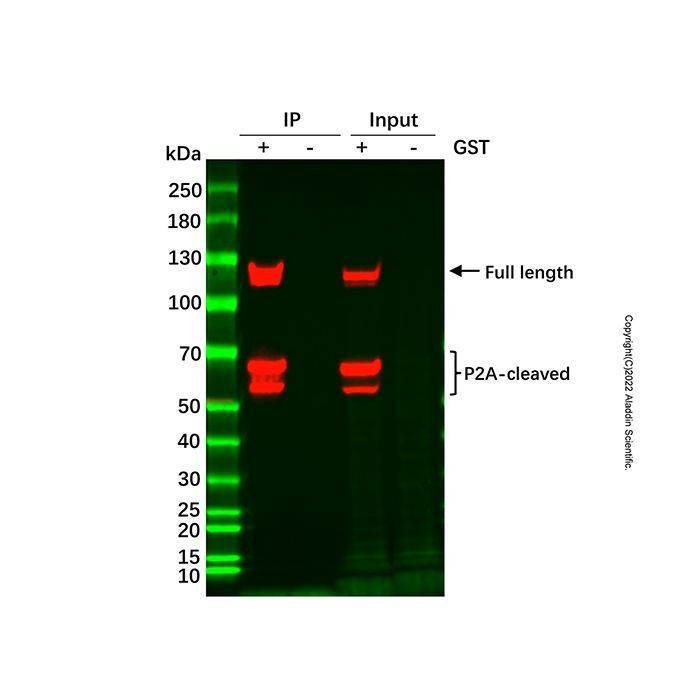
This product is a GST-tagged protein purification resin, constructed with a 4% cross-linked agarose gel matrix. Reduced glutathione is covalently conjugated via a 12-atom spacer arm using chemical methods, significantly improving purification efficiency. The resin can bind
>20 mg of GST fusion protein per mL of matrix.
Additionally, it offers high specificity and cost-effectiveness, enabling one-step purification of glutathione-S-transferase, glutathione-dependent proteins, and glutathione recombinant derivatives from various expression systems.
Aladdin GST Agarose
Resin
is stored in
1× PBS containing 20% ethanol, with a settled gel to storage solution ratio of
1:1.
The product specification refers to the actual volume of the settled gel.
Parameter
Value / Description
Matrix
4% cross-linked agarose
Ligand
Glutathione conjugated via a 12-atom spacer arm
Particle Size Range
45~165 μm
Binding Capacity
>20 mg GST protein (40 kDa)/mL matrix
Maximum Pressure
0.1 MPa, 1 bar
pH Stability Range
3-12
Storage Conditions
1× PBS with 20% ethanol, 2–8°C
Shelf Life
2 years
Protocol
1. Buffer Preparation
Buffers should be filtered through a 0.22 μm or 0.45 μm membrane before use.
Equilibration/Wash Buffer: 140 mM NaCl, 2.7 mM KCl, 10 mM Na₂HPO₄, 1.8 mM KH₂PO₄, pH 7.4
Elution Buffer: 10 mM reduced glutathione in equilibration buffer (prepare fresh)
Note: 1–10 mM DTT may be added to both equilibration and elution buffers.
2. Sample Preparation
Clarify samples by centrifugation or filtration (0.22/0.45 μm) before loading to reduce impurities, improve efficiency, and prevent column clogging.
2.1 Proteins Expressed in Bacteria or Yeast
(1) Inoculate a single colony into medium. Induce expression according to vector instructions.
(2) Harvest cells by centrifugation at 7,500 × g for 15 min. Resuspend pellet in equilibration buffer (1:10 w/v). Add PMSF to 1 mM final concentration and lysozyme (0.2–0.4 mg/mL; omit if host contains pLysS/pLysE). Protease inhibitors may be added if they do not affect target binding.
(3) Suspend the pellet thoroughly. Optionally add RNase A (10 μg/mL) and DNase I (5 μg/mL). Mix and place on ice. Sonicate on ice until lysate is clear.
(4) Centrifuge at 15,000 × g, 4°C for 20–30 min. Collect supernatant for immediate use or store at -20°C.
2.2 Soluble Proteins Secreted by Yeast, Insect, or Mammalian Cells
(1) Centrifuge cell culture at 3,800 × g for 10 min. Collect supernatant for direct loading.
(2) For large volumes, concentrate by ammonium sulfate precipitation and dialyze against equilibration buffer before loading.
3. Gravity Column Packing
(1) Select a suitable gravity column. Insert the bottom frit, rinse with purified water, and close the outlet.
(2) Resuspend the GST resin thoroughly. Transfer an appropriate volume of slurry to the column (settled resin volume is half of the slurry). Open the outlet to drain the storage solution.
(3) Rinse with purified water. Close the outlet after draining.
(4) Insert the top frit, ensuring no gaps and a horizontal position.
(5) Equilibrate with equilibration buffer or store with storage solution at 2–8°C.
4. Sample Purification
4.1 Batch Purification
(1) Transfer resin to a centrifuge tube. Centrifuge at 1,000 rpm for 1 min and discard supernatant.
(2) Wash with 5 resin volumes of equilibration buffer. Repeat twice.
(3) Add sample. Incubate at 4°C with shaking for 2–4 h or at 37°C for 30 min–2 h.
(4) Centrifuge at 1,000 rpm for 1 min. Collect supernatant as flow-through for analysis.
(5) Wash with 5 resin volumes of wash buffer. Repeat 3–5 times. Change tubes if needed.
(6) Elute with 3–5 resin volumes of elution buffer. Incubate at RT for 5 min. Collect eluate. Repeat 2–3 times.
4.2 Gravity Column Purification
(1) Equilibrate the column with 5 column volumes (CV) of equilibration buffer. Repeat 2–3 times.
(2) Load sample. Allow at least 2 min residence time. Collect flow-through. Reload to enhance binding.
(3) Wash with 10–15 CV of wash buffer. Collect wash fractions.
(4) Elute with 5–10 CV of elution buffer. Collect fractions (1 CV per tube) for analysis.
After elution, wash with 3 CV equilibration buffer, 5 CV water, and 2 CV storage solution. Store at 2–8°C.
5. SDS-PAGE Analysis
Analyze samples (flow-through, wash, elution, and crude sample) by SDS-PAGE to evaluate purification.
6. Resin Cleaning
Although reusable, resin may require cleaning if performance declines due to non-specific binding or aggregation.
Precipitated/denatured material: Clean with 2 CV of 6 M guanidine HCl, followed by 5 CV PBS, pH 7.4.
Hydrophobic adsorption: Clean with 3–4 CV of 70% ethanol or 2 CV of 1% Triton X-100, followed by 5 CV PBS, pH 7.4.
Precautions
Do not freeze the product.
Resuspend the resin thoroughly by gentle inversion before use.
For research use only.
Wear a lab coat and disposable gloves during operation.
Storage and Shipping
| Shipped In | Wet ice,Do not freeze |
| Stability and Storage | Store at 2-8℃ long term (24 months). Do not freeze. |
| Storage Temp | Store at 2-8°C,Do not freeze |
Additional Information
| Concentration | 50% v/v |