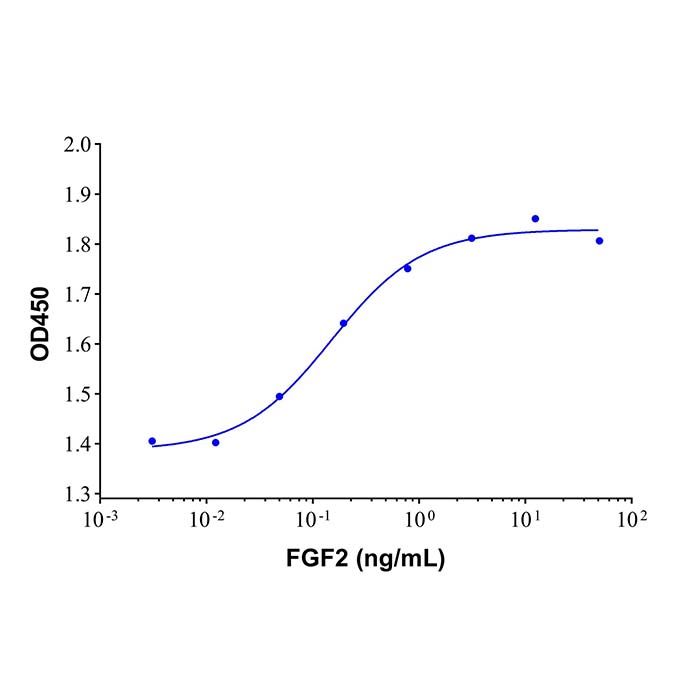
Recombinant human basic fibroblast growth factor (FGF2, bFGF) supplied as a lyophilized, untagged protein expressed in Oryza sativa. The source identifies residues 134–288, a 10 μg package, and a cell-proliferation activity assay.
Selection notes. Choose this rice-expressed preparation when the stated expression host, absence of tag and carrier-free specification fit the experiment. The source reports <1.0 EU/μg endotoxin and a typical ED₅₀ <1 ng/mL in BALB/3T3 cells; the latter is an assay result, not a universal culture dose.
Specifications
SKU
rp155946-10μg
Package size
10μg
Brand
Aladdin
Product Name
Recombinant Human FGF basic/FGF2/bFGF Protein, CAS No.62031-54-3
Short Description
GMP, ≥95% (SDS-PAGE), Active, Oryza sativa, No tag, 134-288 aa
The supplied product record describes a proliferation assay using BALB/3T3 mouse embryo fibroblasts. The reported ED₅₀ in Specifications is the source’s test endpoint; it is not a recommended dose for all models.
General cell-proliferation workflow; adapt the protocol to the cell line and readout. Incubation time, temperature and treatment doses are not specified in the supplied product record.
Choose a responsive cell model and define the endpoint. For comparison with the listed source activity, use an appropriately qualified BALB/3T3 mouse embryo fibroblasts proliferation system when available.
Prepare the protein using this SKU’s reconstitution instructions. Prepare fresh serial dilutions in a matrix compatible with the cells and the readout; use aseptic technique.
Set up matched untreated and vehicle controls, and a suitable reference growth factor or other positive control. Keep cell number, medium, serum conditions and handling consistent across wells.
Expose replicate cultures to the planned FGF2 concentration range. Set incubation and assay conditions according to the selected, independently established cell protocol.
Measure proliferation with a suitable readout, subtract the assay blank where appropriate, and compare the treated groups with the vehicle and positive controls.
Plot response against concentration and evaluate control performance before interpreting the curve. Estimate ED₅₀ only when the response range and curve quality support it.
Troubleshooting
Observation
Possible cause and next step
No or weak response
Low cell responsiveness, degraded stock, incompatible medium or concentration range. Check the positive control, receptor responsiveness, stock handling and serial dilutions.
High control signal or small treatment window
Serum or medium growth factors may mask the response. Review basal conditions and vehicle matching without compromising cell viability.
Variable response across wells
Uneven seeding, edge effects or inconsistent mixing. Improve cell suspension, plate layout and pipetting; inspect replicate variability.
Non-monotonic curve or precipitate
Check stock clarity, diluent and buffer compatibility, dilution accuracy and cell health. Prepare fresh dilutions before repeating.
Images and captions
Catalog image listed for this SKU; the supplied record does not provide a caption, image identity or experimental conditions.Catalog image listed for this SKU; the supplied record does not provide a caption, image identity or experimental conditions.
Reconstitution, storage and shipping
Reconstitution
It is recommended to redissolve the lyophilized powder in sterile water to 100-200 μg/ml, and further dilute it in other solvents.
Shipped In
Ice chest + Ice pads
Stability and Storage
Store at -20 ℃ for 36 months. Upon delivery aliquot. Avoid freeze/thaw cycle. Upon reconstitution, the product should be stored at 2-8 ℃ for 2-7 days and used up as soon as possible. For future use, should be stored at -20 ℃.
Storage Temp
Store at -20°C,Avoid repeated freezing and thawing
Target and research background
FGF2 is a fibroblast growth factor involved in cell growth and signaling through FGF receptors. Responses depend on receptor expression, medium composition and the biological system being studied.
Documents
The following links and labels are retained from the supplied product record. Open the applicable document and confirm its contents and lot before use.
Human FGF2, residues 134–288, with no tag; the stated expression host is Oryza sativa.
How should I reconstitute this vial?
The supplied instructions recommend sterile water at 100–200 μg/mL before further dilution. Use the instructions for this SKU and maintain sterile technique.
Is the reported ED₅₀ the concentration to add to every culture?
No. The typical <1 ng/mL value is from a BALB/3T3 proliferation assay. Establish the working concentration for your cells and readout.
What controls are useful?
Include an untreated or matched vehicle control and, when available, a reference FGF2 with known activity in the same assay.
How should the reconstituted protein be stored?
The source recommends 2–8 °C for 2–7 days and −20 °C for future use, with aliquoting and avoidance of repeated freeze–thaw cycles.
Does the product contain a protein carrier?
The source specification lists it as carrier free. Check a lot-specific certificate when a defined carrier composition is critical.
Ordering
For this listing, use SKU rp155946-10μg and check the selected package, availability and current price in the purchase area. For a quotation, lot-specific documents or technical questions, include the SKU, intended use and required specification.
2. Yang Min, Ma Yuejiang, Cao Zhu, Zhan Hong, Jin Ye, Huang Xiufeng, Yang Shizhou. (2025) HPV16 E7 Enhances Cell Stemness via RTKN2-Mediated Activation of the NF-κB Pathway in Cervical Cancer. BIOCHEMICAL GENETICS, [PMID:40495058] [10.1007/s10528-025-11144-w]
3. Xiaoshen Zhang, Tao Jiang, Lingyun Ye, Jianguo Sun, Lei Wang, Juanjuan Li, Fengying Wu, Shengxiang Ren, Guanghui Gao. (2025) WISP3 upregulates SDCBP expression to promote the progression of non-small cell lung cancer via the TGF-β signaling pathway. BIOCHEMICAL PHARMACOLOGY, [PMID:40571215] [10.1016/j.bcp.2025.117082]
4. Jianan Li, Jingqi Huang, Zeyang Gao, Chunpeng He, Zaiyan Xu, Bo Zuo. (2025) A novel proliferation synergy factor cocktail maintains proliferation and improves transfection efficiency in muscle cells and fibroblasts under low-serum conditions. Frontiers in Cell and Developmental Biology, [PMID:41332986] [10.3389/fcell.2025.1680263]
5. Yang Shizhou, Wu Tingting, Cao Zhu, Chen Zhengyun, Ma Yuejiang, Wang Ting, Qian Linhua, Huang Xiufeng. (2026) Hypoxic glycolysis-driven histone lactylation activates NHE7 to promote endometrial cancer progression via COX6C-mediated endoplasmic reticulum stress. APOPTOSIS, 31 (2): (55). [PMID:41575611] [10.1007/s10495-026-02262-w]
6. Liping Zhang, Yanyan Wang, Wenxin Qiu, Shuangling Liu, Shengxuan Xu, Hongwei Wang, Lin Yuan. (2026) Dual-loaded exosomes with fibroblast growth factor 2 and retinoic acid enhance directed neural differentiation of embryonic stem cells. COLLOIDS AND SURFACES B-BIOINTERFACES, [PMID:41691875] [10.1016/j.colsurfb.2026.115554]