Human Protein S ELISA Kit CSB-E09903h CUSABIO
$50.00
In stock
SKU
CSB-E09903h
Product Details
| Target Name | Protein S |
| Uniprot No. | P07225 |
| Species | Homo sapiens (Human) |
| Storage | Store at 2-8°C. Please refer to protocol. |
| Sensitivity | 0.78 ng/mL |
| Troubleshooting and FAQs | ELISA kit FAQs |
| Lead Time | 3-5 working days after you place the order, and it takes another 3-5 days for delivery via DHL or FedEx. |
| Associated names | Preproprotein S ELISA Kit; Propiece of latent protein S ELISA Kit; PROS 1 ELISA Kit; PROS ELISA Kit; PROS_HUMAN ELISA Kit; proS1 ELISA Kit; Protein S alpha ELISA Kit; Protein Sa ELISA Kit; PS 21 ELISA Kit; PS 22 ELISA Kit; PS 23 ELISA Kit; PS 24 ELISA Kit; PS 25 ELISA Kit; PS 26 ELISA Kit; PS21 ELISA Kit; PS22 ELISA Kit; PS23 ELISA Kit; PS24 ELISA Kit; PS25 ELISA Kit; PS26 ELISA Kit; PSA ELISA Kit; THPH5 ELISA Kit; THPH6 ELISA Kit; Vitamin K dependent protein S ELISA Kit; Vitamin K-dependent plasma protein S ELISA Kit; Vitamin K-dependent protein S ELISA Kit |
| Abbreviation | PROS1 |
| Sample Types | serum, plasma, tissue homogenates |
| Detection Range | 3.12 ng/mL-200 ng/mL |
| Assay Time | 1-5h |
| Sample Loading Volume | 50-100ul |
| Detection Wavelength | 450 nm |
| Research Area | Cardiovascular |
| Assay Principle | quantitative |
| Measurement | Sandwich |
| Precision | headers: Intra-assay Precision (Precision within an assay): CV%<8%; rows: Intra-assay Precision (Precision within an assay): CV%<8%: Intra-assay Precision (Precision within an assay): CV%<8%; 1: Three samples of known concentration were tested twenty times on one plate to assess.; Intra-assay Precision (Precision within an assay): CV%<8%: Inter-assay Precision (Precision between assays): CV%<10%; 1: Three samples of known concentration were tested in twenty assays to assess.; |
| Linearity | headers: To assess the linearity of the assay, samples were spiked with high concentrations of human Protein S in various matrices and diluted with the Sample Diluent to produce samples with values within the dynamic range of the assay.; rows: To assess the linearity of the assay, samples were spiked with high concentrations of human Protein S in various matrices and diluted with the Sample Diluent to produce samples with values within the dynamic range of the assay.: To assess the linearity of the assay, samples were spiked with high concentrations of human Protein S in various matrices and diluted with the Sample Diluent to produce samples with values within the dynamic range of the assay.; 2: Sample; 3: Serum(n=4); 1: 1:100; 2: Average %; 3: 91; 1: Range %; 2: 87-95; 1: 1:200; 2: Average %; 3: 95; 1: Range %; 2: 90-100; 1: 1:400; 2: Average %; 3: 97; 1: Range %; 2: 94-101; 1: 1:800; 2: Average %; 3: 94; 1: Range %; 2: 91-98 |
| Recovery | headers: The recovery of human Protein S spiked to levels throughout the range of the assay in various matrices was evaluated. Samples were diluted prior to assay as directed in the Sample Preparation section.; rows: The recovery of human Protein S spiked to levels throughout the range of the assay in various matrices was evaluated. Samples were diluted prior to assay as directed in the Sample Preparation section.: The recovery of human Protein S spiked to levels throughout the range of the assay in various matrices was evaluated. Samples were diluted prior to assay as directed in the Sample Preparation section.; 1: Sample Type; 2: Average % Recovery; 3: Range; 1: Serum (n=5); 2: 90; 3: 87-94; 1: EDTA plasma (n=4); 2: 99; 3: 93-105; ; |
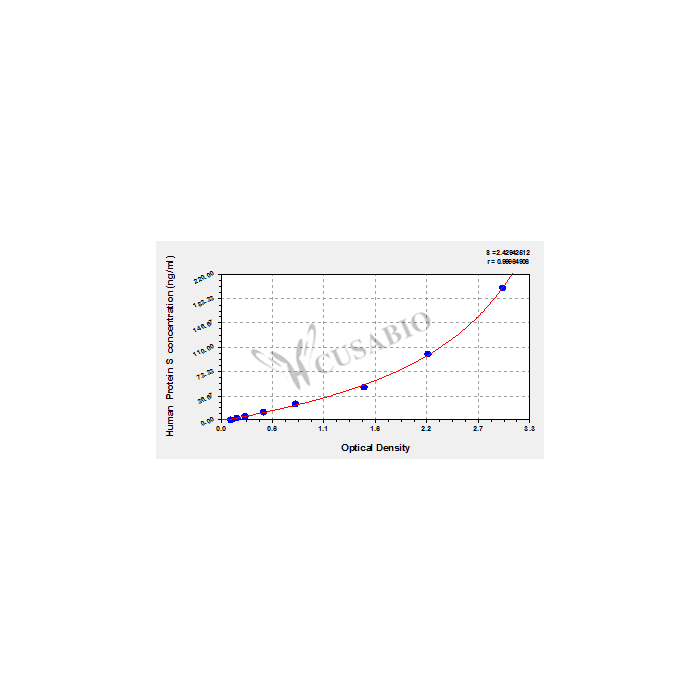
| Typical Data | headers: These standard curves are provided for demonstration only. A standard curve should be generated for each set of samples assayed.; rows: These standard curves are provided for demonstration only. A standard curve should be generated for each set of samples assayed.: These standard curves are provided for demonstration only. A standard curve should be generated for each set of samples assayed.; 1: ng/ml OD1 OD2 Average Corrected 200 2.955 3.003 2.979 2.874 100 2.134 2.254 2.194 2.089 50 1.460 1.568 1.514 1.409 25 0.788 0.792 0.790 0.685 12.5 0.436 0.469 0.453 0.348 6.25 0.265 0.254 0.260 0.155 3.12 0.177 0.166 0.172 0.067 0 0.101 0.109 0.105; 2: ng/ml; 3: OD1; 4: OD2; 5: Average; 6: Corrected; 8: 200; 9: 2.955; 10: 3.003; 11: 2.979; 12: 2.874; 14: 100; 15: 2.134; 16: 2.254; 17: 2.194; 18: 2.089; 20: 50; 21: 1.460; 22: 1.568; 23: 1.514; 24: 1.409; 26: 25; 27: 0.788; 28: 0.792; 29: 0.790; 30: 0.685; 32: 12.5; 33: 0.436; 34: 0.469; 35: 0.453; 36: 0.348; 38: 6.25; 39: 0.265; 40: 0.254; 41: 0.260; 42: 0.155; 44: 3.12; 45: 0.177; 46: 0.166; 47: 0.172; 48: 0.067; 50: 0; 51: 0.101; 52: 0.109; 53: 0.105; 1: ng/ml; 2: OD1; 3: OD2; 4: Average; 5: Corrected; 1: 200; 2: 2.955; 3: 3.003; 4: 2.979; 5: 2.874; 1: 100; 2: 2.134; 3: 2.254; 4: 2.194; 5: 2.089; 1: 50; 2: 1.460; 3: 1.568; 4: 1.514; 5: 1.409; 1: 25; 2: 0.788; 3: 0.792; 4: 0.790; 5: 0.685; 1: 12.5; 2: 0.436; 3: 0.469; 4: 0.453; 5: 0.348; 1: 6.25; 2: 0.265; 3: 0.254; 4: 0.260; 5: 0.155; 1: 3.12; 2: 0.177; 3: 0.166; 4: 0.172; 5: 0.067; 1: 0; 2: 0.101; 3: 0.109; 4: 0.105 |
| ELISA Data Analysis | ELISA Standard Curve & Curve Expert software |
| Shelf Life | 6 months |
| Description | The human Protein S ELISA kit offers a robust and sensitive tool for quantifying Protein S levels in various human samples, including serum, plasma, and tissue homogenates. It provides a detection range of 3.12 ng/mL to 200 ng/mL with a sensitivity of 0.78 ng/mL. The assay principle is based on a sandwich method, utilizing a detection wavelength of 450 nm. The assay time ranges from 1 to 5 hours, requiring a sample volume of 50-100 µl. The kit's sensitivity and wide detection range make it suitable for various experimental applications. The sandwich assay principle ensures precise measurement of Protein S, contributing to the kit's reliability. The use of this ELISA kit can aid in studying conditions such as diabetes and obesity, where Protein S levels are significantly altered and correlated with metabolic markers [1]. References: [1] L. Scheffler, A. Crane, H. Heyne, A. Tönjes, D. Schleinitz, C. Ihlinget al., "Widely used commercial elisa does not detect precursor of haptoglobin2, but recognizes properdin as a potential second member of the zonulin family", Frontiers in Endocrinology, vol. 9, 2018. https://doi.org/10.3389/fendo.2018.00022 |
MDSD