Human B-cell leukemia/lymphoma 2,Bcl-2 ELISA Kit CSB-E08853h CUSABIO
$50.00
In stock
SKU
CSB-E08853h
Product Details
| Target Name | B-cell CLL/lymphoma 2 |
| Uniprot No. | P10415 |
| Species | Homo sapiens (Human) |
| Storage | Store at 2-8°C. Please refer to protocol. |
| Sensitivity | 0.225 ng/mL |
| Troubleshooting and FAQs | ELISA kit FAQs |
| Lead Time | 3-5 working days after you place the order, and it takes another 3-5 days for delivery via DHL or FedEx. |
| Associated names | BCL2; Apoptosis regulator Bcl-2 |
| Abbreviation | BCL2 |
| Sample Types | serum, plasma, tissue homogenates |
| Detection Range | 0.9 ng/mL-60 ng/mL |
| Assay Time | 1-5h |
| Sample Loading Volume | 50-100ul |
| Detection Wavelength | 450 nm |
| Research Area | Cell Biology |
| Assay Principle | quantitative |
| Measurement | Sandwich |
| Precision | headers: Intra-assay Precision (Precision within an assay): CV%<8%; rows: Intra-assay Precision (Precision within an assay): CV%<8%: Intra-assay Precision (Precision within an assay): CV%<8%; 1: Three samples of known concentration were tested twenty times on one plate to assess.; Intra-assay Precision (Precision within an assay): CV%<8%: Inter-assay Precision (Precision between assays): CV%<10%; 1: Three samples of known concentration were tested in twenty assays to assess.; |
| Linearity | headers: To assess the linearity of the assay, samples were spiked with high concentrations of human Bcl-2 in various matrices and diluted with the Sample Diluent to produce samples with values within the dynamic range of the assay.; rows: To assess the linearity of the assay, samples were spiked with high concentrations of human Bcl-2 in various matrices and diluted with the Sample Diluent to produce samples with values within the dynamic range of the assay.: To assess the linearity of the assay, samples were spiked with high concentrations of human Bcl-2 in various matrices and diluted with the Sample Diluent to produce samples with values within the dynamic range of the assay.; 2: Sample; 3: Serum(n=4); 1: 1:1; 2: Average %; 3: 89; 1: Range %; 2: 82-98; 1: 1:2; 2: Average %; 3: 92; 1: Range %; 2: 87-98; 1: 1:4; 2: Average %; 3: 102; 1: Range %; 2: 98-108; 1: 1:8; 2: Average %; 3: 97; 1: Range %; 2: 92-102 |
| Recovery | headers: The recovery of human Bcl-2 spiked to levels throughout the range of the assay in various matrices was evaluated. Samples were diluted prior to assay as directed in the Sample Preparation section.; rows: The recovery of human Bcl-2 spiked to levels throughout the range of the assay in various matrices was evaluated. Samples were diluted prior to assay as directed in the Sample Preparation section.: The recovery of human Bcl-2 spiked to levels throughout the range of the assay in various matrices was evaluated. Samples were diluted prior to assay as directed in the Sample Preparation section.; 1: Sample Type; 2: Average % Recovery; 3: Range; 1: Serum (n=5); 2: 99; 3: 91-108; 1: EDTA plasma (n=4); 2: 94; 3: 90-99; ; |
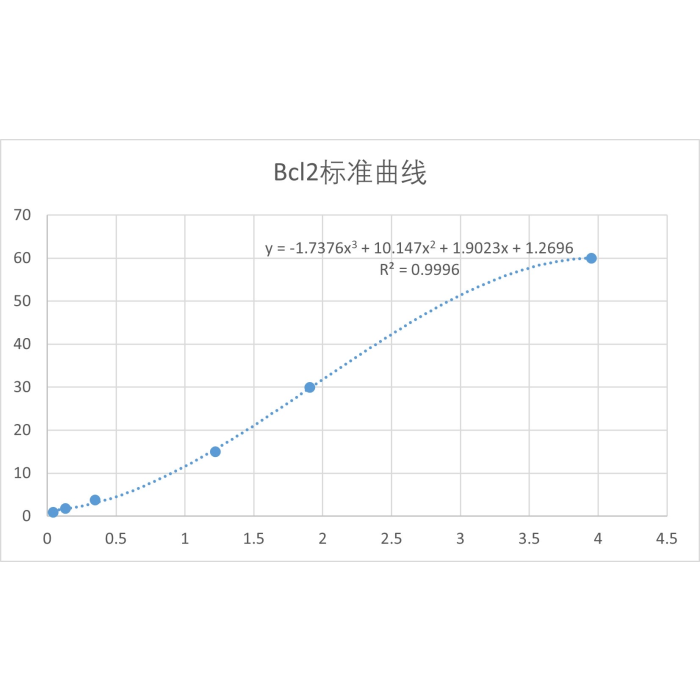
| Typical Data | headers: These standard curves are provided for demonstration only. A standard curve should be generated for each set of samples assayed.; rows: These standard curves are provided for demonstration only. A standard curve should be generated for each set of samples assayed.: These standard curves are provided for demonstration only. A standard curve should be generated for each set of samples assayed.; 1: ng/ml OD1 OD2 Average Corrected 60 2.366 2.465 2.416 2.271 30 1.659 1.758 1.709 1.564 15 1.008 1.027 1.018 0.873 7.5 0.605 0.614 0.610 0.465 3.75 0.392 0.401 0.397 0.252 1.8 0.258 0.268 0.263 0.118 0.9 0.227 0.223 0.225 0.080 0 0.144 0.145 0.145; 2: ng/ml; 3: OD1; 4: OD2; 5: Average; 6: Corrected; 8: 60; 9: 2.366; 10: 2.465; 11: 2.416; 12: 2.271; 14: 30; 15: 1.659; 16: 1.758; 17: 1.709; 18: 1.564; 20: 15; 21: 1.008; 22: 1.027; 23: 1.018; 24: 0.873; 26: 7.5; 27: 0.605; 28: 0.614; 29: 0.610; 30: 0.465; 32: 3.75; 33: 0.392; 34: 0.401; 35: 0.397; 36: 0.252; 38: 1.8; 39: 0.258; 40: 0.268; 41: 0.263; 42: 0.118; 44: 0.9; 45: 0.227; 46: 0.223; 47: 0.225; 48: 0.080; 50: 0; 51: 0.144; 52: 0.145; 53: 0.145; 1: ng/ml; 2: OD1; 3: OD2; 4: Average; 5: Corrected; 1: 60; 2: 2.366; 3: 2.465; 4: 2.416; 5: 2.271; 1: 30; 2: 1.659; 3: 1.758; 4: 1.709; 5: 1.564; 1: 15; 2: 1.008; 3: 1.027; 4: 1.018; 5: 0.873; 1: 7.5; 2: 0.605; 3: 0.614; 4: 0.610; 5: 0.465; 1: 3.75; 2: 0.392; 3: 0.401; 4: 0.397; 5: 0.252; 1: 1.8; 2: 0.258; 3: 0.268; 4: 0.263; 5: 0.118; 1: 0.9; 2: 0.227; 3: 0.223; 4: 0.225; 5: 0.080; 1: 0; 2: 0.144; 3: 0.145; 4: 0.145 |
| ELISA Data Analysis | ELISA Standard Curve & Curve Expert software |
| Shelf Life | 6 months |
| Description | This human BCL2 ELISA kit employs the quantitative sandwich enzyme immunoassay technique to measure the levels of human BCL2 in multiple samples, including serum, plasma, or tissue homogenates. Antibody specific for BCL2 has been pre-coated onto the microplate. Standards and samples are pipetted into the wells and any BCL2 present is bound by the immobilized antibody. After removing any unbound substances, a biotin-conjugated BCL2 antibody is added to the wells. After washing, avidin conjugated HRP is added to the wells, forming an antibody-antigen-enzyme-labeled antibody complex. Following a wash to remove any unbound HRP-avidin, the TMB substrate solution is added to the wells, and the color develops into blue. The color changes from blue to yellow after the addition of stop solution into the wells. The color intensity is in proportion to the amount of BCL2 bound in the initial step. BCL2 is a critical protein regulator of apoptosis. It seems to inhibit apoptosis by preserving mitochondrial membrane integrity as its hydrophobic C-terminal domain is linked to the outer membrane. BCL2 also binds to and inactivates BAX and other pro-apoptotic proteins, thus suppressing apoptosis. In the endoplasmic reticulum (ER), BCL2 modulates calcium storge. The intracellular levels of calcium influence apoptosis. BCL2 is highly expressed in multiple hematological cancers such as CLL, AML, and myeloma, where it protects cells from apoptosis induced by oncogenic and external stresses. |
MDSD