Recombinant Cytochrome C Monoclonal Antibody (E-AB-81449) elabscience
$260.00
In stock
SKU
E-AB-81449
| Size | Price (USD) |
| 100μL | $260.00 |
| 50μL | $160.00 |
| Size | Price (USD) |
| 100μL | $260.00 |
| 50μL | $160.00 |
Product Details
| Abbre | Cytochrome C |
| Synonyms | CYC, Cytochrome C, HCS, Somatic, THC4 |
| Swissprot | P99999 |
| Reactivity | Human, Mouse, Rat |
| Host | Rabbit |
| Clonality | Rabbit Monoclonal |
| Clone | R09-6H3 |
| Isotype | IgG |
| Applications | WB, IHC-P |
| Conjugation | Unconjugated |
| Concentration | 300 μg/mL |
| Buffer | 50mM Tris-Glycine(pH 7.4), 0.15M NaCl, 40% Glycerol, 0.05% stabilizer and 0.05% protective protein. |
| Purification Method | Affinity Purified |
| Immunogen | A synthetic peptide of human Cytochrome C |
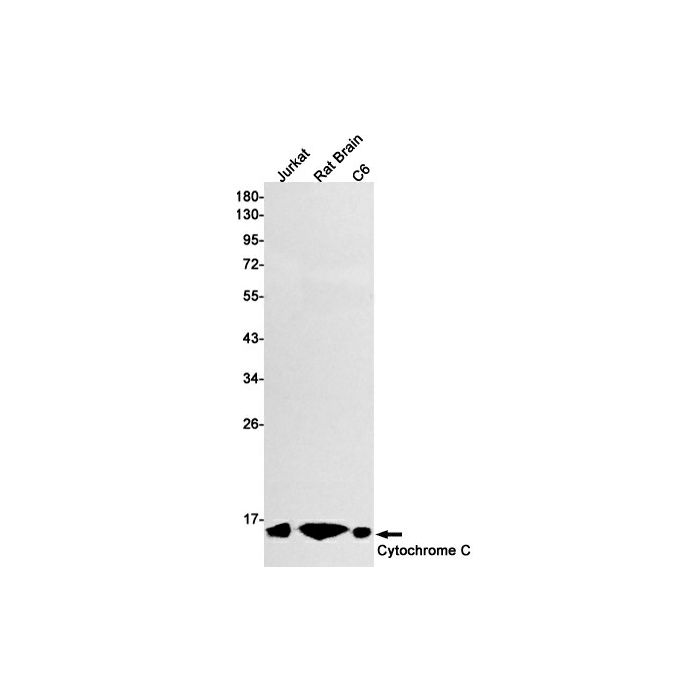
| Calculated MW | 12 kDa |
| Observed MW | 14 kDa The actual band is not consistent with the expectation. Western blotting is a method for detecting a certain protein in a complex sample based on the specific binding of antigen and antibody. Different proteins can be divided into bands based on different mobility rates. The mobility is affected by many factors, which may cause the observed band size to be inconsistent with the expected size. The common factors include: 1. Post-translational modifications: For example, modifications such as glycosylation, phosphorylation, methylation, and acetylation will increase the molecular weight of the protein. 2. Splicing variants: Different expression patterns of various mRNA splicing bodies may produce proteins of different sizes. 3. Post-translational cleavage: Many proteins are first synthesized into precursor proteins and then cleaved to form active forms, such as COL1A1. 4. Relative charge: the composition of amino acids (the proportion of charged amino acids and uncharged amino acids). 5. Formation of multimers: For example, in protein dimer, strong interactions between proteins can cause the bands to be larger. However, the use of reducing conditions can usually avoid the formation of multimers. If a protein in a sample has different modified forms at the same time, multiple bands may be detected on the membrane. |
| Research Areas | Cancer, Cell Biology, Cardiovascular, Metabolism, Signal Transduction |
| Cellular Localization | Mitochondrion matrix. |
Product Description
Background: Cytochrome c is a 12-15 kDa electron transporting protein located in the inner mitochondrial membrane. Upon apoptotic stimulation,cytochrome c can be released from mitochondria into cytoplasm,resulting in caspase-3 activation and apoptosis. Measurement of cytochrome c release from the mitochondria is useful for detection of the onset of apoptosis in cells. In addition,cytochrome c can also leave cells and be detectable in extra-cellular medium of apoptotic cells and serum of cancer patients. The level of serum cytochrome c may serve as a prognostic maker during cancer therapy.
Storage and Shipping
| Storage | Store at -20°C Valid for 12 months. Avoid freeze / thaw cycles. |
| Shipping | The product is shipped with ice pack,upon receipt,store it immediately at the temperature recommended. |
Additional Information
| Verified Samples | Verified Samples in WB: Jurkat, Rat Rat Brain, C6 Verified Samples in IHC: Human tonsil |
| Dilution | WB 1:1000-1:2000, IHC 1:50-1:100 |