
RPL13A Polyclonal Antibody (E-AB-18938) elabscience
$399.00
In stock
SKU
E-AB-18938
| Size | Price (USD) |
| 200μL | $399.00 |
| 120μL | $240.00 |
| 60μL | $143.00 |
| 20μL | $73.00 |
| Size | Price (USD) |
| 200μL | $399.00 |
| 120μL | $240.00 |
| 60μL | $143.00 |
| 20μL | $73.00 |
Product Details
| Abbre | RPL13A |
| Synonyms | 23 kD highly basic protein, 23 kDa highly basic protein, 60S ribosomal protein L13a, L13A, P198, RPL 13A, Ribosomal protein L13a, TSTA1, Tissue specific transplantation antigen 1, Transplantation antigen P198, Tstap198 7, Tum P198 antigen, Tum antigen |
| Swissprot | P40429 |
| Reactivity | Human, Mouse, Rat |
| Host | Rabbit |
| Clonality | Polyclonal |
| Isotype | IgG |
| Applications | WB, IHC |
| Conjugation | Unconjugated |
| Concentration | 1.68 mg/mL |
| Buffer | Phosphate buffered solution, pH 7.4, containing 0.05% stabilizer and 50% glycerol. |
| Purification Method | Antigen affinity purification |
| Immunogen | Fusion protein of human RPL13A |
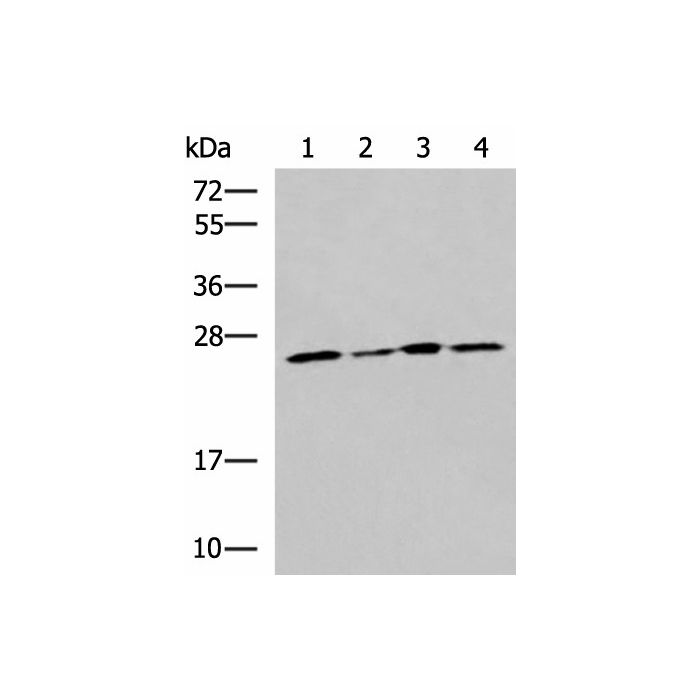
| Calculated MW | 24 kDa |
| Observed MW | Refer to figures The actual band is not consistent with the expectation. Western blotting is a method for detecting a certain protein in a complex sample based on the specific binding of antigen and antibody. Different proteins can be divided into bands based on different mobility rates. The mobility is affected by many factors, which may cause the observed band size to be inconsistent with the expected size. The common factors include: 1. Post-translational modifications: For example, modifications such as glycosylation, phosphorylation, methylation, and acetylation will increase the molecular weight of the protein. 2. Splicing variants: Different expression patterns of various mRNA splicing bodies may produce proteins of different sizes. 3. Post-translational cleavage: Many proteins are first synthesized into precursor proteins and then cleaved to form active forms, such as COL1A1. 4. Relative charge: the composition of amino acids (the proportion of charged amino acids and uncharged amino acids). 5. Formation of multimers: For example, in protein dimer, strong interactions between proteins can cause the bands to be larger. However, the use of reducing conditions can usually avoid the formation of multimers. If a protein in a sample has different modified forms at the same time, multiple bands may be detected on the membrane. |
| Research Areas | Epigenetics and Nuclear Signaling |
Product Description
Background: Ribosomes, the organelles that catalyze protein synthesis, consist of a small 40S subunit and a large 60S subunit.Together these subunits are composed of 4 RNA species and approximately 80 structurally distinct proteins.This gene encodes a member of the L13P family of ribosomal proteins that is a component of the 60S subunit.The encoded protein also plays a role in the repression of inflammatory genes as a component of the IFN-gamma-activated inhibitor of translation (GAIT) complex.This gene is co-transcribed with the small nucleolar RNA genes U32, U33, U34, and U35, which are located in the second, fourth, fifth, and sixth introns, respectively.As is typical for genes encoding ribosomal proteins, there are multiple processed pseudogenes of this gene dispersed throughout the genome.Alternatively spliced transcript variants encoding multiple isoforms have been observed for this gene.
Storage and Shipping
| Storage | Store at -20°C Valid for 12 months. Avoid freeze / thaw cycles. |
| Shipping | The product is shipped with ice pack,upon receipt,store it immediately at the temperature recommended. |
Additional Information
| Verified Samples | Verified Samples in WB: LoVo, Hela, A549, HT29 Verified Samples in IHC: Human tonsil, Human thyroid cancer |
| Dilution | WB 1:1000-1:5000, IHC 1:50-1:300 |
![Elab Fluor ® Red 780 Anti-Rat CD4(domain 1) Antibody[OX-38] (E-AB-F1105S) elabscience](https://www.biogege.com/media/catalog/product/cache/af3f9de669682211425a7c3e7baf6e62/0/q/E-AB-F1105S_1_7c7a902a7c.jpg)
![PerCP/Cyanine5.5 Anti-Mouse CD161/NK1.1 Antibody[PK136] (E-AB-F0987J) elabscience](https://www.biogege.com/media/catalog/product/cache/af3f9de669682211425a7c3e7baf6e62/0/q/E-AB-F0987J_1_e9465ec986.jpg)