Recombinant Human GFAP Protein (His Tag) (PKSH032490) elabscience
$288.00
In stock
SKU
PKSH032490
| Size | Price (USD) |
| 50μg | $288.00 |
| 10μg | $128.00 |
| Size | Price (USD) |
| 50μg | $288.00 |
| 10μg | $128.00 |
Product Details
| Synonyms | GFAP, Glial Fibrillary Acidic Protein |
| Accession | P14136 |
| Species | Human |
| Form | Lyophilized powder |
| Formulation | Lyophilized from a 0.2 μm filtered solution of 20mM Tris-HCl, 10% Trehalose, 0.05% Tween 80, pH 8.5. Normally 5% - 8% trehalose, mannitol and 0.01% Tween 80 are added as protectants before lyophilization. Please refer to the specific buffer information in the printed manual. |
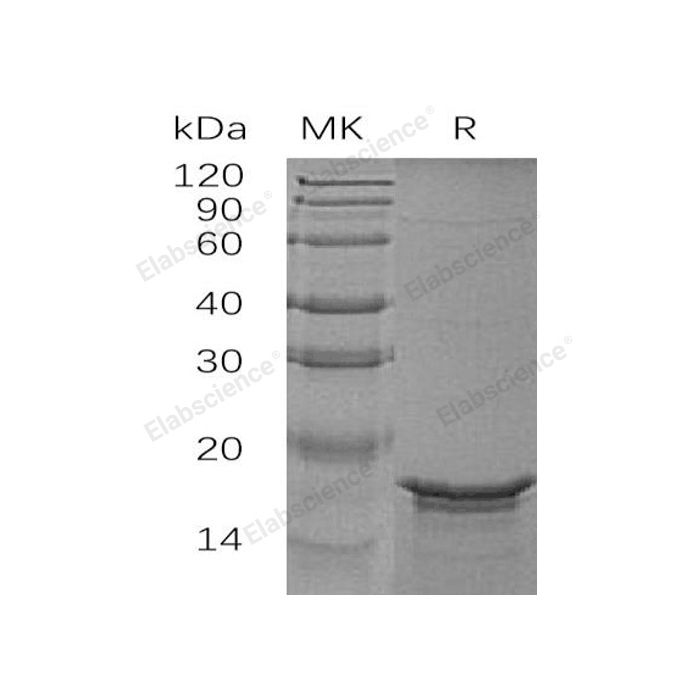
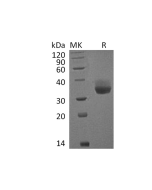
| Purity | > 95 % as determined by reducing SDS-PAGE. |
| Expression Host | E.coli |
| Sequence | Leu292-Met432 |
| Tag | N-His |
| Calculated Molecular Weight | 18.7 kDa |
| Observed Molecular Weight | 17 kDa |
| Endotoxin | < 1.0 EU per μg of the protein as determined by the LAL method. |
| Bio-activity | Not validated for activity |
Product Description
Background: Glial Fibrillary Acidic Protein (GFAP) is an intermediate filament (IF) protein which belongs to the intermediate filament family. GFAP is expressed in numerous cell types of the central nervous system (CNS), ependymal cells and phosphorylated by PKN1. GFAP, a class-III intermediate filament, is a cell-specific marker during the development of the central nervous system and distinguishes astrocytes from other glial cells. It is closely related to its non-epithelial family members, vimentin, desmin, and peripherin, which are all involved in the structure and function of the cell’s cytoskeleton. GFAP is thought to help to maintain astrocyte mechanical strength, as well as the shape of cells but its exact function remains poorly understood.
Storage and Shipping
| Storage | Generally, lyophilized proteins are stable for up to 12 months when stored at -20 to -80℃. Reconstituted protein solution can be stored at 4-8℃ for 2-7 days. Aliquots of reconstituted samples are stable at < -20℃ for 3 months. |
| Shipping | This product is provided as lyophilized powder which is shipped with ice packs. |
| Reconstitution | Please refer to the printed manual for detailed information. |