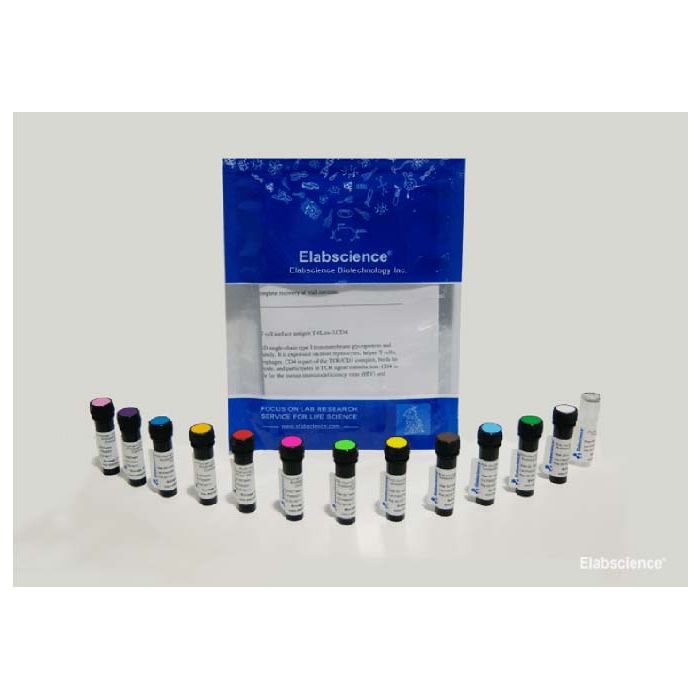
Biotin Anti-Mouse CD86 Antibody[GL-1] (E-AB-F0994B) elabscience

$82.00
In stock
SKU
E-AB-F0994B
SizePrice (USD)
100μg$82.00
25μg$36.00

Product Details

AbbreCD86
SynonymsActivation B7-2 antigen, Cd86, ETC-1, Early T-cell costimulatory molecule 1, T-lymphocyte activation antigen CD86
SwissprotP42082
ReactivityMouse
HostRat
ClonalityMonoclonal
CloneGL-1
IsotypeRat IgG2a, κ
Isotype ControlBiotin Rat IgG2a, κ Isotype Control[2A3]
ApplicationsFCM
ConjugationBiotin
Concentration0.5 mg/mL
BufferPhosphate buffered solution, pH 7.2, containing 0.09% stabilizer.
Research AreasCell Biology, Costimulatory Molecules, Immunology, Neuroscience, Neuroscience Cell Markers
Cellular LocalizationMembrane

Product Description

Background: CD86 is an 80 kD immunoglobulin superfamily member also known as B7-2, B70, and Ly-58. CD86 is expressed on activated B and T cells, macrophages, dendritic cells, and astrocytes. CD86, along with CD80, is a ligand of CD28 and CD152 (CTLA-4). CD86 is expressed earlier in the immune response than CD80. CD86 has also been shown to be involved in immunoglobulin class-switching and triggering of NK cell-mediated cytotoxicity. CD86 binds to CD28 to transduce co-stimulatory signals for T cell activation, proliferation, and cytokine production. CD86 can also bind to CD152, also known as CTLA-4, to deliver an inhibitory signal to T cells.

Storage and Shipping

StorageThis product can be stored at 2-8°C for 24 months. Do not freeze.
ShippingIce bag
  1. Inhibiting cGAS-STING to Preserve Mitochondrial–Nuclear Communication and Stemness in Young Tendon Stem Cells: A Hydrogel Strategy against Age-Related Tendinopathy
    Journal: Advanced Science | Year: 2026 | Impact Factor: 14.100
    DOI: 10.1002/advs.202520941 | Reactivity: Mouse | Sample Type: RAW 264.7 cell
  2. Photosynthetic Plant-Derived Nanovesicles Precisely Amplify Photodynamic Effect by Light-Activated Oxygen Generation for Enhanced Cancer Photoimmunotherapy
    Journal: ACS Nano | Year: 2025 | Impact Factor: 16.000
    DOI: 10.1021/acsnano.5c13350 | Reactivity: Mouse | Sample Type: macrophage
  3. Activated Notch1 promotes macrophage polarization and exacerbates sepsis-induced acute lung injury via β-catenin/NF-κB signaling
    Journal: BIOCHEMICAL PHARMACOLOGY | Year: 2025 | Impact Factor: 5.300
    DOI: 10.1016/j.bcp.2025.116892 | Reactivity: Mouse | Sample Type: Lung cell
  4. Macrophage Membrane-Cloaked ROS-Responsive Albumin Nanoplatforms for Targeted Delivery of Curcumin to Alleviate Acute Liver Injury
    Journal: MOLECULAR PHARMACEUTICS | Year: 2025 | Impact Factor: 4.500
    DOI: 10.1021/acs.molpharmaceut.4c00808 | Reactivity: Mouse | Sample Type: RAW 264.7 cell
  5. β-Tricalcium phosphate nanoparticles induce macrophage polarization to M1-type through mitochondrial oxidative stress activation
    Journal: INTERNATIONAL JOURNAL OF BIOCHEMISTRY & CELL BIOLOGY | Year: 2025 | Impact Factor: 2.800
    DOI: 10.1016/j.biocel.2025.106868 | Reactivity: Mouse | Sample Type: RAW264.7 cell
  6. Carrier-Free Photodynamic Bioregulators Inhibiting Lactic Acid Efflux Combined with Immune Checkpoint Blockade for Triple-Negative Breast Cancer Immunotherapy
    Journal: ACS Nano | Year: 2024 | Impact Factor: 15.800
    DOI: 10.1021/acsnano.4c07213 | Reactivity: Mouse | Sample Type: 4T1 cell-Xenograft,spleen tissue
  7. Semaglutide decelerates the growth and progression of breast cancer by enhancing the acquired antitumor immunity
    Journal: BIOMEDICINE & PHARMACOTHERAPY | Year: 2024 | Impact Factor: 6.900
    DOI: 10.1016/j.biopha.2024.117668 | Reactivity: Mouse | Sample Type: spleen tissue,4T1 cell-Xenograft
  8. Zingerone enhances the antitumor activity of attenuated Salmonella-mediated cancer immunotherapy by promoting tumor infiltration by host immune cells
    Journal: Journal of Functional Foods | Year: 2024 | Impact Factor: 3.800
    DOI: 10.1016/j.jff.2024.106017 | Reactivity: Mouse | Sample Type: CT-26 cell-Xenograft cell
  9. IFN-γ enhances the antitumor activity of attenuated salmonella-mediated cancer immunotherapy by increasing M1 macrophage and CD4 and CD8 T cell counts and decreasing neutrophil counts
    Journal: Frontiers in Bioengineering and Biotechnology | Year: 2022 | Impact Factor: 6.064
    DOI: 10.3389/fbioe.2022.996055 | Reactivity: Mouse | Sample Type: CT26 cell xenografts

Reviews

Write Your Own Review
You're reviewing:Biotin Anti-Mouse CD86 Antibody[GL-1] (E-AB-F0994B) elabscience
Your Rating
Copyright © 2025 Biogege, Inc. All rights reserved.