
ARID1A Polyclonal Antibody (E-AB-92107) elabscience
$530.00
In stock
SKU
E-AB-92107
| Size | Price (USD) |
| 200μL | $530.00 |
| 120μL | $320.00 |
| 60μL | $200.00 |
| Size | Price (USD) |
| 200μL | $530.00 |
| 120μL | $320.00 |
| 60μL | $200.00 |
Product Details
| Abbre | ARID1A |
| Synonyms | BAF250, BAF250a, BM029, C1orf4, CSS2, ELD, MRD14, OSA1, P270, SMARCF1, hELD, hOSA1, B120 |
| Swissprot | O14497 |
| Reactivity | Human, Mouse, Rat |
| Host | Rabbit |
| Clonality | Polyclonal |
| Isotype | IgG |
| Applications | WB |
| Conjugation | Unconjugated |
| Concentration | 1 mg/mL |
| Buffer | Phosphate buffered solution, pH 7.4, containing 0.05% stabilizer and 50% glycerol. |
| Purification Method | Affinity purification |
| Immunogen | Recombinant fusion protein of human ARID1A |
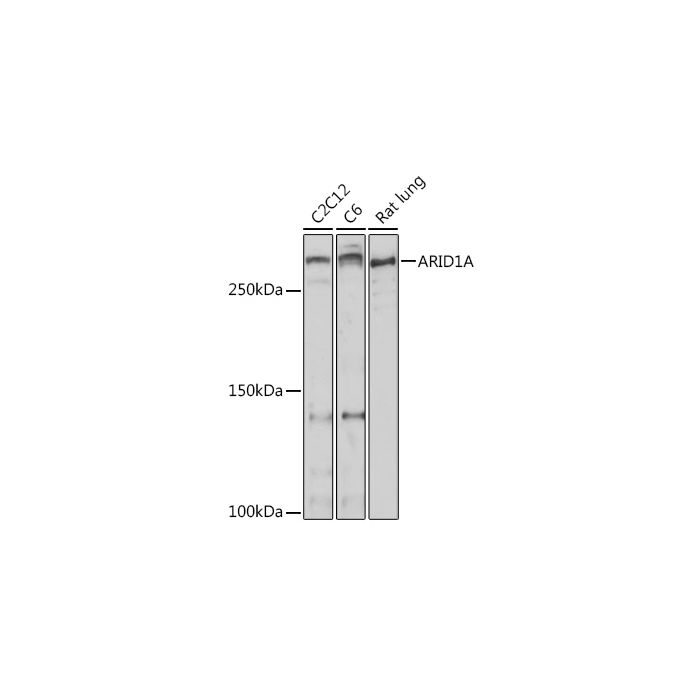
| Observed MW | 270 kDa The actual band is not consistent with the expectation. Western blotting is a method for detecting a certain protein in a complex sample based on the specific binding of antigen and antibody. Different proteins can be divided into bands based on different mobility rates. The mobility is affected by many factors, which may cause the observed band size to be inconsistent with the expected size. The common factors include: 1. Post-translational modifications: For example, modifications such as glycosylation, phosphorylation, methylation, and acetylation will increase the molecular weight of the protein. 2. Splicing variants: Different expression patterns of various mRNA splicing bodies may produce proteins of different sizes. 3. Post-translational cleavage: Many proteins are first synthesized into precursor proteins and then cleaved to form active forms, such as COL1A1. 4. Relative charge: the composition of amino acids (the proportion of charged amino acids and uncharged amino acids). 5. Formation of multimers: For example, in protein dimer, strong interactions between proteins can cause the bands to be larger. However, the use of reducing conditions can usually avoid the formation of multimers. If a protein in a sample has different modified forms at the same time, multiple bands may be detected on the membrane. |
| Research Areas | Cancer, Epigenetics and Nuclear Signaling, Signal Transduction |
| Cellular Localization | Nucleoplasm, nucleus. |
Product Description
Background: This gene encodes a member of the SWI/SNF family, whose members have helicase and ATPase activities and are thought to regulate transcription of certain genes by altering the chromatin structure around those genes. The encoded protein is part of the large ATP-dependent chromatin remodeling complex SNF/SWI, which is required for transcriptional activation of genes normally repressed by chromatin. It possesses at least two conserved domains that could be important for its function. First, it has a DNA-binding domain that can specifically bind an AT-rich DNA sequence known to be recognized by a SNF/SWI complex at the beta-globin locus. Second, the C-terminus of the protein can stimulate glucocorticoid receptor-dependent transcriptional activation. It is thought that the protein encoded by this gene confers specificity to the SNF/SWI complex and may recruit the complex to its targets through either protein-DNA or protein-protein interactions. Two transcript variants encoding different isoforms have been found for this gene. [provided by RefSeq, Jul 2008]
Storage and Shipping
| Storage | Store at -20°C Valid for 12 months. Avoid freeze / thaw cycles. |
| Shipping | The product is shipped with ice pack,upon receipt,store it immediately at the temperature recommended. |
Additional Information
| Verified Samples | Verified Samples in WB: various cell lines |
| Dilution | WB 1:500-1:2000 |
![PE/Elab Fluor ® 594 Anti-Human CD34 Antibody[581] (E-AB-F1143P) elabscience](https://www.biogege.com/media/catalog/product/cache/af3f9de669682211425a7c3e7baf6e62/0/q/E-AB-F1143P_1_060f41de2c.png)
![Elab Fluor ® 700 Anti-Human CD54 Antibody[15.2] (E-AB-F1043M1) elabscience](https://www.biogege.com/media/catalog/product/cache/af3f9de669682211425a7c3e7baf6e62/0/q/E-AB-F1043M1_1_110d67039b.jpg)
![PE/Cyanine5.5 Anti-Mouse IgD Antibody[11-26c.2a] (E-AB-F1189UI) elabscience](https://www.biogege.com/media/catalog/product/cache/af3f9de669682211425a7c3e7baf6e62/0/q/E-AB-F1189UI_1_8f183fb5a6.jpg)