CEACAM-1/CD66a Polyclonal Antibody (AN005960L) elabscience
$260.00
In stock
SKU
AN005960L
| Size | Price (USD) |
| 100μL | $260.00 |
| 25μL | $90.00 |
| Size | Price (USD) |
| 100μL | $260.00 |
| 25μL | $90.00 |
Product Details
| Abbre | CEACAM-1/CD66a |
| Synonyms | bb-1, BGP-1, BGPI, Biliary glycoprotein adhesion molecule, Carcinoembryonic antigen related cell adhesion molecule 1, carcinoembryonic antigen-related cell adhesion molecule 1 (biliary glycoprotein), Cc1, C-CAM, CD66a antigen, Cea1, Cea-1, Cea7, Cea-7, CEAM1, Hv2, Hv-2, mCEA1, Mhv-1, mmCGM1, mmCGM1a, mmCGM2, Antigen CD, meconium antigen, Biliary glycoprotein, Carcinoembryonic antigen-related cell adhesion molecule, MHVR, CEACAM, Antigen CD66, BGP 1, Biliary glycoprotein 1, Biliary glycoprotein D, Carcinoembryonic antigen-related cell adhesion molecule 1, CD66a, meconium antigen 100, MHV-R, MHVR1, Murine hepatitis virus receptor, Bgp, Bgp1, Ceacam1, CEACAM-1, CEACAM-2, BGP, CEA-1 |
| Swissprot | P31809 |
| Reactivity | Human |
| Host | Rabbit |
| Clonality | Polyclonal |
| Isotype | IgG |
| Applications | IHC |
| Conjugation | Unconjugated |
| Concentration | 1 mg/mL |
| Buffer | PBS with 0.05% Proclin300, 1% protective protein and 50% glycerol, pH7.4 |
| Purification Method | Antigen Affinity Purification |
| Immunogen | Recombinant Mouse CEACAM-1/CD66a protein expressed by E.coli |
| Cellular Localization | Cell membrane |
Product Description
Tissue Specificity: Expressed in granulocytes, lymphocytes, granulocytes, B cells, and T-cells. Expressed in bone. Highly expressed in liver and femur. Highly expressed in neutrophils, and to a lesser extent inmonocytes, and macrophages. Slightly higher expressed in peripheral blood neutrophils (PBNs). Intestinal T-cells predominantly express isoform 2 while extraintestinal T-cells mainly express isoform 1. Expressed in small intestine and colon.
Background: Carcinoembryonic antigen (CEA)-related cell adhesion molecule 1 (CEACAM-1; also called BGP and designated CD66a) is a 160 kDa member of the CEACAM branch of the CEA gene family of the immunoglobulin superfamily. It is one of seven human CEACAM subfamily genes that are essentially divided equally between type I transmembrane proteins (CEACAM-1, 3, and 4) and GPI-linked molecules (CEACAM-5-8). There is no CEACAM-2 in human. The gene for human CEACAM-1 codes for a 526 amino acid (aa) type I transmembrane protein that contains a 34 aa signal sequence, a 394 aa extracellular domain (ECD), a 24 aa transmembrane segment, and a 74 aa cytoplasmic region. The ECD contains one N-terminal V-type Ig-like domain, followed by three C2-type Ig-like domains. It shows considerable glycosylation, including high mannose residues and (sialyl) LewisX. The cytoplasmic region shows one ITIM motif and a calmodulin binding site. In addition to the full length form, ten alternate splice forms have been reported. There are three soluble and seven transmembrane isoforms, with variations occurring in both the ECD and cytoplasmic region. All ten alternate splice forms contain the V‑type Ig-like domain (aa’s 35-142). The three soluble forms also contain the first two C2-type Ig-like domains (aa’s 145-317), with differences coming in the third C2-type Ig-like domain. The seven transmembrane isoforms are highly divergent. Five of the seven contain the V-type plus the first two C2-type domains and then diverge considerably both in the ECD and cytoplasmic region. The remaining two contain only the V-type Ig-like domain, the transmembrane region, and either a full-length or truncated cytoplasmic tail. The actual functions of the isoforms are unclear. Full-length mouse and rat CEACAM-1 are approximately 57% aa identical to human CEACAM-1; in the V-type Ig-like domain, they are 58% and 56% aa identical, respectively. The full-length molecule is found on neutrophils, bile duct epithelium, activated NK cells, colonic columnar epithelium and endothelium. It is known to act as an intercellular adhesion molecule, forming both homotypic, and heterotypic bonds with CEA and CEACAM-6/NCA. On neutrophils, CEACAM-1 also binds to dendritic cell CD-SIGN via its LeX moiety, inducing dendritic cell maturation and a subsequent Th1-type response.
Storage and Shipping
| Storage | Store at -20°C Valid for 12 months. Avoid freeze / thaw cycles. |
| Shipping | The product is shipped with ice pack, upon receipt, store it immediately at the temperature recommended. |
Additional Information
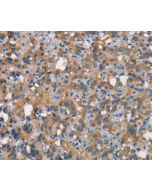
| Verified Samples | Verified Samples in IHC: Human lung cancer, Human gastric cancer |
| Dilution | IHC 1:400-1:800 |