Recombinant Human Amyloid Precursor (C-Fc)(Cat. No.:C00G) novoprotein
$150.00
In stock
SKU
C00G
10μg: $150
50μg: $450
500μg: $2250
1mg: $3375
Description
Recombinant Human Amyloid Precursor is produced by our Mammalian expression system and the target gene encoding Leu18-Lys612 is expressed with a human IgG1 Fc tag at the C-terminus.
Product Details
| Item | Details |
| Known As | Amyloid Precursor; Amyloid Precursor Protein 695; APP695 |
| Mol Mass | 94.6 KDa |
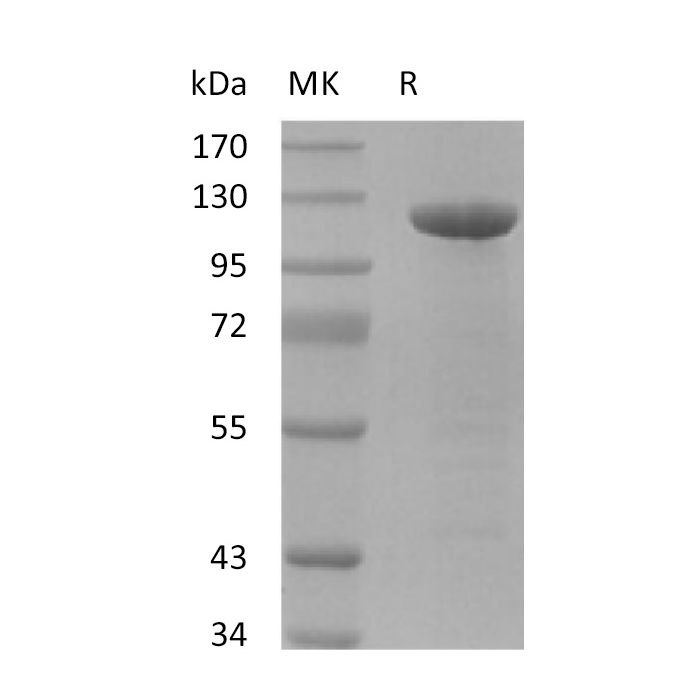
| APMol Mass | 120-145 KDa, reducing conditions |
| Formulation Description | Lyophilized from a 0.2 μm filtered solution of PBS, 5% Trehalose, pH7.4. |
| Endotoxin | < 1 EU/µg as determined by LAL test. |
| Reconstitution | Always centrifuge tubes before opening.Do not mix by vortex or pipetting. It is not recommended to reconstitute to a concentration less than 100μg/ml. Dissolve the lyophilized protein in distilled water. Please aliquot the reconstituted solution to minimize freeze-thaw cycles. |
| Storage | Lyophilized protein should be stored at ≤ -20°C, stable for one year after receipt. Reconstituted protein solution can be stored at 2-8°C for 2-7 days. Aliquots of reconstituted samples are stable at ≤ -20°C for 3 months. |
| Shipping | The product is shipped at ambient temperature. Upon receipt, store it immediately at the temperature listed below. |
Background
Amyloid precursor protein (APP) is a type I membrane protein with several isoforms due to alternative splicing, performs physiological functions on the surface of neurons relevant to neurite growth, neuronal adhesion and axonogenesis. Of the three major splice isoforms of APP (APP695, APP751, and APP770) APP695 is the predominant neuronal form from which Amyloid beta peptide and transcriptionally-active cleaved intracellular domain of APP (AICD) are preferentially generated by selective processing through the amyloidogenic pathway. Human APP695 consists of a 17 amino acid (aa) signal sequence, a 607 aa extracellular domain (ECD), a 24 aa transmembrane domain, and a 47 aa cytoplasmic domain. Within the ECD, human APP695 shares 97% aa sequence identity with mouse and rat APP695. Amyloid beta is a major molecule implicated in pathogenesis of Alzheimer's disease (AD) and related dementias. AICD regulates expression by direct promoter binding of multiple genes, including APP itself, the beta-secretase, BACE-1 and the Amyloid beta-degrading enzyme, Neprilysin. As such, APP695 plays an important role in brain development, learning and memory, synaptic plasticity, and neurodegeneration including AD.
title: APP mediates tau uptake and its overexpression leads to the exacerbated tau pathology
authors: Chen Jiang, Fan Anran, Li Song, Xiao Yan, Fu Yanlin, Chen Jun-Sheng, Zi Dan, Zeng Ling-Hui, Tan Jun
date: 2023
journal: CELLULAR AND MOLECULAR LIFE SCIENCES
MDSD