Recombinant Human Mindin (C-6His)(Cat. No.:CM63) novoprotein
$75.00
In stock
SKU
CM63
10μg: $75
50μg: $180
500μg: $1260
1mg: $1800
Description
Recombinant Human Spondin2 is produced by our Mammalian expression system and the target gene encoding Gln27-Val331 is expressed with a 6His tag at the C-terminus.
Product Details
| Item | Details |
| Known As | Spondin-2; Differentially expressed in cancerous and non-cancerous lung cells 1; DIL-1; Mindin; SPON2 |
| Mol Mass | 34.4 KDa |
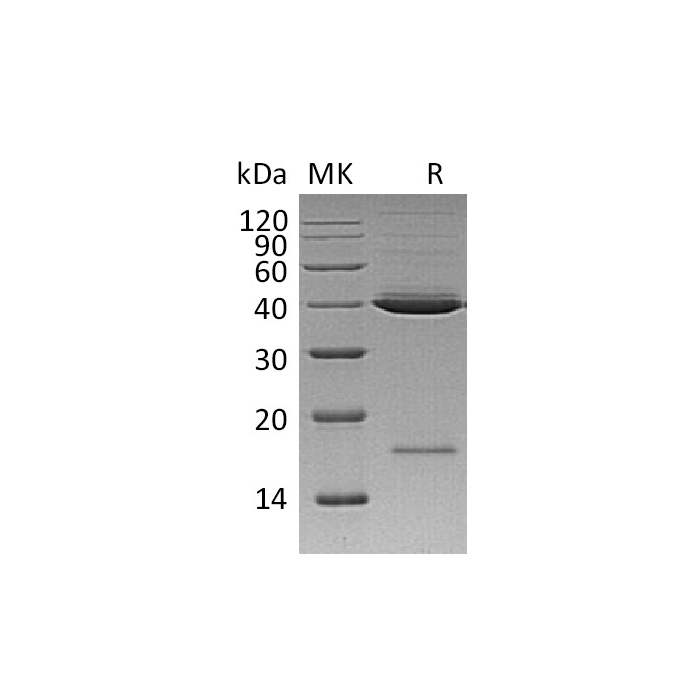
| APMol Mass | 38-42 KDa, reducing conditions |
| Formulation Description | Lyophilized from a 0.2 μm filtered solution of 20mM PB, 150mM NaCl, 1mM EDTA, pH 7.4. |
| Endotoxin | < 1 EU/µg as determined by LAL test. |
| Reconstitution | Always centrifuge tubes before opening.Do not mix by vortex or pipetting. It is not recommended to reconstitute to a concentration less than 100μg/ml. Dissolve the lyophilized protein in distilled water. Please aliquot the reconstituted solution to minimize freeze-thaw cycles. |
| Storage | Lyophilized protein should be stored at ≤ -20°C, stable for one year after receipt. Reconstituted protein solution can be stored at 2-8°C for 2-7 days. Aliquots of reconstituted samples are stable at ≤ -20°C for 3 months. |
| Shipping | The product is shipped at ambient temperature. Upon receipt, store it immediately at the temperature listed below. |
Background
Spondin-2, also referred to as mindin, belongs to the F-spondin family of secreted extracellular matrix proteins. Spondins are characterised by the presence of F-spondin domains 1 and 2 (FS1 and FS2) at the N-terminus and a thrombospondin-type 1 repeat (TSR1) domain at the C-terminus. Spondin-2 functions as a pattern-recognition molecule for bacterial and viral pathogens and as an integrin ligand for inflammatory cell recruitment and T cell priming. In addition to its roles in promoting neuron outgrowth and inhibiting both cancer and angiogenesis, Spondin-2 plays an important role in the initiation of the immune response and is involved in inflammatory processes.
MDSD