BenzoNuclease® ELISA Kit(Cat. No.:PA018) novoprotein
$50.00
In stock
SKU
PA018
96T: Inquiry
Description
BenzoNuclease® is a genetically engineered endonuclease from Serratia marcescens.
BenzoNuclease® acts as an endonuclease that degrades both DNA and RNA—whether single stranded, double-stranded, linear, circular or supercoiled. Upon complete digestion, all free nucleic acids present in solution are reduced to 5’-monophosphateterminated oligonucleotides, which are three to five bases in length.
BenzoNuclease® is an efficient enzyme for removing all forms of DNA and RNA from biological products. In processed biological products, there may be traces of BenzoNuclease® residues, and these traces of residues will have a certain impact on the application of subsequent biological products. The residual amount of BenzoNuclease® in biological products is one of the important indicators to measure the quality of biological products.
This kit can detect and quantitatively analyze the BenzoNuclease® residues in recombinant viral vectors and vaccine preparations with high sensitivity and specificity.
Reaction Principle
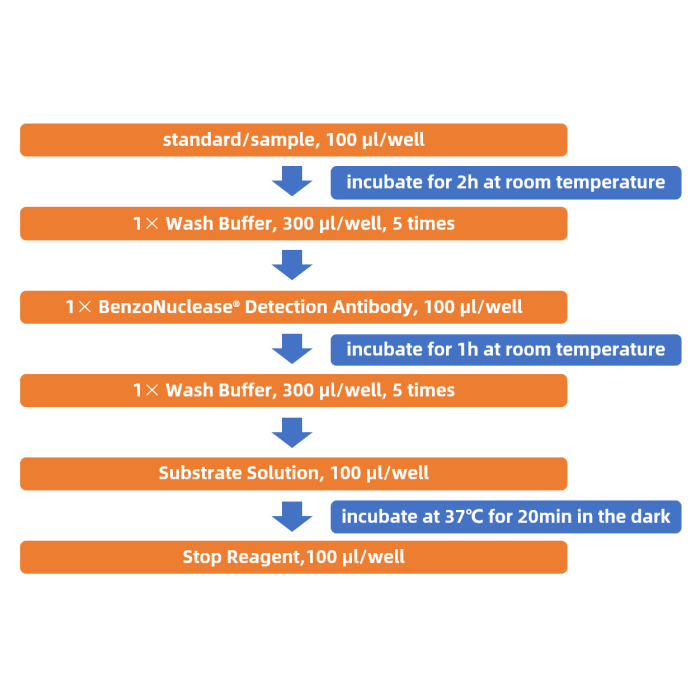
Concise Test Procedure
This kit adopts the double-antibody sandwich ELISA method. The BenzoNuclease® capture antibody is pre-coated. After adding the sample, the sample is captured to form an antibody-antigen complex, and then the HRP-conjugated BenzoNuclease® detection antibody is added to form an antibody-antigen-antibody "sandwich" complex. Finally, TMB substrate was added for color development. After the reaction was terminated, the absorbance value (OD value) was read at a wavelength of 450 nm. The content of BenzoNuclease® in the sample was positively correlated with the OD value.
Components
| Item | Description | Quantity |
| BenzoNuclease® Microplate | Coated capture antibody | 96T/Kit |
| 100×BenzoNuclease® Detection Antibody | HRP-conjugated, dilution ratio 1:100 | 150μl |
| BenzoNuclease® Standard | Recombinant BenzoNuclease®, 10μg/ml, dilution range 0.014-10.00ng/ml | 150μl |
| 20×Wash Buffer | - | 25ml×2 |
| 1×Dilution Buffer 1 | Sample dilution buffer | 30ml×2 |
| 1×Dilution Buffer 2 | Detection Antibody dilution buffer | 15ml |
| Color Reagent A | - | 6ml |
| Color Reagent B | - | 6ml |
| Stop Reagent | - | 12ml |
| Sealing Film | - | 2 pieces |
Product Details
| Item | Details |
| Storage | When the kit is unopened, store it in a dry place at 2-8°C away from light, with a validity period of one year; after the kit is opened, use it as soon as possible. |
Notes
The reagents should be equilibrated to room temperature according to relevant requirements before the experiment.
Each reagent should be thoroughly mixed before use to ensure the uniformity and accuracy of the reagents.
Strictly control the reaction temperature and reaction time.
The measured value cannot exceed the normal range.
The times of washings, the amount of washing buffer, the soaking time of washing solution, and the strength of washing are all issues that should be paid attention to.
Try to avoid air bubbles in the microwells when terminating the reaction.
A corresponding standard curve should be prepared for each test. Standard curves from different kits and different days cannot be mixed.
Pay attention to changing the sample tank and pipette tip in time between different samples and steps to avoid cross-contamination.
The reading of the light absorption value should be completed within 20 minutes after adding the stop solution.
High concentration may produce black flocs during color development, which is a normal phenomenon, and a slight degree will not affect the final reading result.
MDSD