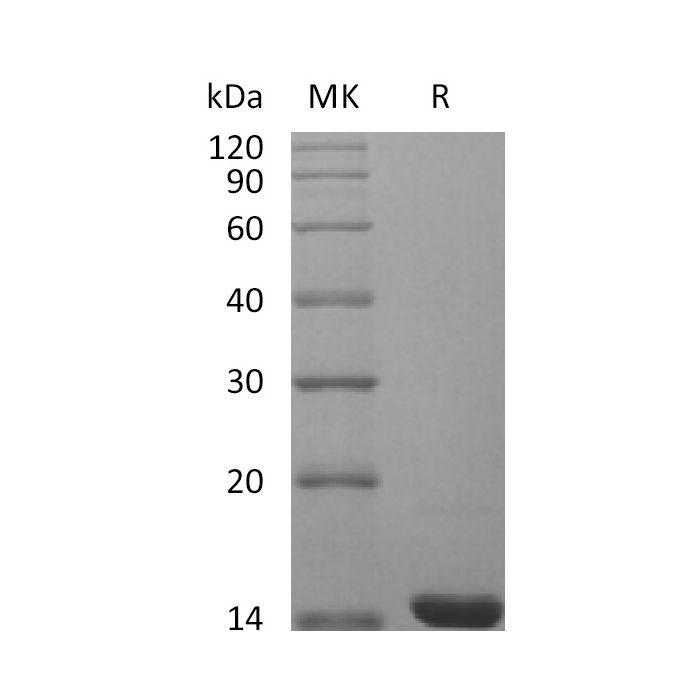
Recombinant Mouse FGF-4(Cat. No.:CR66) novoprotein
$79.00
In stock
SKU
CR66
10μg: $79
50μg: $236
500μg: $1496
1mg: $2250
Description
Recombinant Mouse Fibroblast Growth Factor 4 is produced by our E.coli expression system and the target gene encoding Ser67Leu202 is expressed.
Product Details
| Item | Details |
| Known As | Fibroblast growth factor 4; FGF-4; Heparin secretory-transforming protein 1; HST; HST-1; HSTF-1; Heparin-binding growth factor 4; HBGF-4; Transforming protein KS3; FGF4; HST; HSTF1; KS3 |
| Mol Mass | 15.2 KDa |
| APMol Mass | 15 KDa, reducing conditions |
| Formulation Description | Lyophilized from a 0.2 μm filtered solution of PBS, pH 7.4. |
| Endotoxin | < 0.01 EU/µg as determined by LAL test. |
| Reconstitution | Always centrifuge tubes before opening.Do not mix by vortex or pipetting. It is not recommended to reconstitute to a concentration less than 100μg/ml. Dissolve the lyophilized protein in distilled water. Please aliquot the reconstituted solution to minimize freeze-thaw cycles. |
| Storage | Lyophilized protein should be stored at ≤ -20°C, stable for one year after receipt. Reconstituted protein solution can be stored at 2-8°C for 2-7 days. Aliquots of reconstituted samples are stable at ≤ -20°C for 3 months. |
| Shipping | The product is shipped at ambient temperature. Upon receipt, store it immediately at the temperature listed below. |
Background
Fibroblast growth factor 4(FGF-4) is a heparin binding member of the FGF family. The human FGF4 cDNA encodes 206 amino acids (aa) with a 33 aa signal sequence and a 173 aa mature protein with an FGF homology domain that contains a heparin binding region near the C-terminus. Mature human FGF4 shares 91%, 82%, 94% and 91% aa identity with mouse, rat, canine and bovine FGF4, respectively. Human FGF-4 has been shown to exhibit cross species activity. Expression of FGF-4 and its receptors, FGF R1c, 2c, 3c and 4, is spatially and temporally regulated during embryonic development. FGF-4 is proposed to play a physiologically relevant role in human embryonic stem cell selfrenewal. It promotes stem cell proliferation, but may also aid differentiation depending on context and concentration, and is often included in embryonic stem cell media in vitro. FGF-4 is mitogenic for fibroblasts and endothelial cells in vitro and has autocrine transforming potential. It is a potent angiogenesis promoter in vivo and has been investigated as therapy for coronary artery disease.
title: A continuous totipotent-like cell-based embryo model recapitulates mouse embryogenesis from zygotic genome activation to gastrulation
authors: Ren Yixuan, Wang Xuyang, Liu Haiyin, Xu Yaxing, Cheng Ruoqi, Ren Shengnan, Li Zining, Huo Yunfei, Li Bo, Guan Jingyang, Li Cheng, Deng Hongkui, Xu Jun
date: 2025/10/15
journal: NATURE CELL BIOLOGY
title: A cationic thermosensitive polymer scaffold combined with fibroblast growth factor- 4/insulin-like growth factor-1 (FGF-4/IGF-1) promotes liver regeneration in acute liver failure
authors: Beining Liao, Qingpeng Liu, Dandan Zhang, Guowei Huang, Kuo Ma, Shengjun Pan, Jingfeng Che, Yan-Qing Guan
date: 2025/09/30
journal: COLLOIDS AND SURFACES B-BIOINTERFACES
title: Highly reproducible and cost-effective one-pot organoid differentiation using a novel platform based on PF-127 triggered spheroid assembly
authors: Xiao-Shan Zhang, Gang Xie, Honghao Ma, Shuangjin Ding, Yi-Xia Wu, Yuan Fei, Qiang Cheng, Yanyi Huang, Yangming Wang
date: 2023
journal: Biofabrication
MDSD