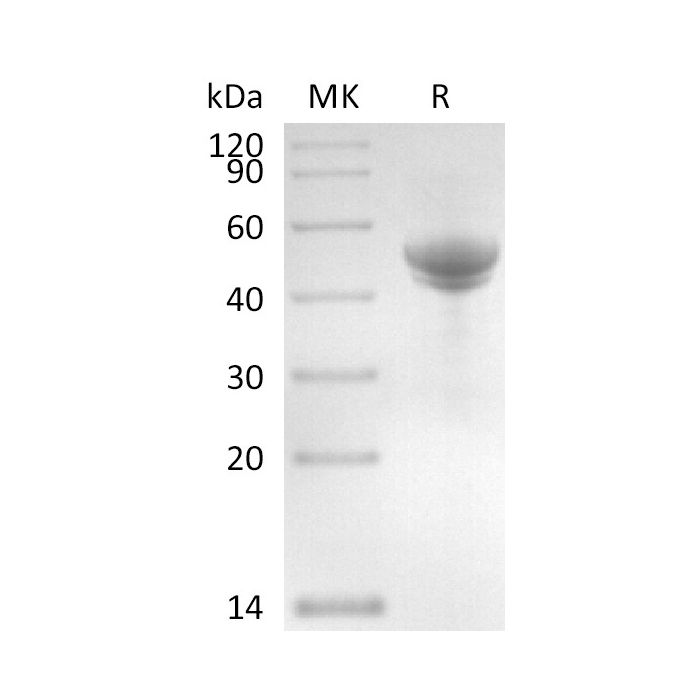
Recombinant Salmonella Typhimurium Flagellin(Cat. No.:CR91) novoprotein
$75.00
In stock
SKU
CR91
10μg: $75
50μg: $218
500μg: $1675
1mg: $2100
Description
Recombinant Salmonella typhimurium Flagellin is produced by our E.coli expression system and the target gene encoding Met1-Arg495 is expressed.
Product Details
| Item | Details |
| Known As | Flagellin; Phase 1-I flagellin; fliC; flaF; hag |
| Mol Mass | 51.6 KDa |
| APMol Mass | 45-65 KDa, reducing conditions |
| Formulation Description | Lyophilized from a 0.2 μm filtered solution of PBS, pH 7.4. |
| Endotoxin | < 0.01 EU/µg as determined by LAL test. |
| Reconstitution | Always centrifuge tubes before opening.Do not mix by vortex or pipetting. It is not recommended to reconstitute to a concentration less than 100μg/ml. Dissolve the lyophilized protein in distilled water. Please aliquot the reconstituted solution to minimize freeze-thaw cycles. |
| Storage | Lyophilized protein should be stored at ≤ -20°C, stable for one year after receipt. Reconstituted protein solution can be stored at 2-8°C for 2-7 days. Aliquots of reconstituted samples are stable at ≤ -20°C for 3 months. |
| Shipping | The product is shipped at ambient temperature. Upon receipt, store it immediately at the temperature listed below. |
Background
Flagellin is the major structural protein monomer of bacterial flagella. Flagellin through binding to its receptor and activation of antigen presenting cells stimulates the innate and adaptive immune responses. Flagellin is used as an effective systemic or mucosal adjuvant to stimulate the immune system. Flagellin is an agonist of Toll-like receptor 5 (TLR5), a pattern recognition receptor (PRR) of the innate immune system expressed on the basolateral surface of intestinal epithelial cells and on the surface of a subset of intestinal dendritic cells. Flagellin is delivered into the cytosol of macrophages by the T3SS-1 of serotype Typhimurium, where it activates the cytosolic interleukin-1 (IL-1) converting enzyme-protease activating factor (IPAF), a nucleotide-binding and oligomerization domain-like receptor (NLR) of the innate immunesystem. Recognition of flagellin by IPAF leads to activation of the inflammasome, followed by proteolytic activation of IL-1 and IL-18.
title: Novel mechanism of Clostridium butyricum alleviated coprophagy prevention-induced intestinal inflammation in rabbit
authors: Zhichao Li, Hui He, Mengjuan Chen, Mengke Ni, Chaohui Guo, Zhiyi Wan, Jianshe Zhou, Zhitong Wang, Yaling Wang, Hanfang Cai, Ming Li, HuiZeng Sun, Huifen Xu
date: 2024/03/01
journal: INTERNATIONAL IMMUNOPHARMACOLOGY
MDSD