Recombinant Human PD-1 (C-6His)(Cat. No.:CX91) novoprotein
$95.00
In stock
SKU
CX91
10μg: $95
50μg: $250
500μg: $1540
1mg: $2200
Description
Recombinant Human Programmed Cell Death Protein 1 is produced by our Mammalian expression system and the target gene encoding Pro21-Gln167 is expressed with a 6His tag at the C-terminus.
Product Details
| Item | Details |
| Known As | Programmed cell death protein 1; hPD-1; PDCD1; CD279 |
| Mol Mass | 17 KDa |
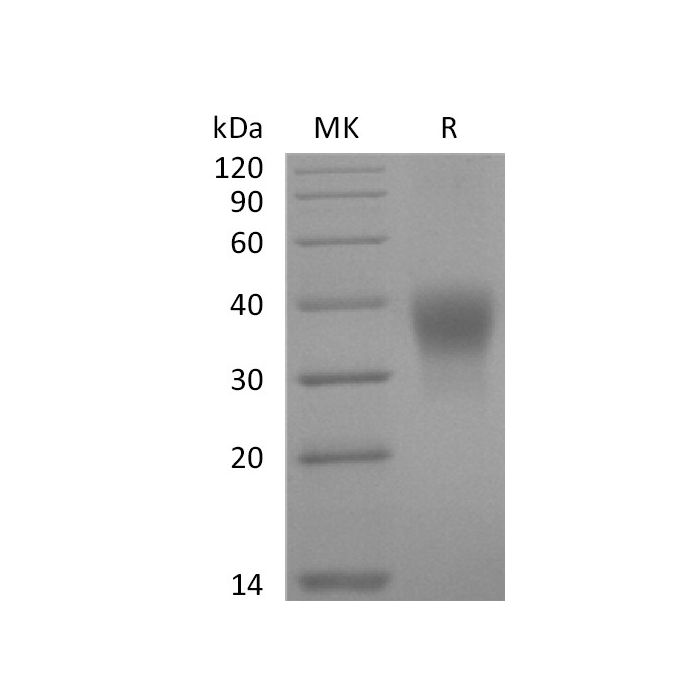
| APMol Mass | 30-42 KDa, reducing conditions |
| Formulation Description | Lyophilized from a 0.2 μm filtered solution of 20mM Tris-HCl, 10% Trehalose, 100mM NaCl, 0.05% Tween 80, pH 7.5. |
| Endotoxin | < 1 EU/µg as determined by LAL test. |
| Reconstitution | Always centrifuge tubes before opening.Do not mix by vortex or pipetting. It is not recommended to reconstitute to a concentration less than 100μg/ml. Dissolve the lyophilized protein in distilled water. Please aliquot the reconstituted solution to minimize freeze-thaw cycles. |
| Storage | Lyophilized protein should be stored at ≤ -20°C, stable for one year after receipt. Reconstituted protein solution can be stored at 2-8°C for 2-7 days. Aliquots of reconstituted samples are stable at ≤ -20°C for 3 months. |
| Shipping | The product is shipped at ambient temperature. Upon receipt, store it immediately at the temperature listed below. |
Background
Programmed cell death protein 1(PDCD1) is a single-pass type I membrane protein and contains 1 Ig-like V-type domain. PD-1 is a member of the extended CD28/CTLA-4 family of T cell regulators. PDCD1 inhibits the T-cell proliferation and production of related cytokines including IL-1, IL-4, IL-10 and IFN-γ by suppressing the activation and transduction of PI3K/AKT pathway. In addition, coligation of PDCD1 inhibits BCR-mediating signal by dephosphorylating key signal transducer. PDCD1 has been suggested to be involved in lymphocyte clonal selection and peripheral tolerance, and thus contributes to the prevention of autoimmune diseases. As a cell surface molecule, PDCD1 regulates the adaptive immune response. Engagement of PD-1 by its ligands PD-L1 or PD-L2 transduces a signal that inhibits T-cell proliferation, cytokine production, and cytolytic function.
title: Anti-tumor effect of PD-L1-targeting antagonistic aptamer-ASO delivery system with dual inhibitory function in immunotherapy
authors: Fatao Luo, Gang Yang, Xia Bai, Deyu Yuan, Ling Li, Diyue Wang, Xiaoxiang Lu, Yiran Cheng, Yuchun Wang, Xu Song, Yongyun Zhao
date: 2023-11-08
journal: Cell Chemical Biology
MDSD