Recombinant Human MICA (C-6His)(Cat. No.:C489) novoprotein
$70.00
In stock
SKU
C489
10μg: $70
50μg: $220
500μg: $1225
1mg: $1750
Description
Recombinant Human MHC Class I Polypeptide-Related Sequence A is produced by our Mammalian expression system and the target gene encoding Glu24-Gln308 is expressed with a 6His tag at the C-terminus.
Product Details
| Item | Details |
| Known As | MHC Class I Polypeptide-Related Sequence A; MIC-A; MICA; PERB11.1 |
| Mol Mass | 33.87 KDa |
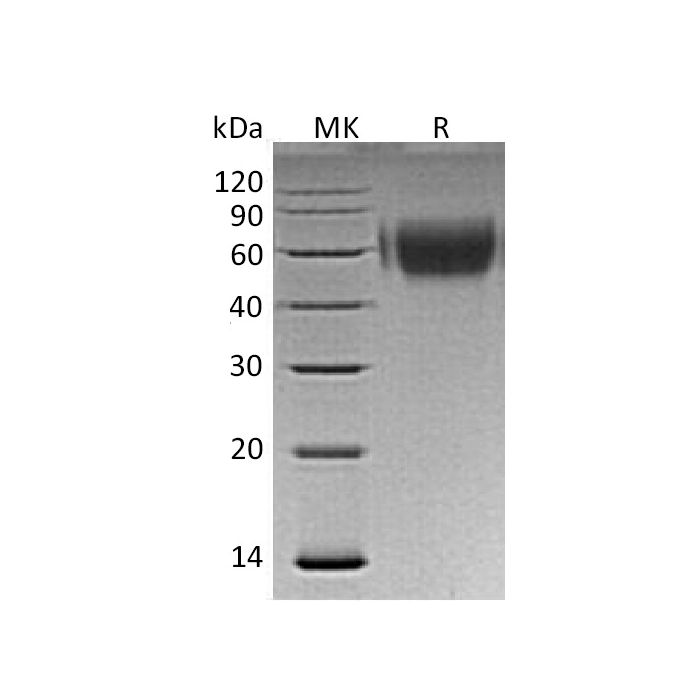
| APMol Mass | 60 KDa, reducing conditions |
| Formulation Description | Lyophilized from a 0.2 μm filtered solution of PBS, pH 7.4. |
| Endotoxin | < 1 EU/µg as determined by LAL test. |
| Reconstitution | Always centrifuge tubes before opening.Do not mix by vortex or pipetting. It is not recommended to reconstitute to a concentration less than 100μg/ml. Dissolve the lyophilized protein in distilled water. Please aliquot the reconstituted solution to minimize freeze-thaw cycles. |
| Storage | Lyophilized protein should be stored at ≤ -20°C, stable for one year after receipt. Reconstituted protein solution can be stored at 2-8°C for 2-7 days. Aliquots of reconstituted samples are stable at ≤ -20°C for 3 months. |
| Shipping | The product is shipped at ambient temperature. Upon receipt, store it immediately at the temperature listed below. |
Background
MHC Class I Polypeptide-Related Sequence A (MICA) is a transmembrane glycoprotein that functions as a ligand for human NKG2D. Unlike classical MHC class I molecules, MICA does not form a heterodimer with beta-2-microglobulin. MICA shares 85% amino acid identity with a closely related protein, MICB. MICA acts as a stress-induced self-antigen that is recognized by NK cells, NKT cells, and most of the subtypes of T cells. As a Ligand for the KLRK1/NKG2D receptor, MICA binds to KLRK1 leads to cell lysis. MICA functions as an antigen for gamma delta T cells and is frequently expressed in epithelial tumors. MICA antigens are able to elicit the synthesis of alloantibodies in transplant recipients. Studies have shown that anti-MICA antibodies are associated with acute renal allograft rejection and failure. MICA recognition is involved in tumor surveillance, viral infections, and autoimmune diseases.
title: An epitope-directed mRNA vaccine inhibits tumor metastasis through the blockade of MICA/B α1/2 shedding
authors: Rui Wang, Jingni Wu, Yifeng Lin, Yufei Xiao, Bin Yang, Sheng Yao, Tianhui Pan, Zhixuan Fu, Shuyu Li, Caihua Wang, Yongliang Zhu
date: 2025/02/24
journal: Cell Reports Medicine
MDSD