
USP14 Polyclonal antibody 14517-1-AP proteintech

$149.00
In stock
SKU
14517-1-AP
Catalog No.SizePrice (USD)
14517-1-AP-20UL20 μL$149.00
14517-1-AP-150UL150 μL$449.00
Catalog Number14517-1-AP
SynonymsDeubiquitinating enzyme 14, EC:3.4.19.12, TGT, Ubiquitin carboxyl-terminal hydrolase 14, Ubiquitin thioesterase 14
HostRabbit
Reactivityhuman, mouse, rat and More (1)
Reactivityhuman, mouse, rat, pig
FormLiquid
FormulationPBS, Azide, Glycerol
ApplicationsWB, IHC, IF/ICC, IP, CoIP, ELISA
ApplicationsWB, IF/ICC, IP, ELISA
Host / IsotypeRabbit / IgG
Tested Applications — Positive WB detected inDU 145 cells, HeLa cells, mouse heart tissue, HEK-293T cells, HEK-293 cells, SKOV-3 cells, Neuro-2a cells
Tested Applications — Positive IP detected inmouse liver tissue
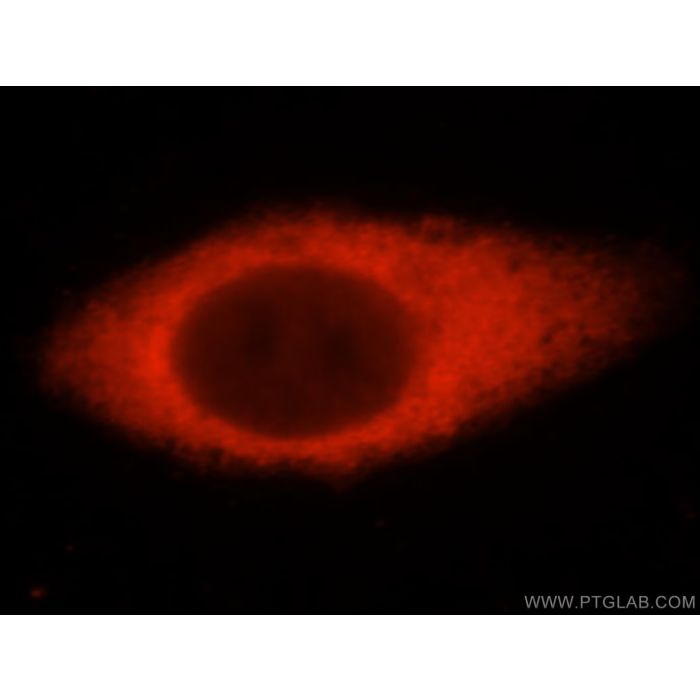
Tested Applications — Positive IF/ICC detected inHepG2 cells
Recommended Dilutions — Western Blot (WB)WB : 1:2000-1:18000
Recommended Dilutions — Immunoprecipitation (IP)IP : 0.5-4.0 ug for 1.0-3.0 mg of total protein lysate
Recommended Dilutions — Immunofluorescence (IF)/ICCIF/ICC : 1:10-1:100
Positive WB detected inDU 145 cells, HeLa cells, mouse heart tissue, HEK-293T cells, HEK-293 cells, SKOV-3 cells, Neuro-2a cells
Positive IP detected inmouse liver tissue
Positive IF/ICC detected inHepG2 cells
Western Blot (WB)WB : 1:2000-1:18000
Immunoprecipitation (IP)IP : 0.5-4.0 ug for 1.0-3.0 mg of total protein lysate
Immunofluorescence (IF)/ICCIF/ICC : 1:10-1:100
Tested Reactivityhuman, mouse, rat
Cited Reactivityhuman, mouse, rat, pig
ClassPolyclonal
TypeAntibody
ImmunogenCatNo: Ag5979 Product name: Recombinant human USP14 protein Source: e coli. -derived, PGEX-4T Tag: GST Domain: 1-294 aa of BC003556 Sequence: MPLYSVTVKWGKEKFEGVELNTDEPPMVFKAQLFALTGVQPARQKVMVKGGTLKDDDWGNIKIKNGMTLLMMGSADALPEEPSAKTVFVEDMTEEQLASAMELPCGLTNLGNTCYMNATVQCIRSVPELKDALKRYAGALRASGEMASAQYITAALRDLFDSMDKTSSSIPPIILLQFLHMAFPQFAEKGEQGQYLQQDANECWIQMMRVLQQKLEAIEDDSVKETDSSSASAATPSKKKSLIDQFFGVEFETTMKCTESEEEEVTKGKENQLQLSCFINQEVKYLFTGLKLRL Predict reactive species
Full Nameubiquitin specific peptidase 14 (tRNA-guanine transglycosylase)
Calculated Molecular Weight54 kDa
Observed Molecular Weight52-60 kDa
GenBank Accession NumberBC003556
Gene SymbolUSP14
Gene ID (NCBI)9097
RRIDAB_2257124
ConjugateUnconjugated
Purification MethodAntigen affinity purification
UNIPROT IDP54578
Storage BufferPBS with 0.02% sodium azide and 50% glycerol, pH 7.3.
Storage ConditionsStore at -20°C. Stable for one year after shipment. Aliquoting is unnecessary for -20 o C storage. 20ul sizes contain 0.1% BSA.
IF protocol for USP14 antibody 14517-1-APDownload protocol
IP protocol for USP14 antibody 14517-1-APDownload protocol
WB protocol for USP14 antibody 14517-1-APDownload protocol
humanWB,IF Autophagy USP14 regulates DNA damage repair by targeting RNF168-dependent ubiquitination. Authors - Arishya Sharma View Article
pigWB,IP,IF Autophagy Inhibition of USP14 influences alphaherpesvirus proliferation by degrading viral VP16 protein via ER stress-triggered selective autophagy. Authors - Sheng-Li Ming KD Validated View Article
mouseWB,IF,CoIP Sci Adv The cohesin-associated protein Pds5A governs the meiotic spindle assembly via deubiquitination of Kif5B in oocytes Authors - Yu Zhang KD Validated View Article
Citations43
DilutionsWB : 1:2000-1:18000 IP : 0.5-4.0 ug for IP and 0.5-4.0 ug for 1.0-3.0 mg of total protein lysate for WB IF/ICC : 1:10-1:100
IsotypeIgG
ClonalityPolyclonal
Clone Number-
ConjugationUnconjugated

USP14(Ubiquitin carboxyl-terminal hydrolase 14) is also named as TGT and belongs to the peptidase C19 family. Mammalian USP14 is unique among known UBP enzymes in that it is activated catalytically upon specific association with the 26S proteasome. USP14 inhibition accelerated the degradation of oxidized proteins and enhanced resistance to oxidative stress.This protein has a 45-kDa catalytic domain (PMID:16211010). Protocols Product Specific Protocols IF protocol for USP14 antibody 14517-1-AP Download protocol IP protocol for USP14 antibody 14517-1-AP Download protocol WB protocol for USP14 antibody 14517-1-AP Download protocol Standard Protocols Click here to view our Standard Protocols

Publications
  1. NAP1L1 degradation by FBXW7 reduces the deubiquitination of HDGF-p62 signaling to stimulate autophagy and induce primary cisplatin chemosensitivity in nasopharyngeal carcinoma
    Journal: Mol Cancer | Authors: Bin Gong | Species: human | Application: WB
  2. Inhibition of USP14 influences alphaherpesvirus proliferation by degrading viral VP16 protein via ER stress-triggered selective autophagy.
    Journal: Autophagy | Authors: Sheng-Li Ming KD Validated | Species: pig | Application: WB,IP,IF
  3. USP14 regulates DNA damage repair by targeting RNF168-dependent ubiquitination.
    Journal: Autophagy | Authors: Arishya Sharma | Species: human | Application: WB,IF
  4. USP9X-mediated REV1 deubiquitination promotes lung cancer radioresistance via the action of REV1 as a Rad18 molecular scaffold for cystathionine γ-lyase
    Journal: J Biomed Sci | Authors: Yunshang Chen
  5. The cohesin-associated protein Pds5A governs the meiotic spindle assembly via deubiquitination of Kif5B in oocytes
    Journal: Sci Adv | Authors: Yu Zhang KD Validated | Species: mouse | Application: WB,IF,CoIP
  6. OTULIN protects hyperoxia-induced neonatal lung injury and modulates mitochondrial protein OPA1 in association with the E3 ubiquitin ligase RNF31.
    Journal: Cell Mol Biol Lett | Authors: Li Huang
  7. Ultrasmall Nanoparticles Mitigate Tau Hyperphosphorylation to Restore Synaptic Integrity and Boost Cognitive Function in Alzheimer's Disease
    Journal: Adv Healthc Mater | Authors: Hanbing Xu | Species: mouse | Application: WB,IF
  8. Identification of AKOS, a Chikungunya virus inhibitor, as a USP14 inhibitor for colorectal cancer treatment.
    Journal: Acta Pharmacol Sin | Authors: Bin Lu | Species: human | Application: WB
  9. Derepression of the USP22-FASN axis by p53 loss under oxidative stress drives lipogenesis and tumorigenesis
    Journal: Cell Death Discov | Authors: Zelong Han | Species: human | Application: WB
  10. Mettl1 knockdown alleviates cardiac I/R injury in mice by inactivating the Mettl1-CYLD-P53 positive feedback loop
    Journal: Acta Pharmacol Sin | Authors: Shu-Ting Yu | Species: mouse | Application: WB
  11. Macrophage-derived IL-6 reprograms lipid metabolism to promote colorectal cancer development through USP14-mediated FASN deubiquitination.
    Journal: J Transl Med | Authors: Liu Yunxin | Species: human | Application: WB
  12. USP14 inhibits mitophagy and promotes tumorigenesis and chemosensitivity through deubiquitinating BAG4 in microsatellite instability-high colorectal cancer
    Journal: Mol Med | Authors: Zhiyong Wang | Species: human | Application: WB,IHC,IF,CoIP
  13. PKCiota Inhibits the Ferroptosis of Esophageal Cancer Cells via Suppressing USP14-Mediated Autophagic Degradation of GPX4
    Journal: Antioxidants (Basel) | Authors: Hao Tao | Species: human | Application: WB
  14. USP14 modulates cell pyroptosis and ameliorates doxorubicin-induced cardiotoxicity by deubiquitinating and stabilizing SIRT3
    Journal: Free Radic Biol Med | Authors: Zhiming Zhang | Species: rat,human | Application: WB
  15. GSTM3 enhances radiosensitivity of nasopharyngeal carcinoma by promoting radiation-induced ferroptosis through USP14/FASN axis and GPX4
    Journal: Br J Cancer | Authors: Yuting Chen | Species: human | Application: WB
  16. HSPA9 contributes to tumor progression and ferroptosis resistance by enhancing USP14-driven SLC7A11 deubiquitination in multiple myeloma
    Journal: Cell Rep | Authors: Na Shen | Species: human | Application: WB
  17. SPAG5-AS1 inhibited autophagy and aggravated apoptosis of podocytes via SPAG5/AKT/mTOR pathway.
    Journal: Cell Prolif | Authors: Jun Xu | Species: human | Application: IF
  18. Interplay between acetylation and ubiquitination controls PSAT1 protein stability in lung adenocarcinoma
    Journal: Commun Biol | Authors: Yuhan Liu | Species: human | Application: WB
  19. USP14-mediated stabilization of ACTN1 maintains mesenchymal characteristics in glioblastoma.
    Journal: Commun Biol | Authors: Wenjin Qiu | Species: human | Application: WB,IF
  20. C-MYC-activated lncRNA SNHG20 accelerates the proliferation of diffuse large B cell lymphoma via USP14-mediated deubiquitination of β-catenin
    Journal: Biol Direct | Authors: Chaoyu Wang | Species: human | Application: WB
  21. SOAT1 Promotes Gastric Cancer Lymph Node Metastasis Through Lipid Synthesis.
    Journal: Front Pharmacol | Authors: Tingting Zhu | Species: human | Application: WB
  22. HAO2 inhibits the growth and lipid metabolism of head and neck squamous cell carcinoma by enhancing MYH9 ubiquitination mediated by STUB1 and USP14.
    Journal: Biochim Biophys Acta Mol Basis Dis | Authors: Danqing Yan | Species: human | Application: WB
  23. Ubiquitin-specific protease 14 inhibition promotes mitophagy and attenuates neural apoptosis after spinal cord injury.
    Journal: Sci Rep | Authors: Dingwei Wu | Species: rat | Application: WB
  24. MGMT upregulation mediates Temozolomide resistance conferred USP5 dependency.
    Journal: Sci Rep | Authors: Sachin Bhardwaj | Species: human | Application: WB
  25. USP14 Positively Modulates Head and Neck Squamous Carcinoma Tumorigenesis and Potentiates Heat Shock Pathway through HSF1 Stabilization
    Journal: Cancers (Basel) | Authors: Jie Wang | Species: human | Application: WB,IHC,IF
  26. Regulation of sepsis-associated acute kidney injury by ELAVL1 through USP14/NCOA4-mediated ferroptosis in renal tubular epithelial cells.
    Journal: Mol Cell Biochem | Authors: Xiaoliang Zhu | Species: mouse,human | Application: WB,CoIP
  27. USP14 promotes the proliferation of cervical cancer via upregulating β-catenin
    Journal: Environ Toxicol | Authors: Han Song | Species: human | Application: WB
  28. BECN1 promotes the migration of NSCLC cells through regulating the ubiquitination of Vimentin.
    Journal: Cell Adh Migr | Authors: Zhujun Cheng | Species: Human | Application: WB
  29. miR-30a enhanced RIG-I-mediated type I interferon antiviral response by targeting USP14
    Journal: Microbiol Spectr | Authors: Jikai Zhang
  30. The USP14-NLRC5 pathway inhibits titanium particle-induced osteolysis in mice by suppressing NF-κB and PI3K/AKT activities.
    Journal: J Biol Chem | Authors: Guibin Fang | Species: human | Application: IHC
  31. Regulation of CHK1 inhibitor resistance by a c-Rel and USP1 dependent pathway
    Journal: Biochem J | Authors: Jill E Hunter | Species: mouse,human | Application: WB
  32. CyclinB1 deubiquitination by USP14 regulates cell cycle progression in breast cancer.
    Journal: Pathol Res Pract | Authors: Bing Liu | Species: human | Application: WB
  33. USP14 as a novel prognostic marker promotes cisplatin resistance via Akt/ERK signaling pathways in gastric cancer.
    Journal: Cancer Med | Authors: Ying Fu | Species: human | Application: WB,IHC
  34. Association Between Proteasome 26S Subunit, Non-ATPase 3 Methylation and Insulin β Cell Apoptosis in Type 2 Diabetic Mellitus
    Journal: Diabetes Metab Syndr Obes | Authors: Guiping Huang | Application: WB
  35. Piceatannol upregulates USP14-mediated GPX4 deubiquitination to inhibit neuronal ferroptosis caused by cerebral ischemia-reperfusion in mice
    Journal: Food Chem Toxicol | Authors: Qiuju Zhao | Species: mouse | Application: IF,CoIP
  36. Lupeol induces apoptosis of glioma cells via governing ubiquitination-mediated SPARC turnover.
    Journal: Tissue Cell | Authors: Yiting Wei | Species: human | Application: WB
  37. Lupeol induces apoptosis of glioma cells via governing ubiquitination-mediated SPARC turnover.
    Journal: Tissue Cell | Authors: Yiting Wei | Species: human | Application: WB
  38. Proteasome-associated cysteine deubiquitinases are molecular targets of environmental optical brightener compounds.
    Journal: J Cell Biochem | Authors: Isel Castro | Species: human | Application: WB
  39. USP14 promotes epithelial-mesenchymal transition and functions as a multifaceted biomarker in lung adenocarcinoma.
    Journal: Discov Oncol | Authors: Chenzhuo Wu | Species: human | Application: WB
  40. Overexpression of ubiquitin specific peptidase 14 predicts unfavorable prognosis in esophageal squamous cell carcinoma.
    Journal: Thorac Cancer | Authors: Baozhu Zhang | Species: human | Application: WB,IHC
  41. USP14 promotes head and neck squamous cell carcinoma progression via deubiquitinating and stabilizing CFL2.
    Journal: Future Sci OA | Authors: Yue Liu
  42. Synergistic Effect of Ubiquitin-Specific Protease 14 and Poly(ADP-Ribose) Glycohydrolase Co-Inhibition in BRCA1-Mutant, Poly(ADP-Ribose) Polymerase Inhibitor-Resistant Triple-Negative Breast Cancer Cells
    Journal: Onco Targets Ther | Authors: Pisong Li | Species: human | Application: WB
  43. Triptolide attenuates cardiac remodeling by inhibiting pyroptosis and EndMT via modulating USP14/Keap1/Nrf2 pathway
    Journal: Heliyon | Authors: Lina Ba | Species: mouse | Application: WB
  44. CD81 drives immune evasion in radioresistant glioblastoma by blocking selective autophagic degradation of CD274/PD-L1.
    Journal: Autophagy | Authors: Liang Zeng | Species: human, mouse | Application: WB,IF

Reviews

Write Your Own Review
You're reviewing:USP14 Polyclonal antibody 14517-1-AP proteintech
Your Rating
Copyright © 2025 Biogege, Inc. All rights reserved.