MKS1 Polyclonal antibody 16206-1-AP proteintech

$149.00
In stock
SKU
16206-1-AP
Catalog No.SizePrice (USD)
16206-1-AP-20UL20 μL$149.00
16206-1-AP-150UL150 μL$449.00
Catalog Number16206-1-AP
SynonymsBBS13, MKS 1, Tectonic-like complex member MKS1
HostRabbit
Reactivityhuman, mouse, rat
FormLiquid
FormulationPBS, Azide, Glycerol
ApplicationsWB, IHC, IF, IP, ELISA
Host / IsotypeRabbit / IgG
Tested Applications — Positive WB detected inHEK-293 cells, mouse uterus tissue, SH-SY5Y cells, HeLa cells, mouse testis tissue, rat testis tissue
Tested Applications — Positive IP detected inHEK-293 cells
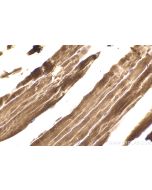
Tested Applications — Positive IHC detected inhuman liver cancer tissue Note: suggested antigen retrieval with TE buffer pH 9.0; (*) Alternatively, antigen retrieval may be performed with citrate buffer pH 6.0
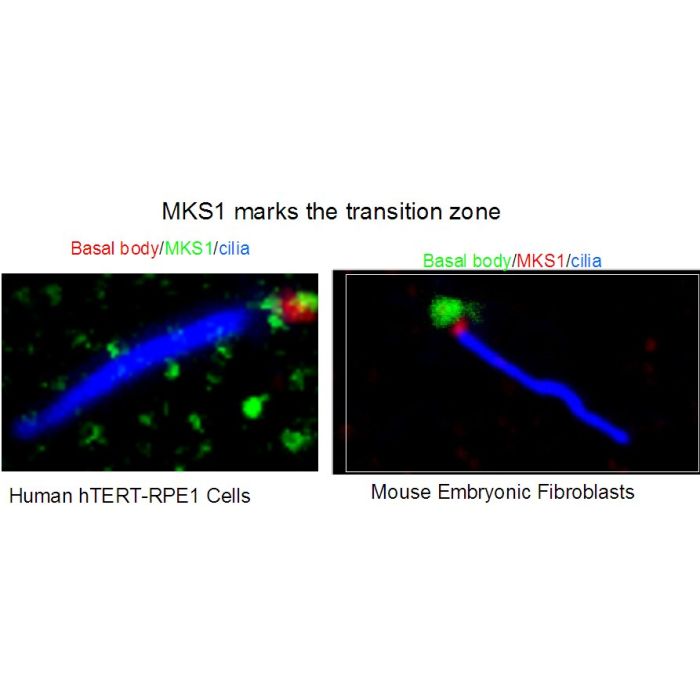
Tested Applications — Positive IF detected inhTERT-RPE1 cells and Mouse embryonic fibroblasts
Recommended Dilutions — Western Blot (WB)WB : 1:500-1:2000
Recommended Dilutions — Immunoprecipitation (IP)IP : 0.5-4.0 ug for 1.0-3.0 mg of total protein lysate
Recommended Dilutions — Immunohistochemistry (IHC)IHC : 1:50-1:500
Positive WB detected inHEK-293 cells, mouse uterus tissue, SH-SY5Y cells, HeLa cells, mouse testis tissue, rat testis tissue
Positive IP detected inHEK-293 cells
Positive IHC detected inhuman liver cancer tissue Note: suggested antigen retrieval with TE buffer pH 9.0; (*) Alternatively, antigen retrieval may be performed with citrate buffer pH 6.0
Positive IF detected inhTERT-RPE1 cells and Mouse embryonic fibroblasts
Western Blot (WB)WB : 1:500-1:2000
Immunoprecipitation (IP)IP : 0.5-4.0 ug for 1.0-3.0 mg of total protein lysate
Immunohistochemistry (IHC)IHC : 1:50-1:500
Immunofluorescence (IF)IF : 1:20-1:200
Tested Reactivityhuman, mouse, rat
Cited Reactivityhuman, mouse
ClassPolyclonal
TypeAntibody
ImmunogenCatNo: Ag9177 Product name: Recombinant human BBS13 protein Source: e coli. -derived, PGEX-4T Tag: GST Domain: 1-321 aa of BC010061 Sequence: MTTAASEVPSFLVERMANVRRRRQDRRGMEGGILKSRIVTWEPSEEFVRNNHVINTPLQTMHIMADLGPYKKLGYKKYEHVLCTLKVDSNGVITVKPDFTGLKGPYRIETEGEKQELWKYTIDNVSPHAQPEEEERERRVFKDLYGRHKEYLSSLVGTDFEMTVPGALRLFVNGEVVSAQGYEYDNLYVHFFVELPTAHWSSPAFQQLSGVTQTCTTKSLAMDKVAHFSYPFTFEAFFLHEDESSDALPEWPVLYCEVLSLDFWQRYRVEGYGAVVLPATPGSHTLTVSTWRPVELGTVAELRRFFIGGSLELEDLSYVRI Predict reactive species
Full NameMeckel syndrome, type 1
Calculated Molecular Weight559 aa, 65 kDa
Observed Molecular Weight65-70 kDa
GenBank Accession NumberBC010061
Gene SymbolMKS1
Gene ID (NCBI)54903
RRIDAB_10637856
ConjugateUnconjugated
Purification MethodAntigen affinity purification
UNIPROT IDQ9NXB0
Storage BufferPBS with 0.02% sodium azide and 50% glycerol, pH 7.3.
Storage ConditionsStore at -20°C. Stable for one year after shipment. Aliquoting is unnecessary for -20 o C storage. 20ul sizes contain 0.1% BSA.
IF protocol for MKS1 antibody 16206-1-APDownload protocol
IHC protocol for MKS1 antibody 16206-1-APDownload protocol
IP protocol for MKS1 antibody 16206-1-APDownload protocol
WB protocol for MKS1 antibody 16206-1-APDownload protocol
mouse,humanWB,IF Nat Genet A transition zone complex regulates mammalian ciliogenesis and ciliary membrane composition. Authors - Garcia-Gonzalo Francesc R FR View Article
mouseIF Nat Cell Biol Lineage specificity of primary cilia in the mouse embryo. Authors - Fiona K Bangs View Article
humanIF Nat Commun Phosphatidylinositol phosphate kinase PIPKIγ and phosphatase INPP5E coordinate initiation of ciliogenesis. Authors - Qingwen Xu View Article
Citations33
DilutionsWB : 1:500-1:2000 IP : 0.5-4.0 ug for IP and 0.5-4.0 ug for 1.0-3.0 mg of total protein lysate for WB IHC : 1:50-1:500 IF : 1:20-1:200
IsotypeIgG
ClonalityPolyclonal
Clone Number-
ConjugationUnconjugated

MKS1 (Meckel syndrome type 1 protein) is a 559-amino acid protein that contains a conserved B9 domain. It is a component of a large protein complex which localizes to the ciliary transition zone and regulates mammalian ciliogenesis and ciliary membrane composition (PMID: 21725307). MKS1 is required for ciliary structure and function, and is involved in centrosome migration to the apical cell surface during early ciliogenesis (PMID: 17185389; 19515853). Broad tissue expression of the MKS1 gene has been reported (PMID: 16415886). Defects in MKS1 are the cause of Meckel syndrome type 1 (MKS1), an autosomal recessive lethal malformation syndrome characterized by renal cystic dysplasia, central nervous system malformations, and hepatic developmental defects (PMID: 16415886). In addition, defects in MKS1 are also the cause of Bardet-Biedl syndrome type 13 (BBS13) (PMID: 18327255). Protocols Product Specific Protocols IF protocol for MKS1 antibody 16206-1-AP Download protocol IHC protocol for MKS1 antibody 16206-1-AP Download protocol IP protocol for MKS1 antibody 16206-1-AP Download protocol WB protocol for MKS1 antibody 16206-1-AP Download protocol Standard Protocols Click here to view our Standard Protocols

Publications
  1. A transition zone complex regulates mammalian ciliogenesis and ciliary membrane composition.
    Journal: Nat Genet | Authors: Garcia-Gonzalo Francesc R FR | Species: mouse,human | Application: WB,IF
  2. The spinocerebellar ataxia-associated gene Tau tubulin kinase 2 controls the initiation of ciliogenesis.
    Journal: Cell | Authors: Goetz Sarah C SC | Species: mouse | Application: IF
  3. Lineage specificity of primary cilia in the mouse embryo.
    Journal: Nat Cell Biol | Authors: Fiona K Bangs | Species: mouse | Application: IF
  4. Ciliopathy protein HYLS1 coordinates the biogenesis and signaling of primary cilia by activating the ciliary lipid kinase PIPKIγ.
    Journal: Sci Adv | Authors: Chuan Chen | Species: human | Application: IF
  5. Microtubule asters anchored by FSD1 control axoneme assembly and ciliogenesis.
    Journal: Nat Commun | Authors: Hai-Qing Tu | Species: human | Application: IF
  6. Phosphatidylinositol phosphate kinase PIPKIγ and phosphatase INPP5E coordinate initiation of ciliogenesis.
    Journal: Nat Commun | Authors: Qingwen Xu | Species: human | Application: IF
  7. An organelle-specific protein landscape identifies novel diseases and molecular mechanisms.
    Journal: Nat Commun | Authors: Karsten Boldt | Species: human | Application: IF
  8. Loss of RPGR disrupts motile cilia and causes primary ciliary dyskinesia by affecting F-actin dynamics.
    Journal: J Clin Invest | Authors: Yang Wu | Species: human | Application: IF
  9. Primary cilia formation requires the Leigh syndrome-associated mitochondrial protein NDUFAF2
    Journal: J Clin Invest | Authors: Chien-Hui Lo | Species: human | Application: IF
  10. Ciliopathy protein HYLS1 coordinates the biogenesis and signaling of primary cilia by activating the ciliary lipid kinase PIPKIγ.
    Journal: Sci Adv | Authors: Chuan Chen | Species: human | Application: IF
  11. ASK1-Mediated Phosphorylation Blocks HDAC6 Ubiquitination and Degradation to Drive the Disassembly of Photoreceptor Connecting Cilia.
    Journal: Dev Cell | Authors: Jie Ran | Species: mouse | Application: WB
  12. A microscopy-based CRISPR screening platform enables organellar functional genomics and illuminates ciliary biology.
    Journal: Dev Cell | Authors: Jingbo Sun | Species: mouse,human | Application: IF
  13. Cell type-specific regulation of ciliary transition zone assembly in vertebrates.
    Journal: EMBO J | Authors: Antonia Wiegering | Species: mouse | Application: IF
  14. TMEM231, mutated in orofaciodigital and Meckel syndromes, organizes the ciliary transition zone.
    Journal: J Cell Biol | Authors: Elle C Roberson
  15. The small GTPase RSG1 controls a final step in primary cilia initiation.
    Journal: J Cell Biol | Authors: Stephanie O Agbu | Species: mouse | Application: IF
  16. LUBAC regulates ciliogenesis by promoting CP110 removal from the mother centriole.
    Journal: J Cell Biol | Authors: Xiao-Lin Shen | Species: human | Application: IF
  17. INPP5E regulates phosphoinositide-dependent cilia transition zone function.
    Journal: J Cell Biol | Authors: Jennifer M Dyson | Species: mouse | Application: IF
  18. Multi-omics analysis delineates molecular signatures of spinal ependymal tumor.
    Journal: Cell Oncol (Dordr) | Authors: Weihao Liu | Species: human | Application: IF
  19. EVC-EVC2 complex stability and ciliary targeting are regulated by modification with ubiquitin and SUMO
    Journal: Front Cell Dev Biol | Authors: Pablo Barbeito | Species: mouse | Application: IF
  20. Deacetylation of α-tubulin and cortactin is required for HDAC6 to trigger ciliary disassembly.
    Journal: Sci Rep | Authors: Jie Ran | Species: human | Application: WB
  21. Superresolution Pattern Recognition Reveals the Architectural Map of the Ciliary Transition Zone.
    Journal: Sci Rep | Authors: T Tony Yang | Species: human | Application: IF
  22. Glucose deprivation induces primary cilium formation through mTORC1 inactivation.
    Journal: J Cell Sci | Authors: Kengo Takahashi | Species: human | Application: IF
  23. Acute versus chronic loss of mammalian Azi1/Cep131 results in distinct ciliary phenotypes.
    Journal: PLoS Genet | Authors: Emma A Hall | Species: mouse | Application: IF
  24. Super-Resolution Imaging Reveals TCTN2 Depletion-Induced IFT88 Lumen Leakage and Ciliary Weakening.
    Journal: Biophys J | Authors: Rueyhung Roc Weng | Species: human | Application: IF
  25. MKS1 regulates ciliary INPP5E levels in Joubert syndrome.
    Journal: J Med Genet | Authors: Gisela G Slaats | Species: human | Application: WB,IF
  26. Cilia gene mutations cause atrioventricular septal defects by multiple mechanisms.
    Journal: Hum Mol Genet | Authors: Ozanna Burnicka-Turek | Species: mouse | Application: WB
  27. Visualizing renal primary cilia.
    Journal: Nephrology (Carlton) | Authors: James A Deane | Species: human | Application: IF
  28. Fused (Stk36) is a ciliary protein required for central pair assembly and motile cilia orientation in the mammalian oviduct.
    Journal: Dev Dyn | Authors: Nozawa Yoko Inès YI | Species: mouse | Application: IF
  29. Regulation of canonical Wnt signalling by the ciliopathy protein MKS1 and the E2 ubiquitin-conjugating enzyme UBE2E1.
    Journal: Elife | Authors: Katarzyna Szymanska | Species: mouse | Application: WB,IF
  30. Two functional forms of the Meckel-Gruber syndrome protein TMEM67 generated by proteolytic cleavage by ADAMTS9 mediate Wnt signaling and ciliogenesis
    Journal: bioRxiv | Authors: Manu Ahmed | Application: IF
  31. Regulation of canonical Wnt signalling by the ciliopathy protein MKS1 and the E2 ubiquitin-conjugating enzyme UBE2E1.
    Journal: Elife | Authors: Katarzyna Szymanska | Species: mouse | Application: WB,IF
  32. The multifaceted role of EXOC6A in ciliogenesis.
    Journal: Elife | Authors: Te-Lin Lin | Species: human | Application: IF
  33. A WDR35-dependent coat protein complex transports ciliary membrane cargo vesicles to cilia.
    Journal: Elife | Authors: Tooba Quidwai | Species: mouse | Application: IF

Reviews

Write Your Own Review
You're reviewing:MKS1 Polyclonal antibody 16206-1-AP proteintech
Your Rating
Copyright © 2025 Biogege, Inc. All rights reserved.