
BBS5 Polyclonal antibody 14569-1-AP proteintech

$149.00
In stock
SKU
14569-1-AP
Catalog No.SizePrice (USD)
14569-1-AP-20UL20 μL$149.00
14569-1-AP-150UL150 μL$449.00
Catalog Number14569-1-AP
SynonymsBardet-Biedl syndrome 5 protein, Bardet Biedl syndrome 5
HostRabbit
Reactivityhuman, mouse, rat
FormLiquid
FormulationPBS, Azide, Glycerol
ApplicationsWB, IHC, IF, IP, CoIP, ELISA
ApplicationsWB, IHC, IP, ELISA
Host / IsotypeRabbit / IgG
Tested Applications — Positive WB detected inmouse retina tissue, mouse testis tissue, human testis tissue, rat testis tissue, mouse eye tissue
Tested Applications — Positive IP detected inmouse testis tissue
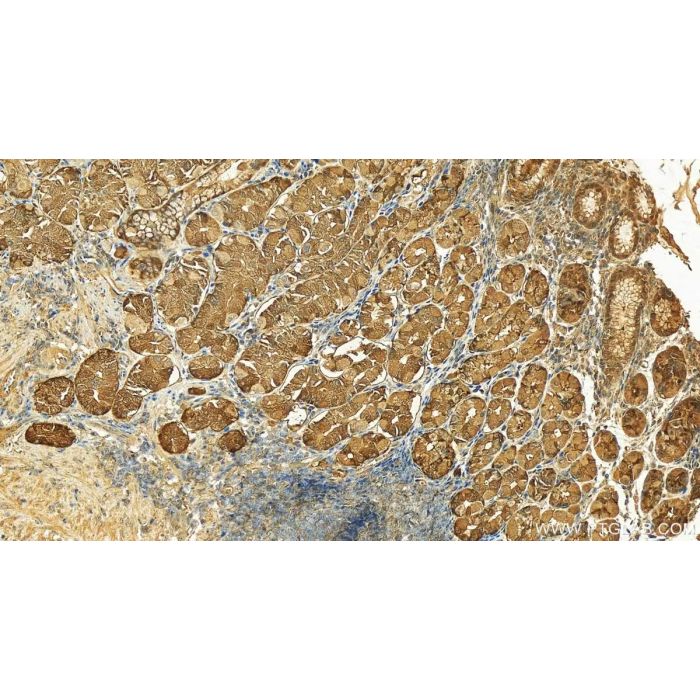
Tested Applications — Positive IHC detected inhuman testis tissue, human kidney tissue, human stomach tissue, mouse kidney tissue, mouse testis tissue Note: suggested antigen retrieval with TE buffer pH 9.0; (*) Alternatively, antigen retrieval may be performed with citrate buffer pH 6.0
Recommended Dilutions — Western Blot (WB)WB : 1:500-1:1000
Recommended Dilutions — Immunoprecipitation (IP)IP : 0.5-4.0 ug for 1.0-3.0 mg of total protein lysate
Recommended Dilutions — Immunohistochemistry (IHC)IHC : 1:50-1:500
Positive WB detected inmouse retina tissue, mouse testis tissue, human testis tissue, rat testis tissue, mouse eye tissue
Positive IP detected inmouse testis tissue
Positive IHC detected inhuman testis tissue, human kidney tissue, human stomach tissue, mouse kidney tissue, mouse testis tissue Note: suggested antigen retrieval with TE buffer pH 9.0; (*) Alternatively, antigen retrieval may be performed with citrate buffer pH 6.0
Western Blot (WB)WB : 1:500-1:1000
Immunoprecipitation (IP)IP : 0.5-4.0 ug for 1.0-3.0 mg of total protein lysate
Immunohistochemistry (IHC)IHC : 1:50-1:500
Tested Reactivityhuman, mouse, rat
Cited Reactivityhuman, mouse, rat
ClassPolyclonal
TypeAntibody
ImmunogenCatNo: Ag6153 Product name: Recombinant human BBS5 protein Source: e coli. -derived, PGEX-4T Tag: GST Domain: 1-341 aa of BC044593 Sequence: MSVLDALWEDRDVRFDLSAQQMKTRPGEVLIDCLDSIEDTKGNNGDRGRLLVTNLRILWHSLALSRVNVSVGYNCILNITTRTANSKLRGQTEALYILTKCNSTRFEFIFTNLVPGSPRLFTSVMAVHRAYETSKMYRDFKLRSALIQNKQLRLLPQEHVYDKINGVWNLSSDQGNLGTFFITNVRIVWHANMNDSFNVSIPYLQIRSIKIRDSKFGLALVIESSQQSGGYVLGFKIDPVEKLQESVKEINSLHKVYSASPIFGVDYEMEEKPQPLEALTVEQIQDDVEIDSDGHTDAFVAYFADGNKQQDREPVFSEELGLAIEKLKDGFTLQGLWEVMS Predict reactive species
Full NameBardet-Biedl syndrome 5
Calculated Molecular Weight39 kDa
Observed Molecular Weight39 kDa
GenBank Accession NumberBC044593
Gene SymbolBBS5
Gene ID (NCBI)129880
RRIDAB_10597551
ConjugateUnconjugated
Purification MethodAntigen affinity purification
UNIPROT IDQ8N3I7
Storage BufferPBS with 0.02% sodium azide and 50% glycerol, pH 7.3.
Storage ConditionsStore at -20°C. Stable for one year after shipment. Aliquoting is unnecessary for -20 o C storage. 20ul sizes contain 0.1% BSA.
IHC protocol for BBS5 antibody 14569-1-APDownload protocol
IP protocol for BBS5 antibody 14569-1-APDownload protocol
WB protocol for BBS5 antibody 14569-1-APDownload protocol
humanWB Nat Cell Biol Systematic proteomics of the VCP-UBXD adaptor network identifies a role for UBXN10 in regulating ciliogenesis. Authors - Malavika Raman View Article
mouseWB,IF Dev Cell IFT27 Links the BBSome to IFT for Maintenance of the Ciliary Signaling Compartment. Authors - Thibaut Eguether View Article
ratIF Nat Struct Mol Biol Structural basis for membrane targeting of the BBSome by ARL6. Authors - André Mourão View Article
Citations27
DilutionsWB : 1:500-1:1000 IP : 0.5-4.0 ug for IP and 0.5-4.0 ug for 1.0-3.0 mg of total protein lysate for WB IHC : 1:50-1:500
IsotypeIgG
ClonalityPolyclonal
Clone Number-
ConjugationUnconjugated

BBS5 encodes a protein that has been directly linked to Bardet-Biedl syndrome. Bardet-Biedl syndrome (BBS) is an autosomal recessive condition characterised by rod-cone dystrophy, postaxial polydactyly, central obesity, mental retardation, hypogonadism, and renal dysfunction. Other associated clinical findings in BBS patients include diabetes, hypertension and congenital heart defects. BBS expression varies both within and between families and diagnosis is often difficult. Experimentation in non-human eukaryotes suggests that BBS5 is expressed in ciliated cells and that it is required for the formation of cilia. Alternate transcriptional splice variants have been observed but have not been fully characterized. Protocols Product Specific Protocols IHC protocol for BBS5 antibody 14569-1-AP Download protocol IP protocol for BBS5 antibody 14569-1-AP Download protocol WB protocol for BBS5 antibody 14569-1-AP Download protocol Standard Protocols Click here to view our Standard Protocols

Publications
  1. A transition zone complex regulates mammalian ciliogenesis and ciliary membrane composition.
    Journal: Nat Genet | Authors: Garcia-Gonzalo Francesc R FR | Species: human | Application: IF
  2. The conserved Bardet-Biedl syndrome proteins assemble a coat that traffics membrane proteins to cilia.
    Journal: Cell | Authors: Jin Hua H | Species: human | Application: IF
  3. Systematic proteomics of the VCP-UBXD adaptor network identifies a role for UBXN10 in regulating ciliogenesis.
    Journal: Nat Cell Biol | Authors: Malavika Raman | Species: human | Application: WB
  4. The Intraflagellar Transport Protein IFT27 Promotes BBSome Exit from Cilia through the GTPase ARL6/BBS3.
    Journal: Dev Cell | Authors: Gerald M Liew | Species: mouse | Application: IF
  5. IFT27 Links the BBSome to IFT for Maintenance of the Ciliary Signaling Compartment.
    Journal: Dev Cell | Authors: Thibaut Eguether | Species: mouse | Application: WB,IF
  6. Structural basis for membrane targeting of the BBSome by ARL6.
    Journal: Nat Struct Mol Biol | Authors: André Mourão | Species: rat | Application: IF
  7. The ancestral ESCRT protein TOM1L2 selects ubiquitinated cargoes for retrieval from cilia
    Journal: Dev Cell | Authors: Swapnil Rohidas Shinde | Species: human | Application: WB
  8. Rabl2 GTP hydrolysis licenses BBSome-mediated export to fine-tune ciliary signaling.
    Journal: EMBO J | Authors: Shichao Duan | Species: mouse | Application: WB,IF
  9. A program of successive gene expression in mouse one-cell embryos
    Journal: Cell Rep | Authors: Maki Asami | Species: mouse | Application: WB
  10. Role for the IFT-A Complex in Selective Transport to the Primary Cilium.
    Journal: Cell Rep | Authors: Wenxiang Fu | Species: human | Application: IF
  11. FBF1 deficiency promotes beiging and healthy expansion of white adipose tissue.
    Journal: Cell Rep | Authors: Yingyi Zhang | Species: mouse | Application: IF
  12. Loss of Bardet-Biedl syndrome proteins causes synaptic aberrations in principal neurons.
    Journal: PLoS Biol | Authors: Naila Haq | Species: mouse | Application: WB,IF
  13. Primary Cilium Formation and Ciliary Protein Trafficking Is Regulated by the Atypical MAP Kinase MAPK15 in Caenorhabditis elegans and Human Cells.
    Journal: Genetics | Authors: Anna Kazatskaya | Species: human | Application: IF
  14. Light-dependent phosphorylation of Bardet-Biedl syndrome 5 in photoreceptor cells modulates its interaction with arrestin1.
    Journal: Cell Mol Life Sci | Authors: Smith Tyler S TS | Species: mouse | Application: WB,IHC
  15. The BBSome Regulates Mitochondria Dynamics and Function
    Journal: Mol Metab | Authors: Deng-Fu Guo | Species: mouse | Application: CoIP
  16. BBSome trains remove activated GPCRs from cilia by enabling passage through the transition zone.
    Journal: J Cell Biol | Authors: Fan Ye | Species: mouse | Application: WB
  17. The Immune Checkpoint Protein PD-L1 Regulates Ciliogenesis and Hedgehog Signaling
    Journal: Cells | Authors: Ewud Agborbesong | Species: human,mouse | Application: WB,IP,IF
  18. Essential Role of the Chaperonin CCT in Rod Outer Segment Biogenesis.
    Journal: Invest Ophthalmol Vis Sci | Authors: Satyabrata Sinha | Species: mouse | Application: WB
  19. Inhibition of Hedgehog signaling suppresses proliferation and microcyst formation of human Autosomal Dominant Polycystic Kidney Disease cells.
    Journal: Sci Rep | Authors: Luciane M Silva | Species: human | Application: IF
  20. Genetic interaction of mammalian IFT-A paralogs regulates cilia disassembly, ciliary entry of membrane protein, Hedgehog signaling, and embryogenesis.
    Journal: FASEB J | Authors: Wei Wang | Species: mouse | Application: IF
  21. DAZ interacting protein 1 (Dzip1) phosphorylation by Polo-like kinase 1 (Plk1) regulates the centriolar satellites localization of the BBSome during the cell cycle.
    Journal: J Biol Chem | Authors: Boyan Zhang | Species: human | Application: WB,IF
  22. The BBSome assembly is spatially controlled by BBS1 and BBS4 in human cells.
    Journal: J Biol Chem | Authors: Avishek Prasai | Species: human | Application: IF, WB
  23. Chibby functions to preserve normal ciliary morphology through the regulation of intraflagellar transport in airway ciliated cells.
    Journal: Cell Cycle | Authors: Saul S Siller | Species: mouse | Application: IF
  24. The Centriolar Satellite Protein AZI1 Interacts with BBS4 and Regulates Ciliary Trafficking of the BBSome.
    Journal: PLoS Genet | Authors: Xitiz Chamling | Species: human | Application: WB
  25. Nephrocystin Proteins NPHP5 and Cep290 Regulate BBSome Integrity, Ciliary Trafficking and Cargo Delivery.
    Journal: Hum Mol Genet | Authors: Marine Barbelanne | Species: human | Application: WB, IF
  26. A mouse model of BBS identifies developmental and homeostatic effects of BBS5 mutation and identifies novel pituitary abnormalities.
    Journal: Hum Mol Genet | Authors: Melissa R Bentley-Ford | Species: mouse | Application: IF
  27. Visualizing renal primary cilia.
    Journal: Nephrology (Carlton) | Authors: James A Deane | Species: human | Application: IF
  28. Bardet-Biedl syndrome 1 mutations differentially impact BBSome integrity and ciliary trafficking.
    Journal: Cell Commun Signal | Authors: Kristyna Maskova
  29. BBS5 as a robust prognostic biomarker in esophageal squamous cell carcinoma: validation in two independent cohorts.
    Journal: Clin Transl Oncol | Authors: Kotaro Aoki

Reviews

Write Your Own Review
You're reviewing:BBS5 Polyclonal antibody 14569-1-AP proteintech
Your Rating
Copyright © 2025 Biogege, Inc. All rights reserved.