TAK1 Monoclonal antibody 67707-1-Ig proteintech
$149.00
In stock
SKU
67707-1-Ig
| Catalog Number | 67707-1-Ig |
| Synonyms | MAP3K7, 1A5B2, EC:2.7.11.25, MAP3K 7, mitogen activated protein kinase kinase kinase 7 |
| Host | Mouse |
| Reactivity | human, mouse, rat |
| Form | Liquid |
| Formulation | PBS, Azide, Glycerol |
| Applications | WB, IHC, IF/ICC, FC (Intra), IP, ELISA |
| Applications | WB, IHC, IF/ICC, FC (Intra), ELISA |
| Host / Isotype | Mouse / IgG1 |
| Tested Applications — Positive WB detected in | A431 cells, NIH/3T3 cells, HepG2 cells, A549 cells, HEK-293 cells, Jurkat cells, K-562 cells, HSC-T6 cells, RAW 264.7 cells |
| Tested Applications — Positive IHC detected in | human prostate cancer tissue, mouse brain tissue Note: suggested antigen retrieval with TE buffer pH 9.0; (*) Alternatively, antigen retrieval may be performed with citrate buffer pH 6.0 |
| Tested Applications — Positive IF/ICC detected in | HepG2 cells |
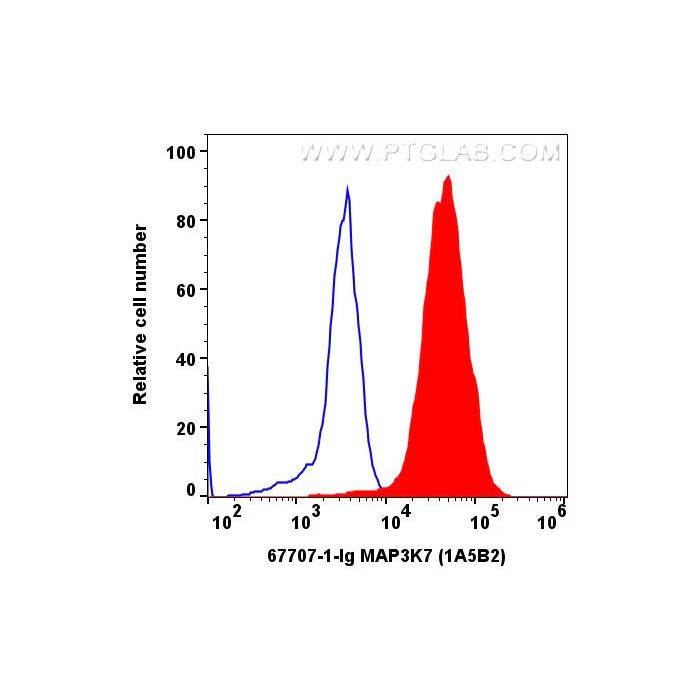
| Tested Applications — Positive FC (Intra) detected in | K-562 cells |
| Recommended Dilutions — Western Blot (WB) | WB : 1:500-1:3000 |
| Recommended Dilutions — Immunohistochemistry (IHC) | IHC : 1:250-1:1000 |
| Recommended Dilutions — Immunofluorescence (IF)/ICC | IF/ICC : 1:50-1:500 |
| Recommended Dilutions — Flow Cytometry (FC) (INTRA) | FC (INTRA) : 0.20 ug per 10^6 cells in a 100 µl suspension |
| Positive WB detected in | A431 cells, NIH/3T3 cells, HepG2 cells, A549 cells, HEK-293 cells, Jurkat cells, K-562 cells, HSC-T6 cells, RAW 264.7 cells |
| Positive IHC detected in | human prostate cancer tissue, mouse brain tissue Note: suggested antigen retrieval with TE buffer pH 9.0; (*) Alternatively, antigen retrieval may be performed with citrate buffer pH 6.0 |
| Positive IF/ICC detected in | HepG2 cells |
| Positive FC (Intra) detected in | K-562 cells |
| Western Blot (WB) | WB : 1:500-1:3000 |
| Immunohistochemistry (IHC) | IHC : 1:250-1:1000 |
| Immunofluorescence (IF)/ICC | IF/ICC : 1:50-1:500 |
| Flow Cytometry (FC) (INTRA) | FC (INTRA) : 0.20 ug per 10^6 cells in a 100 µl suspension |
| Tested Reactivity | human, mouse, rat |
| Cited Reactivity | human, mouse, rat |
| Class | Monoclonal |
| Type | Antibody |
| Immunogen | CatNo: Ag21286 Product name: Recombinant human MAP3K7 protein Source: e coli. -derived, PET28a Tag: 6*His Domain: 1-291 aa of BC017715 Sequence: MSTASAASSSSSSSAGEMIEAPSQVLNFEEIDYKEIEVEEVVGRGAFGVVCKAKWRAKDVAIKQIESESERKAFIVELRQLSRVNHPNIVKLYGACLNPVCLVMEYAEGGSLYNVLHGAEPLPYYTAAHAMSWCLQCSQGVAYLHSMQPKALIHRDLKPPNLLLVAGGTVLKICDFGTACDIQTHMTNNKGSAAWMAPEVFEGSNYSEKCDVFSWGIILWEVITRRKPFDEIGGPAFRIMWAVHNGTRPPLIKNLPKPIESLMTRCWSKDPSQRPSMEEIVKIMTHLMRYF Predict reactive species |
| Full Name | mitogen-activated protein kinase kinase kinase 7 |
| Calculated Molecular Weight | 579 aa, 64 kDa |
| Observed Molecular Weight | 67-70 kDa |
| GenBank Accession Number | BC017715 |
| Gene Symbol | TAK1 |
| Gene ID (NCBI) | 6885 |
| RRID | AB_2882898 |
| Conjugate | Unconjugated |
| Purification Method | Protein G purification |
| UNIPROT ID | O43318 |
| Storage Buffer | PBS with 0.02% sodium azide and 50% glycerol, pH 7.3. |
| Storage Conditions | Store at -20°C. Stable for one year after shipment. Aliquoting is unnecessary for -20 o C storage. 20ul sizes contain 0.1% BSA. |
| IF protocol for TAK1 antibody 67707-1-Ig | Download protocol |
| IHC protocol for TAK1 antibody 67707-1-Ig | Download protocol |
| WB protocol for TAK1 antibody 67707-1-Ig | Download protocol |
| human | WB Biochim Biophys Acta Mol Cell Res IL-17 promotes melanoma through TRAF2 as a scaffold protein recruiting PIAS2 and ELAVL1 to induce EPHA5 Authors - Junfeng Du View Article |
| mouse | IF Exp Cell Res Deubiquitinase USP18 inhibits hepatic stellate cells activation and alleviates liver fibrosis via regulation of TAK1 activity Authors - Yan Zhang View Article |
| rat | IF Neurochem Res Exogenous TIPE2 Inhibit TAK1 to Improve Inflammation and Neuropathic Pain Induced by Sciatic Nerve Injury Through Inactivating NF-κB and JNK. Authors - Xuehua Sun View Article |
| Citations | 17 |
| Dilutions | WB : 1:500-1:3000 IHC : 1:250-1:1000 IF/ICC : 1:50-1:500 FC (INTRA) : 0.20 ug per 10^6 cells in a 100 µl suspension |
| Isotype | IgG1 |
| Clonality | Monoclonal |
| Clone Number | 1A5B2 |
| Conjugation | Unconjugated |
MAP3K7(Mitogen-activated protein kinase kinase kinase 7) is also named as TAK1 and belongs to the MAP kinase kinase kinase subfamily. It plays an important role in the cascades of cellular responses evoked by changes in the environment. It has been linked to interleukin-1 receptor and tumor necrosis factor receptor signaling (PMID: 16186825). It has 4 isoforms (53-55 kDa, 64-70 kDa and 75-80 kDa) produced by alternative splicing. Protocols Product Specific Protocols IF protocol for TAK1 antibody 67707-1-Ig Download protocol IHC protocol for TAK1 antibody 67707-1-Ig Download protocol WB protocol for TAK1 antibody 67707-1-Ig Download protocol Standard Protocols Click here to view our Standard Protocols
Publications