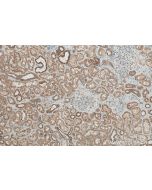
TMEM173/STING Recombinant monoclonal antibody 80165-1-RR proteintech
$149.00
In stock
SKU
80165-1-RR
| Catalog Number | 80165-1-RR |
| Synonyms | STING, Endoplasmic reticulum interferon stimulator, ERIS, MITA, MPYS |
| Host | Rabbit |
| Reactivity | human, mouse, rat |
| Form | Liquid |
| Formulation | PBS, Azide, Glycerol |
| Applications | WB, IHC, IF/ICC, IF-P, IF-Fro, IP, CoIP, ELISA |
| Applications | WB, IHC, IF/ICC, IF-P, IF-Fro, IP, ELISA |
| Host / Isotype | Rabbit / IgG |
| Tested Applications — Positive WB detected in | HeLa cells, C2C12 cells, MOLT-4 cells, Jurkat cells, K-562 cells, THP-1 cells, HSC-T6 cells, NIH/3T3 cells, rat thymus tissue |
| Tested Applications — Positive IP detected in | HeLa cells |
| Tested Applications — Positive IHC detected in | human tonsillitis tissue, human colon tissue, human liver tissue Note: suggested antigen retrieval with TE buffer pH 9.0; (*) Alternatively, antigen retrieval may be performed with citrate buffer pH 6.0 |
| Tested Applications — Positive IF-P detected in | human tonsillitis tissue |
| Tested Applications — Positive IF-Fro detected in | mouse cerebellum tissue |
| Tested Applications — Positive IF/ICC detected in | THP-1 cells, human tonsillitis tissue |
| Recommended Dilutions — Western Blot (WB) | WB : 1:2000-1:10000 |
| Recommended Dilutions — Immunoprecipitation (IP) | IP : 0.5-4.0 ug for 1.0-3.0 mg of total protein lysate |
| Recommended Dilutions — Immunohistochemistry (IHC) | IHC : 1:1000-1:4000 |
| Recommended Dilutions — Immunofluorescence (IF)-P | IF-P : 1:200-1:800 |
| Recommended Dilutions — Immunofluorescence (IF)-FRO | IF-FRO : 1:200-1:800 |
| Recommended Dilutions — Immunofluorescence (IF)/ICC | IF/ICC : 1:50-1:500 |
| Positive WB detected in | HeLa cells, C2C12 cells, MOLT-4 cells, Jurkat cells, K-562 cells, THP-1 cells, HSC-T6 cells, NIH/3T3 cells, rat thymus tissue |
| Positive IP detected in | HeLa cells |
| Positive IHC detected in | human tonsillitis tissue, human colon tissue, human liver tissue Note: suggested antigen retrieval with TE buffer pH 9.0; (*) Alternatively, antigen retrieval may be performed with citrate buffer pH 6.0 |
| Positive IF-P detected in | human tonsillitis tissue |
| Positive IF-Fro detected in | mouse cerebellum tissue |
| Positive IF/ICC detected in | THP-1 cells, human tonsillitis tissue |
| Western Blot (WB) | WB : 1:2000-1:10000 |
| Immunoprecipitation (IP) | IP : 0.5-4.0 ug for 1.0-3.0 mg of total protein lysate |
| Immunohistochemistry (IHC) | IHC : 1:1000-1:4000 |
| Immunofluorescence (IF)-P | IF-P : 1:200-1:800 |
| Immunofluorescence (IF)-FRO | IF-FRO : 1:200-1:800 |
| Immunofluorescence (IF)/ICC | IF/ICC : 1:50-1:500 |
| Tested Reactivity | human, mouse, rat |
| Cited Reactivity | human, mouse |
| Class | Recombinant |
| Type | Antibody |
| Immunogen | CatNo: Ag13921 Product name: Recombinant human TMEM173 protein Source: e coli. -derived, PGEX-4T Tag: GST Domain: 174-379 aa of BC047779 Sequence: ELQARIRTYNQHYNNLLRGAVSQRLYILLPLDCGVPDNLSMADPNIRFLDKLPQQTGDHAGIKDRVYSNSIYELLENGQRAGTCVLEYATPLQTLFAMSQYSQAGFSREDRLEQAKLFCRTLEDILADAPESQNNCRLIAYQEPADDSSFSLSQEVLRHLRQEEKEEVTVGSLKTSAVPSTSTMSQEPELLISGMEKPLPLRTDFS Predict reactive species |
| Full Name | transmembrane protein 173 |
| Calculated Molecular Weight | 379 aa, 42 kDa |
| Observed Molecular Weight | 37 kDa |
| GenBank Accession Number | BC047779 |
| Gene Symbol | STING |
| Gene ID (NCBI) | 340061 |
| RRID | AB_2918870 |
| Conjugate | Unconjugated |
| Purification Method | Protein A purification |
| UNIPROT ID | Q86WV6 |
| Storage Buffer | PBS with 0.02% sodium azide and 50% glycerol, pH 7.3. |
| Storage Conditions | Store at -20°C. Stable for one year after shipment. Aliquoting is unnecessary for -20 o C storage. 20ul sizes contain 0.1% BSA. |
| IF protocol for TMEM173/STING antibody 80165-1-RR | Download protocol |
| IHC protocol for TMEM173/STING antibody 80165-1-RR | Download protocol |
| IP protocol for TMEM173/STING antibody 80165-1-RR | Download protocol |
| WB protocol for TMEM173/STING antibody 80165-1-RR | Download protocol |
| human | WB Int J Mol Sci Network Pharmacology, Molecular Dynamics Simulation, and Biological Validation Insights into the Potential of Ligustri Lucidi Fructus for Diabetic Nephropathy Authors - Manting Liu View Article |
| mouse | WB Cell Mol Biol Lett The role of the cGAS/STING pathway in skeletal muscle regeneration: modulation of inflammation, macrophage polarization, and oxidative stress. Authors - Xiaoguang Liu View Article |
| mouse,human | WB,IHC,IF J Ethnopharmacol Lycopodium japonicum Thunb. inhibits chondrocyte apoptosis, senescence and inflammation in osteoarthritis through STING/NF-κB signaling pathway Authors - Jiawei Ma View Article |
| Fabrizio (Verified Customer) (04-23-2026) | It worked well and fast, just 1 h on RT and the signal is perfect. Still worked ON at 4°C. Sometimes it is possibile to see two bands very close to each other (STAT1/PSTAT1) Applications: Western Blot Primary Antibody Dilution: 1:1000 Cell Tissue Type: Human Fibroblast |
| Citations | 10 |
| Dilutions | WB : 1:2000-1:10000 IP : 0.5-4.0 ug for IP and 0.5-4.0 ug for 1.0-3.0 mg of total protein lysate for WB IHC : 1:1000-1:4000 IF-P : 1:200-1:800 IF-FRO : 1:200-1:800 IF/ICC : 1:50-1:500 |
| Isotype | IgG |
| Clonality | Recombinant |
| Clone Number | 7K7 |
| Conjugation | Unconjugated |
Stimulator of interferon genes (STING, also known as ERIS, MITA and MPYS, and encoded by TMEM173) is a transmembrane adaptor protein that facilitates innate immune signaling (PMID: 18724357). STING is widely expressed in various cell types such as endothelial cells, epithelial cells, T cells, macrophages, and dendritic cells (PMID: 26603901). It is predominantly located in the endoplasmic reticulum (ER). STING functions as a sensor of cytosolic DNA and promotes the production of type I interferons and pro-inflammatory cytokines. Protocols Product Specific Protocols IF protocol for TMEM173/STING antibody 80165-1-RR Download protocol IHC protocol for TMEM173/STING antibody 80165-1-RR Download protocol IP protocol for TMEM173/STING antibody 80165-1-RR Download protocol WB protocol for TMEM173/STING antibody 80165-1-RR Download protocol Standard Protocols Click here to view our Standard Protocols
Publications