JNK Polyclonal antibody 28007-1-AP proteintech
$149.00
In stock
SKU
28007-1-AP
| Catalog Number | 28007-1-AP |
| Synonyms | c Jun N terminal kinase 3, FLJ12099, FLJ33785, JNK, JNK1, JNK1/2/3, JNK2, JNK3, JNK3A, MAP kinase 10, MAP kinase p49 3F12, MAPK 10, MAPK10, MAPK8, MAPK8/9/10, MAPK9, p493F12, p54bSAPK, PRKM10 |
| Host | Rabbit |
| Reactivity | Human, Mouse, canine and More (3) |
| Reactivity | human, mouse, canine, rat |
| Form | Liquid |
| Formulation | PBS, Azide, Glycerol |
| Applications | WB, IHC, IF, ELISA |
| Applications | WB, IHC, ELISA |
| Host / Isotype | Rabbit / IgG |
| Tested Applications — Positive WB detected in | Neuro-2a cells, MDCK cells, mouse brain tissue, mouse cerebellum tissue |
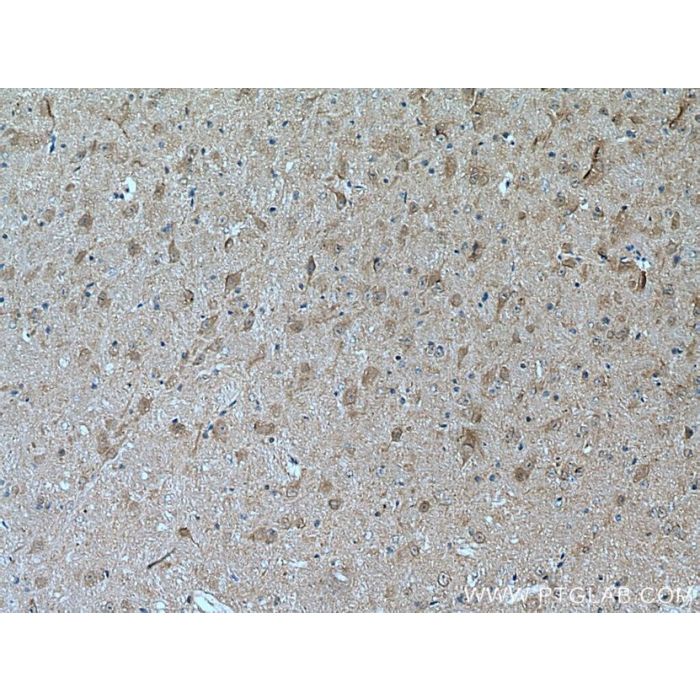
| Tested Applications — Positive IHC detected in | mouse brain tissue, mouse cerebellum tissue Note: suggested antigen retrieval with TE buffer pH 9.0; (*) Alternatively, antigen retrieval may be performed with citrate buffer pH 6.0 |
| Recommended Dilutions — Western Blot (WB) | WB : 1:1000-1:4000 |
| Recommended Dilutions — Immunohistochemistry (IHC) | IHC : 1:50-1:500 |
| Positive WB detected in | Neuro-2a cells, MDCK cells, mouse brain tissue, mouse cerebellum tissue |
| Positive IHC detected in | mouse brain tissue, mouse cerebellum tissue Note: suggested antigen retrieval with TE buffer pH 9.0; (*) Alternatively, antigen retrieval may be performed with citrate buffer pH 6.0 |
| Western Blot (WB) | WB : 1:1000-1:4000 |
| Immunohistochemistry (IHC) | IHC : 1:50-1:500 |
| Tested Reactivity | Human, Mouse, canine |
| Cited Reactivity | human, mouse, rat |
| Class | Polyclonal |
| Type | Antibody |
| Immunogen | CatNo: Ag27823 Product name: Recombinant human MAPK10 protein Source: e coli. -derived, PGEX-4T Tag: GST Domain: 271-408 aa of BC065516 Sequence: QWNKVIEQLGTPCPEFMKKLQPTVRNYVENRPKYAGLTFPKLFPDSLFPADSEHNKLKASQARDLLSKMLVIDPAKRISVDDALQHPYINVWYDPAEVEAPPPQIYDKQLDEREHTIEEWKELIYKEVMNSEEKTKNG Predict reactive species |
| Full Name | mitogen-activated protein kinase 10 |
| Calculated Molecular Weight | 464 aa, 53 kDa |
| Observed Molecular Weight | 45-48 kDa, 54-57 kDa |
| GenBank Accession Number | BC065516 |
| Gene Symbol | JNK3 |
| Gene ID (NCBI) | 5602 |
| RRID | AB_2881035 |
| Conjugate | Unconjugated |
| Purification Method | Antigen affinity purification |
| UNIPROT ID | P53779 |
| Storage Buffer | PBS with 0.02% sodium azide and 50% glycerol, pH 7.3. |
| Storage Conditions | Store at -20°C. Stable for one year after shipment. Aliquoting is unnecessary for -20 o C storage. 20ul sizes contain 0.1% BSA. |
| IHC protocol for JNK antibody 28007-1-AP | Download protocol |
| WB protocol for JNK antibody 28007-1-AP | Download protocol |
| rat | WB,IHC Clin Sci (Lond) Transcriptome-based exploration of potential molecular targets and mechanisms of selenomethionine in alleviating renal ischemia-reperfusion injury. Authors - Jun Pei View Article |
| mouse | WB Int J Biol Macromol VSIG4 inhibits RANKL-induced osteoclastogenesis by enhancing Nrf2-dependent antioxidant response against reactive oxygen species production Authors - Jiansen Miao View Article |
| human | WB Nat Commun SARS-CoV-2 N protein-induced Dicer, XPO5, SRSF3, and hnRNPA3 downregulation causes pneumonia Authors - Yu-Wei Luo View Article |
| Citations | 8 |
| Dilutions | WB : 1:1000-1:4000 IHC : 1:50-1:500 |
| Isotype | IgG |
| Clonality | Polyclonal |
| Clone Number | - |
| Conjugation | Unconjugated |
JNK, also named MAPK10 (mitogen-activated protein kinase 10), belongs to MAP kinase family. MAP kinases act as integration points for multiple biochemical signals, and thus are involved in a wide variety of cellular processes, such as proliferation, differentiation, transcription regulation and development. This kinase is mainly expressed in a subset of neurons in the nervous system, and is activated by threonine and tyrosine phosphorylation. JNK has 3 isoforms of 48-53 kDa. Protocols Product Specific Protocols IHC protocol for JNK antibody 28007-1-AP Download protocol WB protocol for JNK antibody 28007-1-AP Download protocol Standard Protocols Click here to view our Standard Protocols
Publications