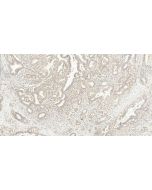
OLIG2 Recombinant monoclonal antibody 82806-7-RR proteintech
$149.00
In stock
SKU
82806-7-RR
| Catalog Number | 82806-7-RR |
| Synonyms | 240839C1, 5O7, bHLHb1, bHLHe19, Class B basic helix-loop-helix protein 1 |
| Host | Rabbit |
| Reactivity | human, mouse, rat |
| Form | Liquid |
| Formulation | PBS, Azide, Glycerol |
| Applications | WB, IHC, IF-P, ELISA |
| Host / Isotype | Rabbit / IgG |
| Tested Applications — Positive WB detected in | THP-1 cells, mouse brain tissue, rat brain tissue |
| Tested Applications — Positive IHC detected in | mouse brain tissue Note: suggested antigen retrieval with TE buffer pH 9.0; (*) Alternatively, antigen retrieval may be performed with citrate buffer pH 6.0 |
| Tested Applications — Positive IF-P detected in | mouse brain tissue |
| Recommended Dilutions — Western Blot (WB) | WB : 1:2000-1:10000 |
| Recommended Dilutions — Immunohistochemistry (IHC) | IHC : 1:200-1:800 |
| Recommended Dilutions — Immunofluorescence (IF)-P | IF-P : 1:50-1:500 |
| Positive WB detected in | THP-1 cells, mouse brain tissue, rat brain tissue |
| Positive IHC detected in | mouse brain tissue Note: suggested antigen retrieval with TE buffer pH 9.0; (*) Alternatively, antigen retrieval may be performed with citrate buffer pH 6.0 |
| Positive IF-P detected in | mouse brain tissue |
| Western Blot (WB) | WB : 1:2000-1:10000 |
| Immunohistochemistry (IHC) | IHC : 1:200-1:800 |
| Immunofluorescence (IF)-P | IF-P : 1:50-1:500 |
| Tested Reactivity | human, mouse, rat |
| Cited Reactivity | human |
| Class | Recombinant |
| Type | Antibody |
| Immunogen | CatNo: Ag5089 Product name: Recombinant human OLIG2 protein Source: e coli. -derived, PGEX-4T Tag: GST Domain: 1-323 aa of BC047511 Sequence: MDSDASLVSSRPSSPEPDDLFLPARSKGSSGSAFTGGTVSSSTPSDCPPELSAELRGAMGSAGAHPGDKLGGSGFKSSSSSTSSSTSSAAASSTKKDKKQMTEPELQQLRLKINSRERKRMHDLNIAMDGLREVMPYAHGPSVRKLSKITTLLLARNYILMLTNSLEEMKRLVSEIYGGHHAGFHPSACGGLAHSAPLPAATAHPAAAAHAAHHPAVHHPILPPAAAAAAAAAAAAAVSSASLPGSGLPSVGSIRPPHGLLKSPSAAAAAPLGGGGGGSGASGGFQHWGGMPCPCSMCQVPPPHHHVSAMGAGSLPRLTSDAK Predict reactive species |
| Full Name | oligodendrocyte lineage transcription factor 2 |
| Calculated Molecular Weight | 32 kDa |
| Observed Molecular Weight | 35 kDa |
| GenBank Accession Number | BC047511 |
| Gene Symbol | OLIG2 |
| Gene ID (NCBI) | 10215 |
| RRID | AB_3670559 |
| Conjugate | Unconjugated |
| Purification Method | Protein A purfication |
| UNIPROT ID | Q13516 |
| Storage Buffer | PBS with 0.02% sodium azide and 50% glycerol, pH 7.3. |
| Storage Conditions | Store at -20°C. Stable for one year after shipment. Aliquoting is unnecessary for -20 o C storage. 20ul sizes contain 0.1% BSA. |
| IF protocol for OLIG2 antibody 82806-7-RR | Download protocol |
| IHC protocol for OLIG2 antibody 82806-7-RR | Download protocol |
| WB protocol for OLIG2 antibody 82806-7-RR | Download protocol |
| human | WB Cell Rep SCD1 and SCD5 modulate PARP-dependent DNA repair via fatty acid desaturation in glioblastoma. Authors - Hayk Mnatsakanyan View Article |
| Citations | 1 |
| Dilutions | WB : 1:2000-1:10000 IHC : 1:200-1:800 IF-P : 1:50-1:500 |
| Isotype | IgG |
| Clonality | Recombinant |
| Clone Number | 240839C1 |
| Conjugation | Unconjugated |
OLIG2, also named as BHLHB1, BHLHE19, PRKCBP2 and RACK17, is required for oligodendrocyte and motor neuron specification in the spinal cord, as well as for the development of somatic motor neurons in the hindbrain. Cooperates with OLIG1, OLIG2 establish the pMN domain of the embryonic neural tube. Antagonist of V2 interneuron and of NKX2-2-induced V3 interneuron development. OLIG2 is widely expressed in subsets of glia cells and progenitors, and it is strongly induced at different sites by both acute and chronic injury, albeit with different mechanisms. OLIG2 acts as a repressor of neurogenesis in cells reacting to brain injury. It may represent an effective approach towards evoking neuronal repair from parenchymal precursors.(PMID:19390819 ) Protocols Product Specific Protocols IF protocol for OLIG2 antibody 82806-7-RR Download protocol IHC protocol for OLIG2 antibody 82806-7-RR Download protocol WB protocol for OLIG2 antibody 82806-7-RR Download protocol Standard Protocols Click here to view our Standard Protocols
Publications