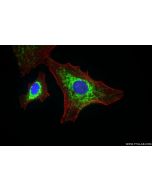
PKLR Polyclonal antibody 17580-1-AP proteintech
$149.00
In stock
SKU
17580-1-AP
| Catalog Number | 17580-1-AP |
| Synonyms | EC:2.7.1.40, PK1, PKL, Pyruvate kinase isozymes L/R, Pyruvate kinase PKLR |
| Host | Rabbit |
| Reactivity | human, mouse, rat |
| Form | Liquid |
| Formulation | PBS, Azide, Glycerol |
| Applications | WB, IHC, IP, ELISA |
| Host / Isotype | Rabbit / IgG |
| Tested Applications — Positive WB detected in | K-562 cells, mouse kidney tissue, mouse liver tissue |
| Tested Applications — Positive IP detected in | K-562 cells |
| Tested Applications — Positive IHC detected in | human liver tissue Note: suggested antigen retrieval with TE buffer pH 9.0; (*) Alternatively, antigen retrieval may be performed with citrate buffer pH 6.0 |
| Recommended Dilutions — Western Blot (WB) | WB : 1:500-1:2400 |
| Recommended Dilutions — Immunoprecipitation (IP) | IP : 0.5-4.0 ug for 1.0-3.0 mg of total protein lysate |
| Recommended Dilutions — Immunohistochemistry (IHC) | IHC : 1:50-1:500 |
| Positive WB detected in | K-562 cells, mouse kidney tissue, mouse liver tissue |
| Positive IP detected in | K-562 cells |
| Positive IHC detected in | human liver tissue Note: suggested antigen retrieval with TE buffer pH 9.0; (*) Alternatively, antigen retrieval may be performed with citrate buffer pH 6.0 |
| Western Blot (WB) | WB : 1:500-1:2400 |
| Immunoprecipitation (IP) | IP : 0.5-4.0 ug for 1.0-3.0 mg of total protein lysate |
| Immunohistochemistry (IHC) | IHC : 1:50-1:500 |
| Tested Reactivity | human, mouse, rat |
| Cited Reactivity | human |
| Class | Polyclonal |
| Type | Antibody |
| Immunogen | CatNo: Ag11096 Product name: Recombinant human PKLR protein Source: e coli. -derived, PET28a Tag: 6*His Domain: 223-574 aa of BC025737 Sequence: LISLVVQKIGPEGLVTQVENGGVLGSRKGVNLPGAQVDLPGLSEQDVRDLRFGVEHGVDIVFASFVRKASDVAAVRAALGPEGHGIKIISKIENHEGVKRFDEILEVSDGIMVARGDLGIEIPAEKVFLAQKMMIGRCNLAGKPVVCATQMLESMITKPRPTRAETSDVANAVLDGADCIMLSGETAKGNFPVEAVKMQHAIAREAEAAVYHRQLFEELRRAAPLSRDPTEVTAIGAVEAAFKCCAAAIIVLTTTGRSAQLLSRYRPRAAVIAVTRSAQAARQVHLCRGVFPLLYREPPEAIWADDVDRRVQFGIESGKLRGFLRVGDLVIVVTGWRPGSGYTNIMRVLSIS Predict reactive species |
| Full Name | pyruvate kinase, liver and RBC |
| Calculated Molecular Weight | 574 aa, 62 kDa, 585 aa, 63 kDa |
| Observed Molecular Weight | 58-62 kDa |
| GenBank Accession Number | BC025737 |
| Gene Symbol | PKLR |
| Gene ID (NCBI) | 5313 |
| RRID | AB_2268201 |
| Conjugate | Unconjugated |
| Purification Method | Antigen affinity purification |
| UNIPROT ID | P30613 |
| Storage Buffer | PBS with 0.02% sodium azide and 50% glycerol, pH 7.3. |
| Storage Conditions | Store at -20°C. Stable for one year after shipment. Aliquoting is unnecessary for -20 o C storage. 20ul sizes contain 0.1% BSA. |
| IHC protocol for PKLR antibody 17580-1-AP | Download protocol |
| IP protocol for PKLR antibody 17580-1-AP | Download protocol |
| WB protocol for PKLR antibody 17580-1-AP | Download protocol |
| human | WB ACS Pharmacol Transl Sci All Blood Brain Barrier Cell Types Demonstrate Capability to Influence Differential Tenofovir and Emtricitabine Metabolism and Transport in the Brain Authors - Hannah N Wilkins View Article |
| Citations | 2 |
| Dilutions | WB : 1:500-1:2400 IP : 0.5-4.0 ug for IP and 0.5-4.0 ug for 1.0-3.0 mg of total protein lysate for WB IHC : 1:50-1:500 |
| Isotype | IgG |
| Clonality | Polyclonal |
| Clone Number | - |
| Conjugation | Unconjugated |
PKLR(Pyruvate kinase isozymes R/L) is also named as PK1,PKL,which is a glycolytic enzyme that catalyzes the transphosphorylation from phosphoenolpyruvate (PEP) to ADP, yielding pyruvate and ATP. It is the last step of the glycolytic pathway and is essentially irreversible.It belongs to the pyruvate kinase family and There are 4 isozymes of pyruvate kinase in mammals: L, R, M1 and M2. L type is major isozyme in the liver, R is found in red cells, M1 is the main form in muscle, heart and brain, and M2 is found in early fetal tissues.Defects in PKLR are the cause of pyruvate kinase hyperactivity (PKHYP) and pyruvate kinase deficiency of red cells (PKRD).It can form a homotetramer(PMID:11960989). Protocols Product Specific Protocols IHC protocol for PKLR antibody 17580-1-AP Download protocol IP protocol for PKLR antibody 17580-1-AP Download protocol WB protocol for PKLR antibody 17580-1-AP Download protocol Standard Protocols Click here to view our Standard Protocols
Publications