PNPLA3 Monoclonal antibody 67369-1-Ig proteintech
$149.00
In stock
SKU
67369-1-Ig
| Catalog Number | 67369-1-Ig |
| Synonyms | Acylglycerol O acyltransferase, Adiponutrin, ADPN, C22orf20, iPLA(2)epsilon, iPLA2 epsilon, PNPLA3 |
| Host | Mouse |
| Reactivity | Human, Rat, pig and More (1) |
| Reactivity | human, rat, pig |
| Form | Liquid |
| Formulation | PBS, Azide, Glycerol |
| Applications | WB, IHC, IF/ICC, ELISA |
| Host / Isotype | Mouse / IgG1 |
| Tested Applications — Positive WB detected in | HeLa cells, HepG2 cells, L02 cells, SMMC-7721 cells, HuH-7 cells, HSC-T6 cells |
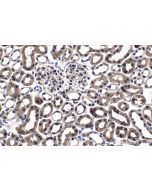
| Tested Applications — Positive IHC detected in | human liver cancer tissue Note: suggested antigen retrieval with TE buffer pH 9.0; (*) Alternatively, antigen retrieval may be performed with citrate buffer pH 6.0 |
| Tested Applications — Positive IF/ICC detected in | HeLa cells |
| Recommended Dilutions — Western Blot (WB) | WB : 1:2000-1:10000 |
| Recommended Dilutions — Immunohistochemistry (IHC) | IHC : 1:250-1:1000 |
| Recommended Dilutions — Immunofluorescence (IF)/ICC | IF/ICC : 1:400-1:1600 |
| Positive WB detected in | HeLa cells, HepG2 cells, L02 cells, SMMC-7721 cells, HuH-7 cells, HSC-T6 cells |
| Positive IHC detected in | human liver cancer tissue Note: suggested antigen retrieval with TE buffer pH 9.0; (*) Alternatively, antigen retrieval may be performed with citrate buffer pH 6.0 |
| Positive IF/ICC detected in | HeLa cells |
| Western Blot (WB) | WB : 1:2000-1:10000 |
| Immunohistochemistry (IHC) | IHC : 1:250-1:1000 |
| Immunofluorescence (IF)/ICC | IF/ICC : 1:400-1:1600 |
| Tested Reactivity | Human, Rat, pig |
| Cited Reactivity | human |
| Class | Monoclonal |
| Type | Antibody |
| Immunogen | CatNo: Ag27407 Product name: Recombinant human PNPLA3 protein Source: e coli. -derived, PET28a Tag: 6*His Domain: 229-339 aa of BC065195 Sequence: PDLKVLGEICLRGYLDAFRFLEEKGICNRPQPGLKSSSEGMDPEVAMPSWANMSLDSSPESAALAVRLEGDELLDHLRLSILPWDESILDTLSPRLATALSEEMKDKGGYM Predict reactive species |
| Full Name | patatin-like phospholipase domain containing 3 |
| Observed Molecular Weight | 53 kDa |
| GenBank Accession Number | BC065195 |
| Gene Symbol | PNPLA3 |
| Gene ID (NCBI) | 80339 |
| RRID | AB_2882619 |
| Conjugate | Unconjugated |
| Purification Method | Protein G purification |
| UNIPROT ID | Q9NST1 |
| Storage Buffer | PBS with 0.02% sodium azide and 50% glycerol, pH 7.3. |
| Storage Conditions | Store at -20°C. Stable for one year after shipment. Aliquoting is unnecessary for -20 o C storage. 20ul sizes contain 0.1% BSA. |
| IF protocol for PNPLA3 antibody 67369-1-Ig | Download protocol |
| IHC protocol for PNPLA3 antibody 67369-1-Ig | Download protocol |
| WB protocol for PNPLA3 antibody 67369-1-Ig | Download protocol |
| human | WB J Hepatol IL-6/STAT3 axis dictates the PNPLA3-mediated susceptibility to non-alcoholic fatty liver disease Authors - Jiwoon Park View Article |
| Citations | 1 |
| Dilutions | WB : 1:2000-1:10000 IHC : 1:250-1:1000 IF/ICC : 1:400-1:1600 |
| Isotype | IgG1 |
| Clonality | Monoclonal |
| Clone Number | 1D2B11 |
| Conjugation | Unconjugated |
PNPLA3 belongs to a family of proteins that share a domain that was first identified in patatin, a major soluble protein of potato tubers with nonspecific acyl hydrolase activity. The domain differs from classical lipases by employing a catalytic dyad (Ser-Asp), rather than a catalytic triad, to effect hydrolysis. PNPLA3 is expressed primarily in liver and adipose tissue, in which it partitions to membranes and lipid droplets. Real-time PCR of cDNA from human tissues indicated that PNPLA3 expression was highest in the liver, followed by skin and adipose tissue. PNPLA3 is expressed at the highest levels in adipose tissue of mice. The PNPLA3 protein was expected at 50-70 kDa, as observed; the additional band at approximately 130-150 kDa is a oligomer bands. (PMID: 20385813, PMID: 24931521, PMID: 23023705) Protocols Product Specific Protocols IF protocol for PNPLA3 antibody 67369-1-Ig Download protocol IHC protocol for PNPLA3 antibody 67369-1-Ig Download protocol WB protocol for PNPLA3 antibody 67369-1-Ig Download protocol Standard Protocols Click here to view our Standard Protocols
Publications