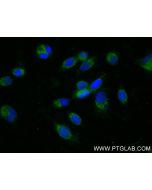
PSD95 Polyclonal antibody 30255-1-AP proteintech

$149.00
In stock
SKU
30255-1-AP
Catalog No.SizePrice (USD)
30255-1-AP-20UL20 μL$149.00
30255-1-AP-150UL150 μL$449.00
Catalog Number30255-1-AP
SynonymsDLG4, PSD-95, psd95/dlg4, DLG 4, PSD 95
HostRabbit
Reactivityhuman, mouse, rat
FormLiquid
FormulationPBS, Azide, Glycerol
ApplicationsWB, IHC, IF-P, ELISA
Host / IsotypeRabbit / IgG
Tested Applications — Positive WB detected inmouse brain tissue, rat brain tissue
Tested Applications — Positive IHC detected inmouse brain tissue Note: suggested antigen retrieval with TE buffer pH 9.0; (*) Alternatively, antigen retrieval may be performed with citrate buffer pH 6.0
Tested Applications — Positive IF-P detected inmouse brain tissue
Recommended Dilutions — Western Blot (WB)WB : 1:5000-1:50000
Recommended Dilutions — Immunohistochemistry (IHC)IHC : 1:50-1:500
Recommended Dilutions — Immunofluorescence (IF)-PIF-P : 1:50-1:500
Positive WB detected inmouse brain tissue, rat brain tissue
Positive IHC detected inmouse brain tissue Note: suggested antigen retrieval with TE buffer pH 9.0; (*) Alternatively, antigen retrieval may be performed with citrate buffer pH 6.0
Positive IF-P detected inmouse brain tissue
Western Blot (WB)WB : 1:5000-1:50000
Immunohistochemistry (IHC)IHC : 1:50-1:500
Immunofluorescence (IF)-PIF-P : 1:50-1:500
Tested Reactivityhuman, mouse, rat
Cited Reactivityhuman, mouse, rat
ClassPolyclonal
TypeAntibody
ImmunogenCatNo: Ag33000 Product name: Recombinant human PSD95 protein Source: e coli. -derived, PGEX-4T Tag: GST Domain: 630-724 aa of NM_001365 Sequence: VSANAVRRLQAAHLHPIAIFIRPRSLENVLEINKRITEEQARKAFDRATKLEQEFTECFSAIVEGDSFEEIYHKVKRVIEDLSGPYIWVPARERL Predict reactive species
Full Namediscs, large homolog 4 (Drosophila)
Calculated Molecular Weight81 kDa
Observed Molecular Weight90-95 kDa
GenBank Accession NumberNM_001365
Gene SymbolPSD95
Gene ID (NCBI)1742
RRIDAB_3086283
ConjugateUnconjugated
Purification MethodAntigen affinity purification
UNIPROT IDP78352
Storage BufferPBS with 0.02% sodium azide and 50% glycerol, pH 7.3.
Storage ConditionsStore at -20°C. Stable for one year after shipment. Aliquoting is unnecessary for -20 o C storage. 20ul sizes contain 0.1% BSA.
IF protocol for PSD95 antibody 30255-1-APDownload protocol
IHC protocol for PSD95 antibody 30255-1-APDownload protocol
WB protocol for PSD95 antibody 30255-1-APDownload protocol
ratWB Gut Microbes Simulated microgravity induces cerebral dysfunction by disturbing protective microbiota-metabolite-microglia signaling across the gut‒brain axis. Authors - Biying Zhang View Article
humanWB J Nanobiotechnology Disruption of cerebral cholesterol homeostasis by PS-NPs: astrocytic endoplasmic reticulum stress. Authors - Lei Tian View Article
mouseIF J Neuroinflammation FADS1 contributes to anesthesia/surgery-induced cognitive impairment by aggravating omega-6 fatty acid metabolic disruption in aged mice. Authors - Zheping Chen View Article
Olga (Verified Customer) (10-03-2025)You can surely dilute it more than 1:1000, as the signal was already saturated at 2.5 seconds of exposition. I find it better for mouse samples as it does not give non-specificity in non-brain tissues (comparing to 20665-1-AP PSD95 antibody) - all the mouse cells tested are of neuronal origin. The principal band size depends on protein marker used (see picture) - and can vary from 80 to 110 kDa. Applications: Western Blot Primary Antibody Dilution: 1:1000 Cell Tissue Type: mouse tissues and cell lines: spleen, heart, lung, liver, forebrain, primary cerebellar neurons, Neuro2A, mHypo PSD95 Antibody Western Blot validation (1:1000 dilution) in mouse tissues and cell lines: spleen, heart, lung, liver, forebrain, primary cerebellar neurons, Neuro2A, mHypo (Cat no:30255-1-AP)
Alessandro (Verified Customer) (02-04-2025)high specificity and sensitivity, providing reliable and reproducible results Applications: Immunohistochemistry, Immunofluorescence
Citations37
DilutionsWB : 1:5000-1:50000 IHC : 1:50-1:500 IF-P : 1:50-1:500
IsotypeIgG
ClonalityPolyclonal
Clone Number-
ConjugationUnconjugated

PSD-95 (postsynaptic density protein 95) also known as SAP-90 (synapse-associated protein 90) is a protein that in humans is encoded by the DLG4 (disks large homolog 4) gene. PSD-95 is a scaffolding protein of the MAGUK protein family, and engages in several vital protein-protein interactions in the brain with its PDZ domains. It has been suggested that PSD-95 is composed of two supramodules, one of which is the PDZ1-2 tandem domain. It plays an important role in synaptic plasticity and the stabilization of synaptic changes during long-term potentiation. Observed MW of PSD95 is 90-95 kDa due to phosphorylation (PMID: 20682303). Protocols Product Specific Protocols IF protocol for PSD95 antibody 30255-1-AP Download protocol IHC protocol for PSD95 antibody 30255-1-AP Download protocol WB protocol for PSD95 antibody 30255-1-AP Download protocol Standard Protocols Click here to view our Standard Protocols

Publications

  1. Simulated microgravity induces cerebral dysfunction by disturbing protective microbiota-metabolite-microglia signaling across the gut‒brain axis.
    Journal: Gut Microbes | Authors: Biying Zhang | Species: rat | Application: WB
  2. Disruption of cerebral cholesterol homeostasis by PS-NPs: astrocytic endoplasmic reticulum stress.
    Journal: J Nanobiotechnology | Authors: Lei Tian | Species: human | Application: WB
  3. High glucose induces hippocampal neuron impairment through the SKP1/COX7C pathway: A potential mechanism for perimenopausal depression.
    Journal: Acta Pharm Sin B | Authors: Ziqi Wang | Species: mouse | Application: WB
  4. Inhibiting Liver-Derived C3 Protein Rescues Anesthesia/Surgery-Induced Cognitive Impairment, Synaptic Disorders, and Microglial Phagocytosis.
    Journal: Adv Sci (Weinh) | Authors: Qianqian Wu | Species: mouse | Application: WB,IF
  5. Impaired docking and recycling of synaptic vesicles in inherited lysosomal sphingolipidoses.
    Journal: Cell Commun Signal | Authors: Diego Zelada | Species: mouse | Application: WB
  6. FADS1 contributes to anesthesia/surgery-induced cognitive impairment by aggravating omega-6 fatty acid metabolic disruption in aged mice.
    Journal: J Neuroinflammation | Authors: Zheping Chen | Species: mouse | Application: IF
  7. Columbianadin improves M1 polarization of microglia after spinal cord injury by stabilizing PTEN and inhibiting the PI3K/AKT pathway.
    Journal: Phytomedicine | Authors: Shining Xiao
  8. Cu(OH)(2) nanopesticide induced adolescent social behavior deficits via long noncoding RNA-mediated synaptic network dysfunction.
    Journal: J Hazard Mater | Authors: Zhihua Ren | Species: mouse | Application: WB
  9. Synaptic rescue in an Alzheimer's mouse model: low-temperature steam-derived black ginseng oligosaccharides remodel protein S-nitrosylation-NADPH oxidase axis.
    Journal: NPJ Sci Food | Authors: Peng Yu | Species: mouse | Application: WB,IF
  10. Lactate links exercise to synaptic protection and cognitive enhancement in Alzheimer's disease models
    Journal: BMC Med | Authors: Hao Han | Species: mouse | Application: WB,IHC
  11. Complement C4 exacerbates astrocyte-mediated neuroinflammation and promotes α-synuclein pathology in Parkinson's disease
    Journal: NPJ Parkinsons Dis | Authors: Wenkai Zou | Species: mouse | Application: WB
  12. High glucose impairs cognitive function by inducing lipid droplet accumulation through lactylation of HSD17B10 at K105.
    Journal: Cell Rep | Authors: Jingxi Xu
  13. Chronic ethanol exposure induces hippocampal neuroinflammation and neuronal damage via the astrocytic RUNX1/TOLLIP/TLR3 pathway
    Journal: Brain Behav Immun | Authors: Hui Shen
  14. Bisphenol F exposure induces depression-like changes: Roles of the kynurenine metabolic pathway along the "liver-brain" axis
    Journal: Environ Pollut | Authors: Zheng Yu | Species: mouse | Application: WB
  15. Lancao decoction alleviates Alzheimer's disease: depending on activating CaMKII to protect neuronal refunction by reducing β-amyloid in the hippocampus
    Journal: J Ethnopharmacol | Authors: Lei Wu | Species: mouse | Application: WB
  16. Rg1 Improves Alzheimer's disease by Regulating Mitochondrial Dynamics Mediated by the AMPK/Drp1 Signaling Pathway
    Journal: J Ethnopharmacol | Authors: Yini Zhang
  17. 5-Methoxyseselin inhibits neuronal ferroptosis and β-amyloid production in female APP/PS1 transgenic mice.
    Journal: Biochem Pharmacol | Authors: Qiushi Li
  18. Muscone enhances synaptic function in vascular dementia through activating BDNF-TrkB-NP2 signaling pathway
    Journal: Int Immunopharmacol | Authors: Ping Huang | Species: rat | Application: WB
  19. Astragaloside IV improves cognitive impairment in diabetes by inhibiting calpain-1/NLRP3 mediated microglial activation.
    Journal: Int Immunopharmacol | Authors: Xiaodi Wang | Species: mouse | Application: WB
  20. Methyl 3-chloroasterric acid exerted anti-neuroinflammatory and antidepressant effects through the downregulation of P2Y1R.
    Journal: Int Immunopharmacol | Authors: Yifei Zhang | Species: mouse | Application: WB,IF
  21. Nicotinamide Riboside Alleviates the Neurotoxic Injury of Dendritic Spine Plasticity Mediated by Hypoxic Microglial Activation.
    Journal: Biomolecules | Authors: Jinchao Hou | Species: mouse | Application: WB
  22. NCOA3 as a Key Regulator in Diabetic Cognitive Dysfunction.
    Journal: Mol Neurobiol | Authors: Yanfang Su | Species: mouse | Application: WB
  23. Desloratadine Rescues Schizophrenia-like Phenotypes by Inhibiting the Pathogenic 5-HT2AR-PI3K/AKT/mTOR Signaling Axis.
    Journal: Mol Neurobiol | Authors: Yuhan Yao | Species: mouse | Application: WB
  24. Long-Term Creatine Supplementation Improves Cognitive and Hippocampal Structural Plasticity Impairments in a D-Gal-Induced Aging Model via Increasing CK-BB Activity in the Brain
    Journal: Food Sci Nutr | Authors: Zhu Zhu | Application: WB
  25. Aerobic exercise alleviates cognitive impairment in T2DM mice through gut microbiota
    Journal: Sci Rep | Authors: Shuping Ruan
  26. Biochanin A exerts neuroprotective effects in Parkinson's disease both in vivo and in vitro by improving mitochondrial dysfunction through the Sirt1 signaling pathway.
    Journal: Exp Neurol | Authors: Shuxiang Tian | Species: mouse | Application: WB,IHC,IF
  27. Nomilin Alleviates Neuroinflammation and Depressive-like Behaviors in Mice through the Upregulation of TAX1BP1-Mediated Modulation of Microglia Polarization
    Journal: ACS Chem Neurosci | Authors: Jiaqi Li
  28. Daytime Dysfunction: Symptoms Associated with Nervous System Disorders Mediated by SIRT1
    Journal: Biomedicines | Authors: Tianke Huang | Species: rat | Application: WB
  29. HDAC1/2/3-mediated downregulation of neurogranin is involved in cognitive impairment in offspring exposed to maternal subclinical hypothyroidism
    Journal: FASEB J | Authors: Xi Yu | Species: mouse | Application: WB
  30. Effects of autotaxin and lysophosphatidic acid deficiencies on depression-like behaviors in mice exposed to chronic unpredictable mild stress
    Journal: Neurobiol Stress | Authors: Chao Wang | Species: mouse | Application: WB
  31. High sn-2 DHA in Dietary Triglyceride Enhances Cognitive Performance of Mice.
    Journal: J Food Sci | Authors: Qi Fang | Species: mouse | Application: WB
  32. Protective role of TRPV2 in synaptic plasticity through the ERK1/2-CREB-BDNF pathway in chronic unpredictable mild stress rats
    Journal: Biochem Biophys Res Commun | Authors: Yitong Zhou | Species: human | Application: WB,IF
  33. Integrated Transcriptomics and Experimental Validation Reveal Müller Cell-Driven PANoptosis in Diabetic Retinopathy via PSAP-GPR37 Signaling.
    Journal: Int J Gen Med | Authors: Jing Li | Species: rat | Application: WB
  34. Exercise-induced Activation of SIRT1/BDNF/mTORC1 Signaling Pathway: A Novel Mechanism to Reduce Neuroinflammation and Improve Post-stroke Depression
    Journal: Actas Esp Psiquiatr | Authors: Junze Tang | Species: mouse | Application: WB
  35. Hesperidin produces antidepressant effects by activating AMPA receptor: enhancing synaptic proteins to promote hippocampal neuronal activities
    Journal: Behav Pharmacol | Authors: Bo Pang | Species: mouse | Application: WB
  36. Chronic stress induces Alzheimer's disease-like pathologies through DNA damage-Chk1-CIP2A signaling
    Journal: Aging (Albany NY) | Authors: Zhuoqun Wang | Species: mouse | Application: WB
  37. Penumbra-derived small extracellular vesicles carry pathogenic RNA driving remote damage after cortical infarction.
    Journal: Brain | Authors: Die Deng

Reviews

Write Your Own Review
You're reviewing:PSD95 Polyclonal antibody 30255-1-AP proteintech
Your Rating
Copyright © 2025 Biogege, Inc. All rights reserved.