
Geminin Polyclonal antibody 10802-1-AP proteintech

$149.00
In stock
SKU
10802-1-AP
Catalog No.SizePrice (USD)
10802-1-AP-20UL20 μL$149.00
10802-1-AP-150UL150 μL$449.00
Catalog Number10802-1-AP
SynonymsGMNN, Gem, MGORS6
HostRabbit
Reactivityhuman, mouse, rat
FormLiquid
FormulationPBS, Azide, Glycerol
ApplicationsWB, IHC, IF/ICC, FC (Intra), IP, ELISA
Host / IsotypeRabbit / IgG
Tested Applications — Positive WB detected inHEK-293 cells, human testis tissue, mouse testis tissue, HeLa cells; mouse testis tissue, rat testis tissue
Tested Applications — Positive IP detected inHEK-293 cells
Tested Applications — Positive IHC detected inhuman colon cancer tissue, human breast cancer tissue Note: suggested antigen retrieval with TE buffer pH 9.0; (*) Alternatively, antigen retrieval may be performed with citrate buffer pH 6.0
Tested Applications — Positive IF/ICC detected inHepG2 cells
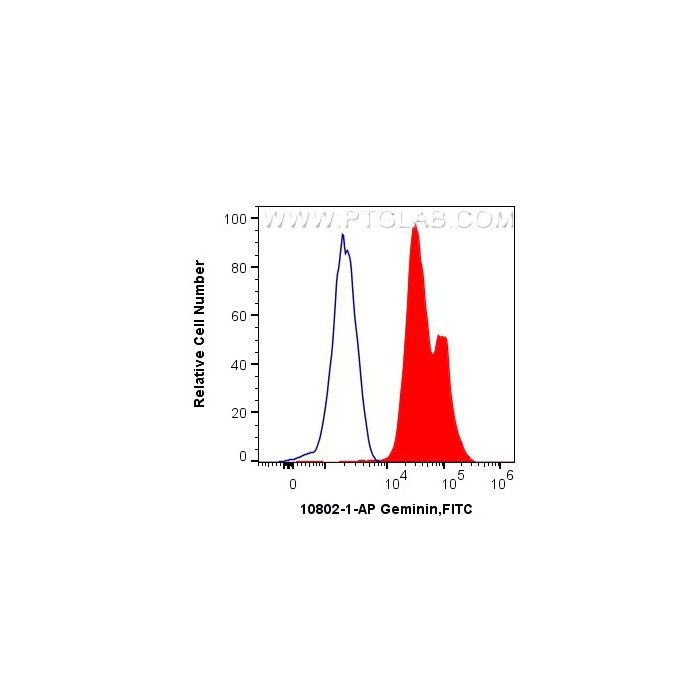
Tested Applications — Positive FC (Intra) detected inHeLa cells
Recommended Dilutions — Western Blot (WB)WB : 1:2000-1:12000
Recommended Dilutions — Immunoprecipitation (IP)IP : 0.5-4.0 ug for 1.0-3.0 mg of total protein lysate
Recommended Dilutions — Immunohistochemistry (IHC)IHC : 1:50-1:500
Recommended Dilutions — Immunofluorescence (IF)/ICCIF/ICC : 1:400-1:1600
Recommended Dilutions — Flow Cytometry (FC) (INTRA)FC (INTRA) : 0.40 ug per 10^6 cells in a 100 µl suspension
Positive WB detected inHEK-293 cells, human testis tissue, mouse testis tissue, HeLa cells; mouse testis tissue, rat testis tissue
Positive IP detected inHEK-293 cells
Positive IHC detected inhuman colon cancer tissue, human breast cancer tissue Note: suggested antigen retrieval with TE buffer pH 9.0; (*) Alternatively, antigen retrieval may be performed with citrate buffer pH 6.0
Positive IF/ICC detected inHepG2 cells
Positive FC (Intra) detected inHeLa cells
Western Blot (WB)WB : 1:2000-1:12000
Immunoprecipitation (IP)IP : 0.5-4.0 ug for 1.0-3.0 mg of total protein lysate
Immunohistochemistry (IHC)IHC : 1:50-1:500
Immunofluorescence (IF)/ICCIF/ICC : 1:400-1:1600
Flow Cytometry (FC) (INTRA)FC (INTRA) : 0.40 ug per 10^6 cells in a 100 µl suspension
Tested Reactivityhuman, mouse, rat
Cited Reactivityhuman, mouse
ClassPolyclonal
TypeAntibody
ImmunogenCatNo: Ag1076 Product name: Recombinant human GMNN protein Source: e coli. -derived, PGEX-4T Tag: GST Domain: 1-209 aa of BC005185 Sequence: MNPSMKQKQEEIKENIKNSSVPRRTLKMIQPSASGSLVGRENELSAGLSKRKHRNDHLTSTTSSPGVIVPESSENKNLGGVTQESFDLMIKENPSSQYWKEVAEKRRKALYEALKENEKLHKEIEQKDNEIARLKKENKELAEVAEHVQYMAELIERLNGEPLDNFESLDNQEFDSEEETVEDSLVEDSEIGTCAEGTVSSSTDAKPCI Predict reactive species
Full Namegeminin, DNA replication inhibitor
Calculated Molecular Weight24 kDa
Observed Molecular Weight28-29 kDa
GenBank Accession NumberBC005185
Gene SymbolGMNN
Gene ID (NCBI)51053
RRIDAB_2110945
ConjugateUnconjugated
Purification MethodAntigen affinity purification
UNIPROT IDO75496
Storage BufferPBS with 0.02% sodium azide and 50% glycerol, pH 7.3.
Storage ConditionsStore at -20°C. Stable for one year after shipment. Aliquoting is unnecessary for -20 o C storage. 20ul sizes contain 0.1% BSA.
FC protocol for Geminin antibody 10802-1-APDownload protocol
IF protocol for Geminin antibody 10802-1-APDownload protocol
IHC protocol for Geminin antibody 10802-1-APDownload protocol
IP protocol for Geminin antibody 10802-1-APDownload protocol
WB protocol for Geminin antibody 10802-1-APDownload protocol
mouseIF Nat Commun Homologous recombination deficiency derived from whole-genome sequencing predicts platinum response in triple-negative breast cancers Authors - Petra Ter Brugge View Article
humanIF Sci Transl Med BRCAness, SLFN11, and RB1 loss predict response to topoisomerase I inhibitors in triple-negative breast cancers. Authors - Florence Coussy View Article
Citations77
DilutionsWB : 1:2000-1:12000 IP : 0.5-4.0 ug for IP and 0.5-4.0 ug for 1.0-3.0 mg of total protein lysate for WB IHC : 1:50-1:500 IF/ICC : 1:400-1:1600 FC (INTRA) : 0.40 ug per 10^6 cells in a 100 µl suspension
IsotypeIgG
ClonalityPolyclonal
Clone Number-
ConjugationUnconjugated

GMNN, also designated geminin, contains 212 amino acids and has a destruction box sequence (RRTLKVIQP). GMNN participates in inhibiting DNA replication by preventing the incorporation of MCM complex into the pre-replication complex (pre-RC). It is degraded during the metaphase-anaphase transition of cell cycle's mitotic phase, which permits replication in the succeeding cell cycle. GMNN has a broad sedimentation profile ranging from about 25 kDa to 90 kDa, with a major peak at 30 kDa. Scanning of the signals shows that discrete peaks corresponding to the apparent mass of 42.5 kDa and 66 kDa are present. The dimer of geminin(50 kDa) can also be detected. (PMID: 15313623) Protocols Product Specific Protocols FC protocol for Geminin antibody 10802-1-AP Download protocol IF protocol for Geminin antibody 10802-1-AP Download protocol IHC protocol for Geminin antibody 10802-1-AP Download protocol IP protocol for Geminin antibody 10802-1-AP Download protocol WB protocol for Geminin antibody 10802-1-AP Download protocol Standard Protocols Click here to view our Standard Protocols

Publications
  1. Whole genomes redefine the mutational landscape of pancreatic cancer.
    Journal: Nature | Authors: Nicola Waddell | Species: mouse | Application: IF
  2. Biomarkers Associating with PARP Inhibitor Benefit in Prostate Cancer in the TOPARP-B Trial.
    Journal: Cancer Discov | Authors: Suzanne Carreira | Species: human | Application: IF
  3. Association of RAD51 with homologous recombination deficiency (HRD) and clinical outcomes in untreated triple-negative breast cancer (TNBC): analysis of the GeparSixto randomized clinical trial.
    Journal: Ann Oncol | Authors: A Llop-Guevara | Species: human | Application: IF
  4. DNA replication initiation factor RECQ4 possesses a role in antagonizing DNA replication initiation
    Journal: Nat Commun | Authors: Xiaohua Xu | Species: human | Application: WB
  5. Homologous recombination deficiency derived from whole-genome sequencing predicts platinum response in triple-negative breast cancers
    Journal: Nat Commun | Authors: Petra Ter Brugge | Species: mouse | Application: IF
  6. BRCAness, SLFN11, and RB1 loss predict response to topoisomerase I inhibitors in triple-negative breast cancers.
    Journal: Sci Transl Med | Authors: Florence Coussy | Species: human | Application: IF
  7. Preclinical In Vivo Validation of the RAD51 Test for Identification of Homologous Recombination-Deficient Tumors and Patient Stratification.
    Journal: Cancer Res | Authors: Benedetta Pellegrino | Species: human | Application: IF
  8. RNF168-mediated ubiquitin signaling inhibits the viability of BRCA1 null cancers.
    Journal: Cancer Res | Authors: John J Krais | Species: human | Application: WB
  9. Harnessing STING Signaling and Natural Killer Cells overcomes PARP Inhibitor Resistance in Homologous Recombination Deficient Breast Cancer
    Journal: Cancer Res | Authors: Flaminia Pedretti | Species: human | Application: IF
  10. A Microfluidic Cancer-on-Chip Platform Predicts Drug Response Using Organotypic Tumor Slice Culture.
    Journal: Cancer Res | Authors: Sanjiban Chakrabarty | Species: mouse | Application: IF
  11. Hyperthermia synergizes with chemotherapy by inhibiting PARP1-dependent DNA replication arrest.
    Journal: Cancer Res | Authors: Lea Schaaf
  12. Homologous recombination DNA repair deficiency and PARP inhibition activity in primary triple negative breast cancer.
    Journal: Nat Commun | Authors: Neha Chopra | Species: human | Application: IHC
  13. A CRISPR-Cas9 screen identifies EXO1 as a formaldehyde resistance gene
    Journal: Nat Commun | Authors: Yuandi Gao | Species: human | Application: IF
  14. Homologous recombination DNA repair deficiency and PARP inhibition activity in primary triple negative breast cancer.
    Journal: Nat Commun | Authors: Neha Chopra | Species: human | Application: IHC
  15. Homologous recombination deficiency derived from whole-genome sequencing predicts platinum response in triple-negative breast cancers
    Journal: Nat Commun | Authors: Petra Ter Brugge | Species: mouse | Application: IF
  16. DNA replication initiation factor RECQ4 possesses a role in antagonizing DNA replication initiation
    Journal: Nat Commun | Authors: Xiaohua Xu | Species: human | Application: WB
  17. CDT1 inhibits CMG helicase in early S phase to separate origin licensing from DNA synthesis
    Journal: Mol Cell | Authors: Nalin Ratnayeke | Species: human | Application: WB
  18. BRCAness, SLFN11, and RB1 loss predict response to topoisomerase I inhibitors in triple-negative breast cancers.
    Journal: Sci Transl Med | Authors: Florence Coussy | Species: human | Application: IF
  19. In Vivo Stabilization of a Gastrin-Releasing Peptide Receptor Antagonist Enhances PET Imaging and Radionuclide Therapy of Prostate Cancer in Preclinical Studies.
    Journal: Theranostics | Authors: Kristell L S Chatalic | Species: human | Application: IF
  20. Homologous recombination repair status in metastatic prostate cancer by next-generation sequencing and functional immunofluorescence
    Journal: Cell Rep Med | Authors: Sara Arce-Gallego | Species: human | Application: IF
  21. Translesion DNA synthesis mediates acquired resistance to olaparib plus temozolomide in small cell lung cancer.
    Journal: Sci Adv | Authors: Marcello Stanzione | Species: human | Application: IF
  22. Developing patient-derived organoids to predict PARP inhibitor response and explore resistance overcoming strategies in ovarian cancer.
    Journal: Pharmacol Res | Authors: Mengyu Tao | Species: human | Application: IF
  23. Functional ex vivo assay to select Homologous Recombination deficient breast tumors for PARP inhibitor treatment.
    Journal: Clin Cancer Res | Authors: Kishan A T Naipal | Species: human | Application: IF
  24. A marker of homologous recombination predicts pathologic complete response to neoadjuvant chemotherapy in primary breast cancer.
    Journal: Clin Cancer Res | Authors: Graeser Monika M | Species: human | Application: IF
  25. RAD51 testing in patients with early HER2-negative breast cancer and homologous recombination deficiency: post-hoc analysis of the GeparOla trial
    Journal: Clin Cancer Res | Authors: Guillermo Villacampa | Species: human | Application: IF
  26. Frequent Homologous Recombination Deficiency in High-grade Endometrial Carcinomas.
    Journal: Clin Cancer Res | Authors: Marthe M de Jonge | Species: human | Application: IF
  27. A marker of homologous recombination predicts pathologic complete response to neoadjuvant chemotherapy in primary breast cancer.
    Journal: Clin Cancer Res | Authors: Graeser Monika M | Species: human | Application: IF
  28. Human metastatic cholangiocarcinoma patient-derived xenografts and tumoroids for preclinical drug evaluation
    Journal: Clin Cancer Res | Authors: Queralt Serra-Camprubí | Species: mouse | Application: IF
  29. The PARP1 selective inhibitor saruparib (AZD5305) elicits potent and durable antitumor activity in patient-derived BRCA1/2-associated cancer models
    Journal: Genome Med | Authors: Andrea Herencia-Ropero | Species: human | Application: IF
  30. Unraveling the complexity of HRD assessment in ovarian cancer by combining genomic and functional approaches: translational analyses of MITO16-MaNGO-OV-2 trial
    Journal: ESMO Open | Authors: B Pellegrino | Application: IF
  31. Comprehensive clinical cancer analysis of homologous recombination deficiency biomarkers in an academic molecular profiling program.
    Journal: NPJ Precis Oncol | Authors: Heura Domènech
  32. Determinants of long-term response to patritumab deruxtecan in breast cancer patient-derived xenografts.
    Journal: NPJ Precis Oncol | Authors: Andreu Òdena | Species: human | Application: IF
  33. Rapid initiation of cell cycle reentry processes protects neurons from amyloid-β toxicity.
    Journal: Proc Natl Acad Sci U S A | Authors: Stefania Ippati | Species: mouse,human | Application: IHC
  34. A Reporter Platform to Study Therapy-Induced Senescence in Live Cancer Cells.
    Journal: Small Methods | Authors: Jacinta van de Grint | Species: human | Application: IF
  35. Clinical consequences of BRCA2 hypomorphism.
    Journal: NPJ Breast Cancer | Authors: Laia Castells-Roca | Species: human | Application: IHC
  36. RAD51-based homologous recombination deficiency is associated with treatment response and survival in early breast cancer.
    Journal: NPJ Breast Cancer | Authors: Alba Llop-Guevara | Species: human | Application: IF
  37. A RAD51 assay feasible in routine tumor samples calls PARP inhibitor response beyond BRCA mutation.
    Journal: EMBO Mol Med | Authors: Marta Castroviejo-Bermejo | Species: human | Application: IF
  38. Delayed DNA double-strand break repair following platin-based chemotherapy predicts treatment response in head and neck squamous cell carcinoma.
    Journal: Br J Cancer | Authors: S A Bhide | Species: human | Application: IF
  39. Basal expression of RAD51 foci predicts olaparib response in patient-derived ovarian cancer xenografts.
    Journal: Br J Cancer | Authors: F Guffanti | Species: mouse | Application: IF
  40. Molecular cascade reveals sequential milestones underlying hippocampal neural stem cell development into an adult state
    Journal: Cell Rep | Authors: Dennisse Jimenez-Cyrus | Species: mouse | Application: IF
  41. HSF2BP Interacts with a Conserved Domain of BRCA2 and Is Required for Mouse Spermatogenesis.
    Journal: Cell Rep | Authors: Inger Brandsma | Species: mouse | Application: IF
  42. BRCA1 Mutation-Specific Responses to 53BP1 Loss-Induced Homologous Recombination and PARP Inhibitor Resistance.
    Journal: Cell Rep | Authors: Joseph Nacson | Species: human | Application: IF
  43. HSF2BP Interacts with a Conserved Domain of BRCA2 and Is Required for Mouse Spermatogenesis.
    Journal: Cell Rep | Authors: Inger Brandsma | Species: mouse | Application: IF
  44. Reporter-based screening identifies RAS-RAF mutations as drivers of resistance to active-state RAS inhibitors in colorectal cancer
    Journal: Sci Signal | Authors: Oleksandra Aust | Application: WB
  45. Harnessing senolytics and PARP inhibition to expand the antitumor activity of CDK4/6 inhibitors in prostate cancer
    Journal: Mol Cancer Ther | Authors: Julian Brandariz | Species: human | Application: IF
  46. Targeting IKKε in Androgen-Independent Prostate Cancer Causes Phenotypic Senescence and Genomic Instability
    Journal: Mol Cancer Ther | Authors: Sophie Gilbert | Species: human | Application: IF
  47. Assessing Determinants of Response to PARP Inhibition in Germline ATM Mutant Melanoma.
    Journal: Int J Mol Sci | Authors: Eleonora Allavena | Species: human | Application: IF
  48. BRCA1 foci test as a predictive biomarker of olaparib response in ovarian cancer patient-derived xenograft models
    Journal: Front Pharmacol | Authors: Federica Guffanti | Species: human | Application: IF
  49. Nuclear pCHK1 as a potential biomarker of increased sensitivity to ATR inhibition
    Journal: J Pathol | Authors: Vignesh Sundararajan | Species: human | Application: IHC
  50. Lysophosphatidic Acid-Induced EGFR Transactivation Promotes Gastric Cancer Cell DNA Replication by Stabilizing Geminin in the S Phase.
    Journal: Front Pharmacol | Authors: Haile Zhao | Species: human | Application: WB,IP
  51. Lysophosphatidic acid suppresses apoptosis of high-grade serous ovarian cancer cells by inducing autophagy activity and promotes cell-cycle progression via EGFR-PI3K/Aurora-AThr288-geminin dual signaling pathways
    Journal: Front Pharmacol | Authors: Haile Zhao | Species: human | Application: WB
  52. Cumulative defects in DNA repair pathways drive the PARP inhibitor response in high-grade serous epithelial ovarian cancer cell lines.
    Journal: Oncotarget | Authors: Hubert Fleury | Application: WB
  53. APC/C(CDC20) and APC/C play pivotal roles in the process of embryonic development in Artemia sinica.
    Journal: Sci Rep | Authors: Mengchen Zhang | Species: human | Application: WB
  54. A murine cytomegalovirus cell cycle regulator (m54.5p) evolved within the conserved viral DNA polymerase gene.
    Journal: PLoS Pathog | Authors: Yan Zheng | Species: mouse | Application: WB,IF
  55. Ex Vivo Functional Assay for Evaluating Treatment Response in Tumor Tissue of Head and Neck Squamous Cell Carcinoma
    Journal: Cancers (Basel) | Authors: Marta E Capala | Species: human | Application: IF
  56. Inhibition of PARP Sensitizes Chondrosarcoma Cell Lines to Chemo- and Radiotherapy Irrespective of the IDH1 or IDH2 Mutation Status.
    Journal: Cancers (Basel) | Authors: Sanne Venneker | Species: human | Application: IF
  57. The RAD51-FFPE Test; Calibration of a Functional Homologous Recombination Deficiency Test on Diagnostic Endometrial and Ovarian Tumor Blocks.
    Journal: Cancers (Basel) | Authors: Lise M van Wijk | Species: human | Application: IF
  58. IKKε Inhibitor Amlexanox Promotes Olaparib Sensitivity through the C/EBP-β-Mediated Transcription of Rad51 in Castrate-Resistant Prostate Cancer
    Journal: Cancers (Basel) | Authors: Sophie Gilbert | Species: mouse | Application: IF
  59. The Genetic and Molecular Analyses of RAD51C and RAD51D Identifies Rare Variants Implicated in Hereditary Ovarian Cancer from a Genetically Unique Population.
    Journal: Cancers (Basel) | Authors: Wejdan M Alenezi | Species: human | Application: IF
  60. The RECAP Test Rapidly and Reliably Identifies Homologous Recombination-Deficient Ovarian Carcinomas.
    Journal: Cancers (Basel) | Authors: Lise M van Wijk | Species: human | Application: IF
  61. Increased replication stress and R-loop accumulation in EGFRvIII-expressing glioblastoma present new therapeutic opportunities.
    Journal: Neurooncol Adv | Authors: Nina Struve | Species: human | Application: IF
  62. RAD51 recruitment but not replication fork stability associates with PARP inhibitor response in ovarian cancer patient-derived xenograft models
    Journal: NAR Cancer | Authors: Francien Talens | Species: mouse,human | Application: IF
  63. Aberrant CDK4/6-driven cell-cycle reentry drives neuronal loss and defines a therapeutic target in C9orf72 ALS/FTD.
    Journal: iScience | Authors: Ling Lian | Species: human | Application: WB
  64. RAD51/geminin/γH2AX immunohistochemical expression predicts platinum-based chemotherapy response in ovarian high-grade serous carcinoma
    Journal: J Gynecol Oncol | Authors: Kyeongmin Kim | Species: human | Application: IHC,IF
  65. RAD51 as an immunohistochemistry-based marker of poly(ADP-ribose) polymerase inhibitor resistance in ovarian cancer
    Journal: Front Oncol | Authors: Yoo-Na Kim | Species: human | Application: IHC
  66. Dual Inhibition of PARP and the Intra-S/G2 Cell Cycle Checkpoints Results in Highly Effective Radiosensitization of HPV-Positive HNSCC Cells.
    Journal: Front Oncol | Authors: Katharina Hintelmann | Species: human | Application: IF
  67. RAD51 as an immunohistochemistry-based marker of poly(ADP-ribose) polymerase inhibitor resistance in ovarian cancer
    Journal: Front Oncol | Authors: Yoo-Na Kim | Species: human | Application: IHC
  68. Performance of a RAD51-based functional HRD test on paraffin-embedded breast cancer tissue
    Journal: Breast Cancer Res Treat | Authors: Lise M van Wijk | Species: human | Application: WB,IHC
  69. Loss of polycystins suppresses deciliation via the activation of the centrosomal integrity pathway.
    Journal: Life Sci Alliance | Authors: Vasileios Gerakopoulos | Species: mouse | Application: IF
  70. Cell cycle and apoptosis regulatory proteins, proliferative markers, cell signaling molecules, CD209, and decorin immunoreactivity in low-grade myxofibrosarcoma and myxoma.
    Journal: Virchows Arch | Authors: Justin M M Cates | Species: human | Application: IHC
  71. Cell Cycle Analysis and Relevance for Single-Cell Gating in Mass Cytometry.
    Journal: Cytometry A | Authors: Idun D Rein | Species: human
  72. Combined B, T and NK Cell Deficiency Accelerates Atherosclerosis in BALB/c Mice.
    Journal: PLoS One | Authors: Fei Cheng | Species: mouse | Application: IHC
  73. Ex vivo assays to predict enhanced chemosensitization by hyperthermia in urothelial cancer of the bladder.
    Journal: PLoS One | Authors: Nathalie van den Tempel | Species: human | Application: IF
  74. Immunohistochemical assessment of chromatin licensing and DNA replication factor 1, geminin, and γ-H2A.X in oral epithelial precursor lesions and squamous cell carcinoma.
    Journal: J Oral Pathol Med | Authors: Yves Junior Siril | Species: human | Application: IHC
  75. Cell cycle kinetic analysis of colorectal neoplasms using a new automated immunohistochemistry-based cell cycle detection method.
    Journal: Medicine (Baltimore) | Authors: Ayako Tomono | Species: human | Application: IHC
  76. Combined Inhibition of Wee1 and Checkpoint Kinases Synergistically Provokes S-Phase Progression and Mitotic Entry, and Promotes Cell Death Under Heat Stress.
    Journal: Genes Cells | Authors: Tamaki Muratani | Species: human | Application: WB
  77. Visualizing DNA Damage Repair Proteins in Patient-Derived Ovarian Cancer Organoids via Immunofluorescence Assays
    Journal: J Vis Exp | Authors: Lillian van Biljon
  78. Replication stress links Geminin depletion to centrosome amplification.
    Journal: bioRxiv | Authors: Inês B. Santos

Reviews

Write Your Own Review
You're reviewing:Geminin Polyclonal antibody 10802-1-AP proteintech
Your Rating
Copyright © 2025 Biogege, Inc. All rights reserved.