RBM15 Monoclonal antibody, PBS Only (Capture) 66059-1-PBS proteintech
$699.00
In stock
SKU
66059-1-PBS
| Catalog Number | 66059-1-PBS |
| Synonyms | 4A1A4, One-twenty two protein 1, OTT, OTT1, RBM 15 |
| Host | Mouse |
| Reactivity | human |
| Form | Liquid |
| Formulation | PBS Only |
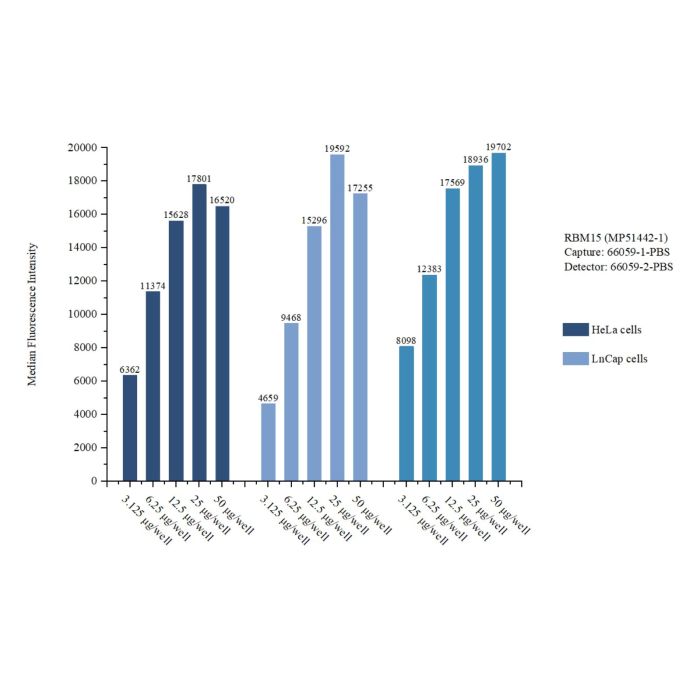
| Applications | WB, IHC, IF/ICC, IP, Cytometric bead array, Indirect ELISA |
| Host / Isotype | Mouse / IgG2a |
| Tested Reactivity | human |
| Class | Monoclonal |
| Type | Antibody |
| Immunogen | CatNo: Ag17970 Product name: Recombinant human RBM15 protein Source: e coli. -derived, PET28a Tag: 6*His Domain: 658-957 aa of BC006397 Sequence: SSSRDRYNSDNDRSSRLLLERPSPIRDRRGSLEKSQGDKRDRKNSASAERDRKHRTTAPTEGKSPLKKEDRSDGSAPSTSTASSKLKSPSQKQDGGTAPVASASPKLCLAWQGMLLLKNSNFPSNMHLLQGDLQVASSLLVEGSTGGKVAQLKITQRLRLDQPKLDEVTRRIKVAGPNGYAILLAVPGSSDSRSSSSSAASDTATSTQRPLRNLVSYLKQKQAAGVISLPVGGNKDKENTGVLHAFPPCEFSQQFLDSPAKALAKSEEDYLVMIIVRGFGFQIGVRYENKKRENLALTLL Predict reactive species |
| Full Name | RNA binding motif protein 15 |
| Calculated Molecular Weight | 105 kDa |
| Observed Molecular Weight | 107 kDa |
| GenBank Accession Number | BC006397 |
| Gene Symbol | RBM15 |
| Gene ID (NCBI) | 64783 |
| RRID | AB_11042326 |
| Conjugate | Unconjugated |
| Purification Method | Protein A purification |
| UNIPROT ID | Q96T37 |
| Storage Buffer | PBS only, pH 7.3. |
| Storage Conditions | Store at -80°C. |
| Citations | - |
| Isotype | IgG2a |
| Clonality | Monoclonal |
| Clone Number | 4A1A4 |
| Conjugation | Unconjugated |
RNA-binding motif protein 15 (RBM15) belongs to the SPEN protein family, which have repressor function in several signaling pathway, and may bind to RNA through interaction with spliceosome components. It was first described as a 5′ translocation partner of the MAL gene in t(1,22)(p13;q13) infant acute megakaryocytic leukemia, and it functions in murine hematopoiesis through modulating Notch-induced transcriptional activation, which play crucial roles in leukemogenesis. Decreasing RBM15 levels with RNA interference could inhibit the growth and proliferation, block the cell cycle, and induce apoptosis in CML cells.