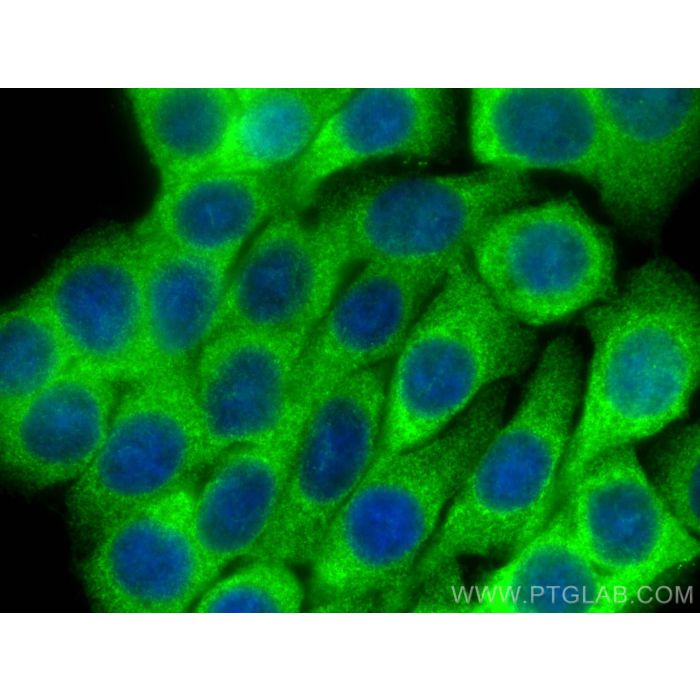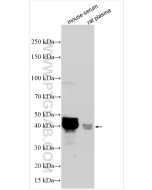
RIPK3 Polyclonal antibody, PBS Only 17563-1-PBS proteintech
$699.00
In stock
SKU
17563-1-PBS
| Catalog Number | 17563-1-PBS |
| Synonyms | RIP3, EC:2.7.11.1, Receptor interacting protein 3, Receptor-interacting protein 3, Receptor-interacting serine/threonine-protein kinase 3 |
| Host | Rabbit |
| Reactivity | human |
| Form | Liquid |
| Formulation | PBS Only |
| Applications | WB, IHC, IF/ICC, IP, Indirect ELISA |
| Host / Isotype | Rabbit / IgG |
| Tested Reactivity | human |
| Class | Polyclonal |
| Type | Antibody |
| Immunogen | CatNo: Ag11759 Product name: Recombinant human RIPK3 protein Source: e coli. -derived, PGEX-4T Tag: GST Domain: 1-289 aa of BC062584 Sequence: MSCVKLWPSGAPAPLVSIEELENQELVGKGGFGTVFRAQHRKWGYDVAVKIVNSKAISREVKAMASLDNEFVLRLEGVIEKVNWDQDPKPALVTKFMENGSLSGLLQSQCPRPWPLLCRLLKEVVLGMFYLHDQNPVLLHRDLKPSNVLLDPELHVKLADFGLSTFQGGSQSGTGSGEPGGTLGYLAPELFVNVNRKASTASDVYSFGILMWAVLAGREVELPTEPSLVYEAVCNRQNRPSLAELPQAGPETPGLEGLKELMQLCWSSEPKDRPSFQECLPKTDEVFQM Predict reactive species |
| Full Name | receptor-interacting serine-threonine kinase 3 |
| Calculated Molecular Weight | 518 aa, 57 kDa |
| Observed Molecular Weight | 57-70 kDa |
| GenBank Accession Number | BC062584 |
| Gene Symbol | RIPK3 |
| Gene ID (NCBI) | 11035 |
| RRID | AB_2178659 |
| Conjugate | Unconjugated |
| Purification Method | Antigen affinity purification |
| UNIPROT ID | Q9Y572 |
| Storage Buffer | PBS only, pH 7.3. |
| Storage Conditions | Store at -80°C. |
| Citations | - |
| Isotype | IgG |
| Clonality | Polyclonal |
| Clone Number | - |
| Conjugation | Unconjugated |
Receptor-interacting protein 3 (RIP3, also known as RIPK3) is a serine-threonine protein involved in the regulation of inflammatory signaling and cell death. RIPK3, also named as RIP3, a Ser/Thr kinase of RIP (Receptor Interacting Protein) family, is a nucleocytoplasmic shuttling protein and its unconventional nuclear localization signal (NLS, 442-472 aa) is sufficient to trigger apoptosis in the nucleus (PMID: 18533105). It has 3 isoforms produced by alternative splicing. What is the molecular weight of RIP3? Is RIP3 post-translationally modified? The molecular weight of RIP3 is 57 kDa. During the induction of necroptosis, RIP3 migrates slower in SDS-PAGE due to its phosphorylation (PMID: 19524512). Additionally, RIP3 can be a subject of poly-ubiquitination, when targeted for degradation. Are there any splice isoforms of RIP3? Apart from full-length RIP3, there are two reported splice isoforms of RIP3: RIP3β and RIP3γ, and 28 and 25 kDa, respectively (PMID: 15896315). What is the subcellular localization of RIP3? RIP3 can shuttle between the cytoplasm and the nucleus. Although RIP3 forms necrosomes in the cytoplasm, a recent study suggests that the phosphorylation of RIP3, required for necroptosis, may also occur in the nucleus (PMID: 30271893). Additionally, the induction of necrosis by reactive oxygen species can cause transient translocation of RIP3 to mitochondria (PMID: 25206339). What is the role of RIP3 in cell death (necroptosis)? Activation of RIP3 kinase is required for the induction of necroptosis (PMID: 19524512, 19524513 and 19498109). Activation of RIP3 can be induced by interferons, death ligands, or by Toll-like receptors in response to pathogens. That leads to the phosphorylation of RIP3 and the formation of a β-amyloid-like protein complex. Phosphorylated RIP3 acts downstream by phosphorylation of MLKL (PMID: 30131615). How to study necroptosis in a cell-based system? The choice of the cell line is important. Many commonly used immortalized cell types are derived from cancers and may have very low RIL3 expression level (PMID: 25952668). Those cell lines are not going to be responsive to necrotic stimuli. A few of the examined cell types have high RIP3 levels: Jurkat, CCRF-CEM, U937, L929 cells, and mouse embryonic fibroblasts (PMID: 19524512). Good necroptosis readouts reflect an increased level of RIP3 protein and its phosphorylation.