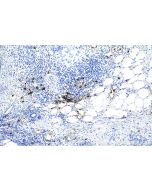
S100A2 Polyclonal antibody 15454-1-AP proteintech
$149.00
In stock
SKU
15454-1-AP
| Catalog Number | 15454-1-AP |
| Synonyms | CAN19, Protein S 100L, Protein S100 A2, Protein S100-A2, Protein S-100L |
| Host | Rabbit |
| Reactivity | human |
| Form | Liquid |
| Formulation | PBS, Azide, Glycerol |
| Applications | WB, IHC, IF/ICC, ELISA |
| Host / Isotype | Rabbit / IgG |
| Tested Applications — Positive WB detected in | HaCaT cells, HeLa cells |
| Tested Applications — Positive IHC detected in | human bowen disease Note: suggested antigen retrieval with TE buffer pH 9.0; (*) Alternatively, antigen retrieval may be performed with citrate buffer pH 6.0 |
| Tested Applications — Positive IF/ICC detected in | A431 cells |
| Tested Applications — Positive FC (Intra) detected in | A431 cells |
| Recommended Dilutions — Western Blot (WB) | WB : 1:500-1:1000 |
| Recommended Dilutions — Immunohistochemistry (IHC) | IHC : 1:50-1:500 |
| Recommended Dilutions — Immunofluorescence (IF)/ICC | IF/ICC : 1:200-1:800 |
| Recommended Dilutions — Flow Cytometry (FC) (INTRA) | FC (INTRA) : 0.40 ug per 10^6 cells in a 100 µl suspension |
| Positive WB detected in | HaCaT cells, HeLa cells |
| Positive IHC detected in | human bowen disease Note: suggested antigen retrieval with TE buffer pH 9.0; (*) Alternatively, antigen retrieval may be performed with citrate buffer pH 6.0 |
| Positive IF/ICC detected in | A431 cells |
| Positive FC (Intra) detected in | A431 cells |
| Western Blot (WB) | WB : 1:500-1:1000 |
| Immunohistochemistry (IHC) | IHC : 1:50-1:500 |
| Immunofluorescence (IF)/ICC | IF/ICC : 1:200-1:800 |
| Flow Cytometry (FC) (INTRA) | FC (INTRA) : 0.40 ug per 10^6 cells in a 100 µl suspension |
| Tested Reactivity | human |
| Cited Reactivity | human |
| Class | Polyclonal |
| Type | Antibody |
| Immunogen | CatNo: Ag7719 Product name: Recombinant human S100A2 protein Source: e coli. -derived, PGEX-4T Tag: GST Domain: 1-98 aa of BC002829 Sequence: MMCSSLEQALAVLVTTFHKYSCQEGDKFKLSKGEMKELLHKELPSFVGEKVDEEGLKKLMGSLDENSDQQVDFQEYAVFLALITVMCNDFFQGCPDRP Predict reactive species |
| Full Name | S100 calcium binding protein A2 |
| Calculated Molecular Weight | 11 kDa |
| Observed Molecular Weight | 10 kDa |
| GenBank Accession Number | BC002829 |
| Gene Symbol | S100A2 |
| Gene ID (NCBI) | 6273 |
| RRID | AB_3669209 |
| Conjugate | Unconjugated |
| Purification Method | Antigen affinity purification |
| UNIPROT ID | P29034 |
| Storage Buffer | PBS with 0.02% sodium azide and 50% glycerol, pH 7.3. |
| Storage Conditions | Store at -20°C. Stable for one year after shipment. Aliquoting is unnecessary for -20 o C storage. 20ul sizes contain 0.1% BSA. |
| FC protocol for S100A2 antibody 15454-1-AP | Download protocol |
| IF protocol for S100A2 antibody 15454-1-AP | Download protocol |
| IHC protocol for S100A2 antibody 15454-1-AP | Download protocol |
| WB protocol for S100A2 antibody 15454-1-AP | Download protocol |
| human | WB Biochem Pharmacol Targeting BACH1/PSPH axis suppresses bladder cancer progression and gemcitabine resistance by downregulating S100A2 expression Authors - Tingxuan Ma View Article |
| Citations | 2 |
| Dilutions | WB : 1:500-1:1000 IHC : 1:50-1:500 IF/ICC : 1:200-1:800 FC (INTRA) : 0.40 ug per 10^6 cells in a 100 µl suspension |
| Isotype | IgG |
| Clonality | Polyclonal |
| Clone Number | - |
| Conjugation | Unconjugated |
S100A2 (S100 calcium-binding protein A2) is also named as S100L and CAN19. S100A2, a member of the S100 protein family, is more highly expressed in endometrial carcinoma tissues than in normal tissues and was correlated with worse survival (PMID: 35042454). S100A2 has a tumor suppressor function. S100A2 is highly upregulated in the epidermis under inflammatory conditions and in drug eruptions, in addition to inflammatory skin diseases such as atopic dermatitis and psoriasis (PMID: 35885660). Protocols Product Specific Protocols FC protocol for S100A2 antibody 15454-1-AP Download protocol IF protocol for S100A2 antibody 15454-1-AP Download protocol IHC protocol for S100A2 antibody 15454-1-AP Download protocol WB protocol for S100A2 antibody 15454-1-AP Download protocol Standard Protocols Click here to view our Standard Protocols
Publications