SLC25A18 Polyclonal antibody 17348-1-AP proteintech
$149.00
In stock
SKU
17348-1-AP
| Catalog Number | 17348-1-AP |
| Synonyms | GC 2, GC2, Glutamate/H(+) symporter 2, SLC25A18 |
| Host | Rabbit |
| Reactivity | human, mouse |
| Form | Liquid |
| Formulation | PBS, Azide, Glycerol |
| Applications | WB, IHC, IF, IP, ELISA |
| Applications | WB, IP, IHC, ELISA |
| Host / Isotype | Rabbit / IgG |
| Tested Applications — Positive WB detected in | mouse liver tissue, mouse kidney tissue, mouse heart tissue |
| Tested Applications — Positive IP detected in | mouse brain tissue |
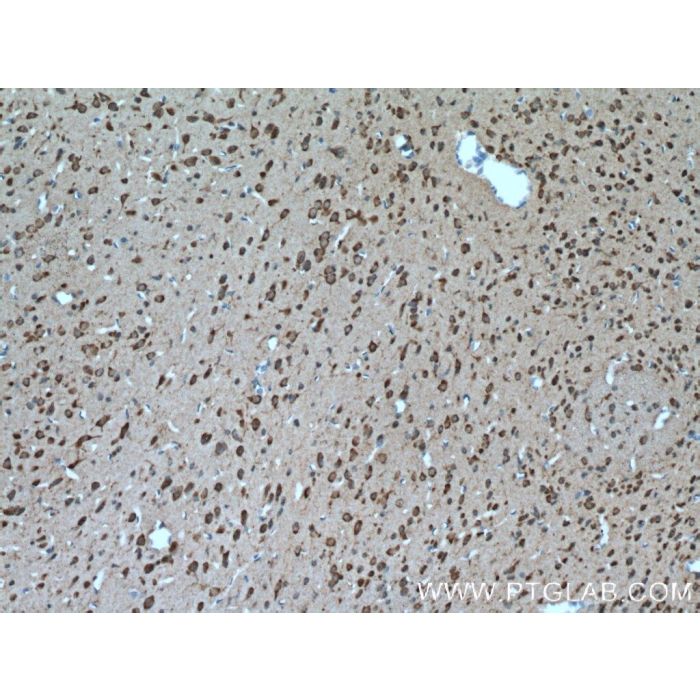
| Tested Applications — Positive IHC detected in | mouse brain tissue Note: suggested antigen retrieval with TE buffer pH 9.0; (*) Alternatively, antigen retrieval may be performed with citrate buffer pH 6.0 |
| Recommended Dilutions — Western Blot (WB) | WB : 1:500-1:1000 |
| Recommended Dilutions — Immunoprecipitation (IP) | IP : 0.5-4.0 ug for 1.0-3.0 mg of total protein lysate |
| Recommended Dilutions — Immunohistochemistry (IHC) | IHC : 1:50-1:500 |
| Positive WB detected in | mouse liver tissue, mouse kidney tissue, mouse heart tissue |
| Positive IP detected in | mouse brain tissue |
| Positive IHC detected in | mouse brain tissue Note: suggested antigen retrieval with TE buffer pH 9.0; (*) Alternatively, antigen retrieval may be performed with citrate buffer pH 6.0 |
| Western Blot (WB) | WB : 1:500-1:1000 |
| Immunoprecipitation (IP) | IP : 0.5-4.0 ug for 1.0-3.0 mg of total protein lysate |
| Immunohistochemistry (IHC) | IHC : 1:50-1:500 |
| Tested Reactivity | human, mouse |
| Cited Reactivity | human, mouse |
| Class | Polyclonal |
| Type | Antibody |
| Immunogen | CatNo: Ag11420 Product name: Recombinant human SLC25A18 protein Source: e coli. -derived, PGEX-4T Tag: GST Domain: 31-228 aa of BC031644 Sequence: LAKTRLQNQHGKAMYKGMIDCLMKTARAEGFFGMYRGAAVNLTLVTPEKAIKLAANDFFRRLLMEDGMQRNLKMEMLAGCGAGMCQVVVTCPMEMLKIQLQDAGRLAVHHQGSASAPSTSRSYTTGSASTHRRPSATLIAWELLRTQGLAGLYRGLGATLLRDIPFSIIYFPLFANLNNLGFNELAGKASFAHSFVSG Predict reactive species |
| Full Name | solute carrier family 25 (mitochondrial carrier), member 18 |
| Calculated Molecular Weight | 315 aa, 34 kDa |
| Observed Molecular Weight | 32-35 kDa |
| GenBank Accession Number | BC031644 |
| Gene Symbol | SLC25A18 |
| Gene ID (NCBI) | 83733 |
| RRID | AB_2189889 |
| Conjugate | Unconjugated |
| Purification Method | Antigen affinity purification |
| UNIPROT ID | Q9H1K4 |
| Storage Buffer | PBS with 0.02% sodium azide and 50% glycerol, pH 7.3. |
| Storage Conditions | Store at -20°C. Stable for one year after shipment. Aliquoting is unnecessary for -20 o C storage. 20ul sizes contain 0.1% BSA. |
| IHC protocol for SLC25A18 antibody 17348-1-AP | Download protocol |
| IP protocol for SLC25A18 antibody 17348-1-AP | Download protocol |
| WB protocol for SLC25A18 antibody 17348-1-AP | Download protocol |
| human | IHC Am J Cancer Res SLC25A18 has prognostic value in colorectal cancer and represses Warburg effect and cell proliferation via Wnt signaling. Authors - Li Liang View Article |
| mouse | WB Sci Adv NPAS3-regulated astrocyte mitochondrial bioenergetics is required for cognition. Authors - Kateryna Murlanova View Article |
| Citations | 4 |
| Dilutions | WB : 1:500-1:1000 IP : 0.5-4.0 ug for IP and 0.5-4.0 ug for 1.0-3.0 mg of total protein lysate for WB IHC : 1:50-1:500 |
| Isotype | IgG |
| Clonality | Polyclonal |
| Clone Number | - |
| Conjugation | Unconjugated |
SLC25A18, also named as GC 2, belongs to the mitochondrial transporter family (SLC25). It is located in inner mitochondrial membrane which involved in the transport of glutamate either with H + or in exchange for OH - . SLC25A18 is highly expressed in brain, testis, lung, kidney, liver, spleen and skeletal muscle. 17348-1-AP antibody detects the band around 32-35 kDa in SDS-PAGE. (PMID: 14598172) Protocols Product Specific Protocols IHC protocol for SLC25A18 antibody 17348-1-AP Download protocol IP protocol for SLC25A18 antibody 17348-1-AP Download protocol WB protocol for SLC25A18 antibody 17348-1-AP Download protocol Standard Protocols Click here to view our Standard Protocols
Publications