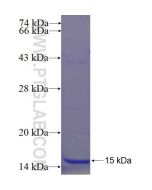
SPATA22 Polyclonal antibody 16989-1-AP proteintech
$149.00
In stock
SKU
16989-1-AP
| Catalog Number | 16989-1-AP |
| Synonyms | NYD SP20, SPATA 22, Spermatogenesis-associated protein 22, Testis development protein NYD-SP20 |
| Host | Rabbit |
| Reactivity | human, mouse, rat |
| Form | Liquid |
| Formulation | PBS, Azide, Glycerol |
| Applications | WB, IHC, IF, IP, ELISA |
| Applications | WB, IHC, IP, ELISA |
| Host / Isotype | Rabbit / IgG |
| Tested Applications — Positive WB detected in | human testis tissue, mouse testis tissue |
| Tested Applications — Positive IP detected in | mouse testis tissue |
| Tested Applications — Positive IHC detected in | mouse testis tissue Note: suggested antigen retrieval with TE buffer pH 9.0; (*) Alternatively, antigen retrieval may be performed with citrate buffer pH 6.0 |
| Recommended Dilutions — Western Blot (WB) | WB : 1:500-1:2000 |
| Recommended Dilutions — Immunoprecipitation (IP) | IP : 0.5-4.0 ug for 1.0-3.0 mg of total protein lysate |
| Recommended Dilutions — Immunohistochemistry (IHC) | IHC : 1:50-1:500 |
| Positive WB detected in | human testis tissue, mouse testis tissue |
| Positive IP detected in | mouse testis tissue |
| Positive IHC detected in | mouse testis tissue Note: suggested antigen retrieval with TE buffer pH 9.0; (*) Alternatively, antigen retrieval may be performed with citrate buffer pH 6.0 |
| Western Blot (WB) | WB : 1:500-1:2000 |
| Immunoprecipitation (IP) | IP : 0.5-4.0 ug for 1.0-3.0 mg of total protein lysate |
| Immunohistochemistry (IHC) | IHC : 1:50-1:500 |
| Tested Reactivity | human, mouse, rat |
| Cited Reactivity | mouse |
| Class | Polyclonal |
| Type | Antibody |
| Immunogen | CatNo: Ag10591 Product name: Recombinant human SPATA22 protein Source: e coli. -derived, PGEX-4T Tag: GST Domain: 1-363 aa of BC029483 Sequence: MKRSLNENSARSTAGCLPVPLFNQKKRNRQPLTSNPLKDDSGISTPSDNYDFPPLPTDWAWEAVNPELAPVMKTVDTGQIPHSVSRPLRSQDSVFNSIQSNTGRSQGGWSYRDGNKNTSLKTWNKNDFKPQCKRTNLVANDGKNSCPMSSGAQQQKQLRTPEPPNLSRNKETELLRQTHSSKISGCTMRGLDKNSALQTLKPNFQQNQYKKQMLDDIPEDNTLKETSLYQLQFKEKASSLRIISAVIESMKYWREHAQKTVLLFEVLAVLDSAVTPGPYYSKTFLMRDGKNTLPCVFYEIDRELPRLIRGRVHRCVGNYDQKKNIFQCVSVRPASVSEQKTFQAFVKIADVEMQYYINVMNET Predict reactive species |
| Full Name | spermatogenesis associated 22 |
| Calculated Molecular Weight | 363 aa, 41 kDa |
| Observed Molecular Weight | 44, 41 kDa |
| GenBank Accession Number | BC029483 |
| Gene Symbol | SPATA22 |
| Gene ID (NCBI) | 84690 |
| RRID | AB_2286640 |
| Conjugate | Unconjugated |
| Purification Method | Antigen affinity purification |
| UNIPROT ID | Q8NHS9 |
| Storage Buffer | PBS with 0.02% sodium azide and 50% glycerol, pH 7.3. |
| Storage Conditions | Store at -20°C. Stable for one year after shipment. Aliquoting is unnecessary for -20 o C storage. 20ul sizes contain 0.1% BSA. |
| IHC protocol for SPATA22 antibody 16989-1-AP | Download protocol |
| IP protocol for SPATA22 antibody 16989-1-AP | Download protocol |
| WB protocol for SPATA22 antibody 16989-1-AP | Download protocol |
| mouse | IF Nucleic Acids Res RNase H1 facilitates recombinase recruitment by degrading DNA-RNA hybrids during meiosis Authors - Chao Liu View Article |
| Murali (Verified Customer) (03-11-2021) | Works nicely.Used on HeLa cells Applications: Immunofluorescence Primary Antibody Dilution: 1:25 Cell Tissue Type: HeLa cells SPATA22 Antibody Immunofluorescence validation (1:25 dilution) in HeLa cells (Cat no:16989-1-AP) |
| Xiaoyu (Verified Customer) (11-04-2019) | good for immunofluorescence Applications: Immunofluorescence, Primary Antibody Dilution: 1:50 Cell Tissue Type: germ cell |
| Citations | 14 |
| Dilutions | WB : 1:500-1:2000 IP : 0.5-4.0 ug for IP and 0.5-4.0 ug for 1.0-3.0 mg of total protein lysate for WB IHC : 1:50-1:500 |
| Isotype | IgG |
| Clonality | Polyclonal |
| Clone Number | - |
| Conjugation | Unconjugated |
Spata22 (NYD-SP20), a novel vertebrate-specific gene, is required for meiotic progress in mouse germ cells. It is essential for one or more key events of early meiotic prophase, as homologous chromosomes of mutant germ cells do not achieve normal synapsis or repair meiotic DNA double-strand breaks. Protocols Product Specific Protocols IHC protocol for SPATA22 antibody 16989-1-AP Download protocol IP protocol for SPATA22 antibody 16989-1-AP Download protocol WB protocol for SPATA22 antibody 16989-1-AP Download protocol Standard Protocols Click here to view our Standard Protocols
Publications