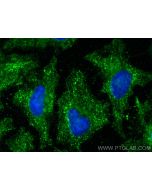
SRPK2 Polyclonal antibody 25417-1-AP proteintech
$149.00
In stock
SKU
25417-1-AP
| Catalog Number | 25417-1-AP |
| Synonyms | SFRS protein kinase 2, SFRSK2, SR protein specific kinase 2, SRPK2 |
| Host | Rabbit |
| Reactivity | human, mouse |
| Form | Liquid |
| Formulation | PBS, Azide, Glycerol |
| Applications | WB, IP, IF, IHC, ELISA |
| Applications | WB, IP, IHC, ELISA |
| Host / Isotype | Rabbit / IgG |
| Tested Applications — Positive WB detected in | HeLa cells |
| Tested Applications — Positive IP detected in | HeLa cells |
| Tested Applications — Positive IHC detected in | mouse testis tissue, mouse brain tissue Note: suggested antigen retrieval with TE buffer pH 9.0; (*) Alternatively, antigen retrieval may be performed with citrate buffer pH 6.0 |
| Recommended Dilutions — Western Blot (WB) | WB : 1:500-1:1000 |
| Recommended Dilutions — Immunoprecipitation (IP) | IP : 0.5-4.0 ug for 1.0-3.0 mg of total protein lysate |
| Recommended Dilutions — Immunohistochemistry (IHC) | IHC : 1:50-1:500 |
| Positive WB detected in | HeLa cells |
| Positive IP detected in | HeLa cells |
| Positive IHC detected in | mouse testis tissue, mouse brain tissue Note: suggested antigen retrieval with TE buffer pH 9.0; (*) Alternatively, antigen retrieval may be performed with citrate buffer pH 6.0 |
| Western Blot (WB) | WB : 1:500-1:1000 |
| Immunoprecipitation (IP) | IP : 0.5-4.0 ug for 1.0-3.0 mg of total protein lysate |
| Immunohistochemistry (IHC) | IHC : 1:50-1:500 |
| Tested Reactivity | human, mouse |
| Cited Reactivity | human |
| Class | Polyclonal |
| Type | Antibody |
| Immunogen | CatNo: Ag17885 Product name: Recombinant human SRPK2 protein Source: e coli. -derived, PGEX-4T Tag: GST Domain: 293-513 aa of BC035214 Sequence: LEREAERKIIEENITSAAPSNDQDGEYCPEVKLKTTGLEEAAEAETAKDNGEAEDQEEKEDAEKENIEKDEDDVDQELANIDPTWIESPKTNGHIENGPFSLEQQLDDEDDDEEDCPNPEEYNLDEPNAESDYTYSSSYEQFNGELPNGRHKIPESQFPEFSTSLFSGSLEPVACGSVLSEGSPLTEQEESSPSHDRSRTVSASSTGDLPKAKTRAADLLV Predict reactive species |
| Full Name | SFRS protein kinase 2 |
| Calculated Molecular Weight | 688 aa, 78 kDa |
| Observed Molecular Weight | 105-110 kDa |
| GenBank Accession Number | BC035214 |
| Gene Symbol | SRPK2 |
| Gene ID (NCBI) | 6733 |
| RRID | AB_2880068 |
| Conjugate | Unconjugated |
| Purification Method | Antigen affinity purification |
| UNIPROT ID | P78362 |
| Storage Buffer | PBS with 0.02% sodium azide and 50% glycerol, pH 7.3. |
| Storage Conditions | Store at -20°C. Stable for one year after shipment. Aliquoting is unnecessary for -20 o C storage. 20ul sizes contain 0.1% BSA. |
| IHC protocol for SRPK2 antibody 25417-1-AP | Download protocol |
| IP protocol for SRPK2 antibody 25417-1-AP | Download protocol |
| WB protocol for SRPK2 antibody 25417-1-AP | Download protocol |
| human | WB,IF Cancer Discov Stress Granules determine the Development of Obesity-associated Pancreatic Cancer. Authors - Guillaume Fonteneau View Article |
| Citations | 1 |
| Dilutions | WB : 1:500-1:1000 IP : 0.5-4.0 ug for IP and 0.5-4.0 ug for 1.0-3.0 mg of total protein lysate for WB IHC : 1:50-1:500 |
| Isotype | IgG |
| Clonality | Polyclonal |
| Clone Number | - |
| Conjugation | Unconjugated |
SRPK2, also named as serine/arginine protein kinase 2 and SFRSK2, belongs to SR protein-specific kinase family which phosphorylate the serine/arginine domain containing proteins in the nuclear speckles to mediate pre-mRNA splicing (PMID: 22854045). In addition to its major role as kinase for the phosphorylation of SR proteins, SRPK2 is involved in cell cycle regulation and cell apoptosis (PMID: 19592491). SRPK2 promotes the proliferation and migration of the colon cancer cells. It has been reported to be regulated in several cancer types (PMID: 27041240). It has 2 isoforms with the calculated molecular mass of 77-79 kDa, and the apparent molecular mass of 105-115 kDa due to posttranslational modification (PMID: 12134018, 16122776). Protocols Product Specific Protocols IHC protocol for SRPK2 antibody 25417-1-AP Download protocol IP protocol for SRPK2 antibody 25417-1-AP Download protocol WB protocol for SRPK2 antibody 25417-1-AP Download protocol Standard Protocols Click here to view our Standard Protocols
Publications