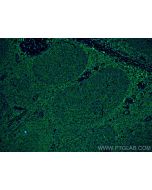
STAU1 Polyclonal antibody 14225-1-AP proteintech
$149.00
In stock
SKU
14225-1-AP
| Catalog Number | 14225-1-AP |
| Synonyms | Double-stranded RNA-binding protein Staufen homolog 1, STAU |
| Host | Rabbit |
| Reactivity | human, mouse, rat and More (2) |
| Reactivity | human, mouse, rat, pig, monkey |
| Form | Liquid |
| Formulation | PBS, Azide, Glycerol |
| Applications | WB, IHC, IF/ICC, IP, RIP, ELISA |
| Applications | WB, IHC, IF/ICC, IP, ELISA |
| Host / Isotype | Rabbit / IgG |
| Tested Applications — Positive WB detected in | HepG2 cells, human brain tissue, K-562 cells, mouse brain tissue, Jurkart cells |
| Tested Applications — Positive IP detected in | mouse brain tissue |
| Tested Applications — Positive IHC detected in | mouse brain tissue, mouse pancreas tissue Note: suggested antigen retrieval with TE buffer pH 9.0; (*) Alternatively, antigen retrieval may be performed with citrate buffer pH 6.0 |
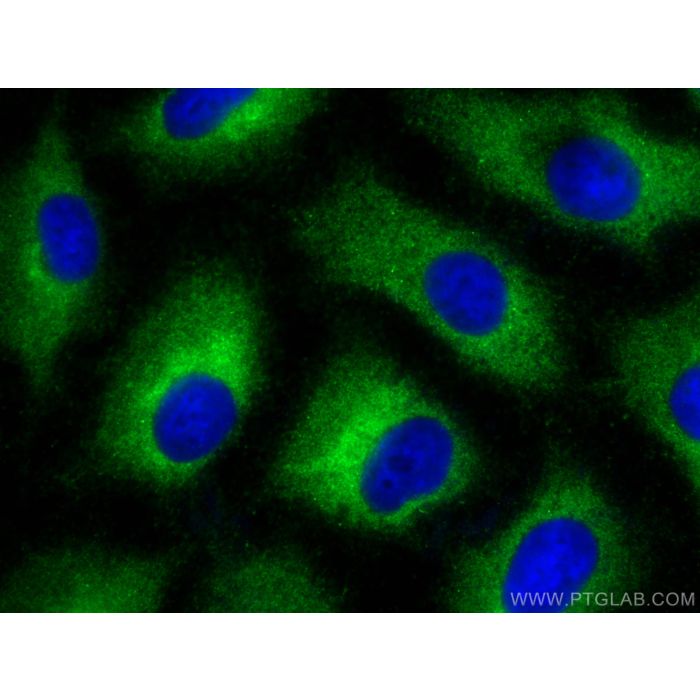
| Tested Applications — Positive IF/ICC detected in | A549 cells |
| Recommended Dilutions — Western Blot (WB) | WB : 1:2000-1:10000 |
| Recommended Dilutions — Immunoprecipitation (IP) | IP : 0.5-4.0 ug for 1.0-3.0 mg of total protein lysate |
| Recommended Dilutions — Immunohistochemistry (IHC) | IHC : 1:500-1:2000 |
| Recommended Dilutions — Immunofluorescence (IF)/ICC | IF/ICC : 1:200-1:800 |
| Positive WB detected in | HepG2 cells, human brain tissue, K-562 cells, mouse brain tissue, Jurkart cells |
| Positive IP detected in | mouse brain tissue |
| Positive IHC detected in | mouse brain tissue, mouse pancreas tissue Note: suggested antigen retrieval with TE buffer pH 9.0; (*) Alternatively, antigen retrieval may be performed with citrate buffer pH 6.0 |
| Positive IF/ICC detected in | A549 cells |
| Western Blot (WB) | WB : 1:2000-1:10000 |
| Immunoprecipitation (IP) | IP : 0.5-4.0 ug for 1.0-3.0 mg of total protein lysate |
| Immunohistochemistry (IHC) | IHC : 1:500-1:2000 |
| Immunofluorescence (IF)/ICC | IF/ICC : 1:200-1:800 |
| Tested Reactivity | human, mouse, rat |
| Cited Reactivity | human, mouse, rat, pig, monkey |
| Class | Polyclonal |
| Type | Antibody |
| Immunogen | CatNo: Ag5464 Product name: Recombinant human STAU1 protein Source: e coli. -derived, PGEX-4T Tag: GST Domain: 227-577 aa of BC050432 Sequence: GEGEGKSKKISKKNAAIAVLEELKKLPPLPAVERVKPRIKKKTKPIVKPQTSPEYGQGINPISRLAQIQQAKKEKEPEYTLLTERGLPRRREFVMQVKVGNHTAEGTGTNKKVAKRNAAENMLEILGFKVPQAQPTKPALKSEEKTPIKKPGDGRKVTFFEPGSGDENGTSNKEDEFRMPYLSHQQLPAGILPMVPEVAQAVGVSQGHHTKDFTRAAPNPAKATVTAMIARELLYGGTSPTAETILKNNISSGHVPHGPLTRPSEQLDYLSRVQGFQVEYKDFPKNNKNEFVSLINCSSQPPLISHGIGKDVESCHDMAALNILKLLSELDQQSTEMPRTGNGPMSVCGRC Predict reactive species |
| Full Name | staufen, RNA binding protein, homolog 1 (Drosophila) |
| Calculated Molecular Weight | 63 kDa |
| Observed Molecular Weight | 55 kDa |
| GenBank Accession Number | BC050432 |
| Gene Symbol | STAU1 |
| Gene ID (NCBI) | 6780 |
| RRID | AB_2302744 |
| Conjugate | Unconjugated |
| Purification Method | Antigen affinity purification |
| UNIPROT ID | O95793 |
| Storage Buffer | PBS with 0.02% sodium azide and 50% glycerol, pH 7.3. |
| Storage Conditions | Store at -20°C. Stable for one year after shipment. Aliquoting is unnecessary for -20 o C storage. 20ul sizes contain 0.1% BSA. |
| IF protocol for STAU1 antibody 14225-1-AP | Download protocol |
| IHC protocol for STAU1 antibody 14225-1-AP | Download protocol |
| IP protocol for STAU1 antibody 14225-1-AP | Download protocol |
| WB protocol for STAU1 antibody 14225-1-AP | Download protocol |
| human | WB Nucleic Acids Res Comprehensive analysis of the BC200 ribonucleoprotein reveals a reciprocal regulatory function with CSDE1/UNR. Authors - Evan P Booy View Article |
| mouse,human | WB,RIP,IHC Nat Commun Genome-wide enhancer-gene regulatory maps link causal variants to target genes underlying human cancer risk Authors - Pingting Ying View Article |
| Citations | 28 |
| Dilutions | WB : 1:2000-1:10000 IP : 0.5-4.0 ug for IP and 0.5-4.0 ug for 1.0-3.0 mg of total protein lysate for WB IHC : 1:500-1:2000 IF/ICC : 1:200-1:800 |
| Isotype | IgG |
| Clonality | Polyclonal |
| Clone Number | - |
| Conjugation | Unconjugated |
Staufen1 (STAU1)-mediated mRNA decay (SMD) degrades translationally active mRNAs that bind the double-stranded (ds)RNA binding protein STAU1 within their 3'-untranslated regions (3'UTRs) [PMID:21307942]. STAU1 can binds to stem structures and protect Dvl2 mRNA from degradation by associating with the secondary structure in the U1 region which is located at 5′ position of second U stretch in the U2 region [PMID:17510634]. It has a role in specific positioning of mRNAs at given sites in the cell by cross-linking cytoskeletal and RNA components, and in stimulating their translation at the site. There are two isoforms of STAU1 protein and the molecular weight of two isoforms are repectively 63 kDa and 55 kDa Protocols Product Specific Protocols IF protocol for STAU1 antibody 14225-1-AP Download protocol IHC protocol for STAU1 antibody 14225-1-AP Download protocol IP protocol for STAU1 antibody 14225-1-AP Download protocol WB protocol for STAU1 antibody 14225-1-AP Download protocol Standard Protocols Click here to view our Standard Protocols
Publications