STBD1 Polyclonal antibody 11842-1-AP proteintech

$149.00
In stock
SKU
11842-1-AP
Catalog No.SizePrice (USD)
11842-1-AP-20UL20 μL$149.00
11842-1-AP-150UL150 μL$449.00
Catalog Number11842-1-AP
SynonymsGenethonin 1, GENEX3414, GENX 3414, starch binding domain 1, STBD1
HostRabbit
Reactivityhuman, mouse and More (2)
Reactivityhuman, mouse, rat, chicken
FormLiquid
FormulationPBS, Azide, Glycerol
ApplicationsWB, IHC, IF, IP, CoIP, ELISA
ApplicationsWB, IP, IHC, ELISA
Host / IsotypeRabbit / IgG
Tested Applications — Positive WB detected inmouse skeletal muscle tissue, HeLa cells, A549 cells
Tested Applications — Positive IP detected inA549 cells
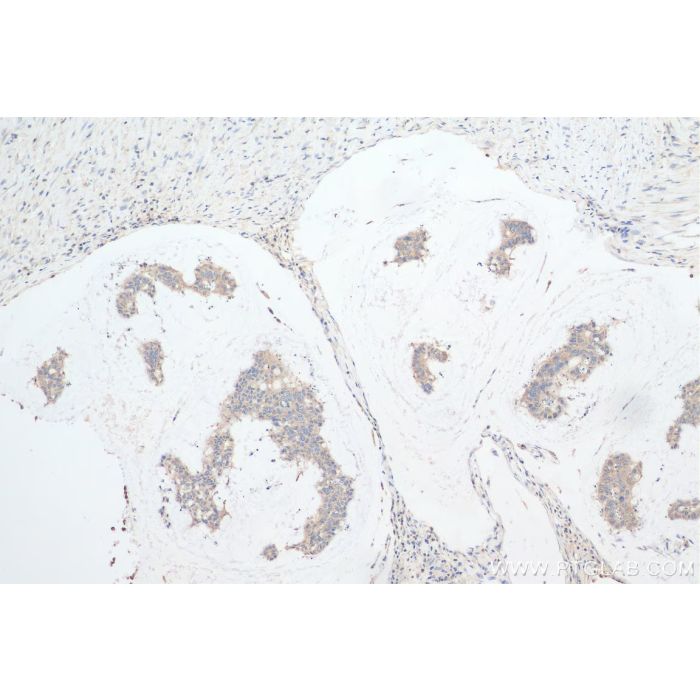
Tested Applications — Positive IHC detected inhuman colon cancer tissue Note: suggested antigen retrieval with TE buffer pH 9.0; (*) Alternatively, antigen retrieval may be performed with citrate buffer pH 6.0
Recommended Dilutions — Western Blot (WB)WB : 1:500-1:2000
Recommended Dilutions — Immunoprecipitation (IP)IP : 0.5-4.0 ug for 1.0-3.0 mg of total protein lysate
Recommended Dilutions — Immunohistochemistry (IHC)IHC : 1:50-1:500
Positive WB detected inmouse skeletal muscle tissue, HeLa cells, A549 cells
Positive IP detected inA549 cells
Positive IHC detected inhuman colon cancer tissue Note: suggested antigen retrieval with TE buffer pH 9.0; (*) Alternatively, antigen retrieval may be performed with citrate buffer pH 6.0
Western Blot (WB)WB : 1:500-1:2000
Immunoprecipitation (IP)IP : 0.5-4.0 ug for 1.0-3.0 mg of total protein lysate
Immunohistochemistry (IHC)IHC : 1:50-1:500
Tested Reactivityhuman, mouse
Cited Reactivityhuman, mouse, rat, chicken
ClassPolyclonal
TypeAntibody
ImmunogenCatNo: Ag2481 Product name: Recombinant human STBD1 protein Source: e coli. -derived, PGEX-4T Tag: GST Domain: 26-358 aa of BC022301 Sequence: GPGDTGKDGDAEQEKDAPLGGAAIPGGHQSGSSGLSPGPSGQELVTKPEHLQESNGHLISKTKDLGKLQAASWRLQNPSREVCDNSREHVPSGQFPDTEAPATSETSNSRSYSEVSRNESLESPMGEWGFQKGQEISAKAATCFAEKLPSSNLLKNRAKEEMSLSDLNSQDRVDHEEWEMVPRHSSWGDVGVGGSLKAPVLNLNQGMDNGRSTLVEARGQQVHGKMERVAVMPAGSQQVSVRFQVHYVTSTDVQFIAVTGDHECLGRWNTYIPLHYNKDGFWSHSIFLPADTVVEWKFVLVENGGVTRWEECSNRFLETGHEDKVVHAWWGIH Predict reactive species
Full Namestarch binding domain 1
Calculated Molecular Weight41 kDa
Observed Molecular Weight35-43 kDa
GenBank Accession NumberBC022301
Gene SymbolSTBD1
Gene ID (NCBI)8987
RRIDAB_2197523
ConjugateUnconjugated
Purification MethodAntigen affinity purification
UNIPROT IDO95210
Storage BufferPBS with 0.02% sodium azide and 50% glycerol, pH 7.3.
Storage ConditionsStore at -20°C. Stable for one year after shipment. Aliquoting is unnecessary for -20 o C storage. 20ul sizes contain 0.1% BSA.
IHC protocol for STBD1 antibody 11842-1-APDownload protocol
IP protocol for STBD1 antibody 11842-1-APDownload protocol
WB protocol for STBD1 antibody 11842-1-APDownload protocol
mouseWB Acta Pharmacol Sin Asiatic acid alleviates ischemic myocardial injury in mice by modulating mitophagy- and glycophagy-based energy metabolism. Authors - Fan Qiu View Article
human,mouseWB,IP Mol Cell Glucose-1-phosphate promotes compartmentalization of glycogen with the pentose phosphate pathway in CD8+ memory T cells Authors - Yabo Zhou View Article
Citations24
DilutionsWB : 1:500-1:2000 IP : 0.5-4.0 ug for IP and 0.5-4.0 ug for 1.0-3.0 mg of total protein lysate for WB IHC : 1:50-1:500
IsotypeIgG
ClonalityPolyclonal
Clone Number-
ConjugationUnconjugated

STBD1 may have the capability to bind to carbohydrates. It functions as a glycogen receptor that tethers glycogen to autophagic membranes for delivery and breakdown in lysosomes. STBD1 appears molecular mass of 35-38 kDa band in mouse/rat tissues and 38-43 kDa in human tissue. Protocols Product Specific Protocols IHC protocol for STBD1 antibody 11842-1-AP Download protocol IP protocol for STBD1 antibody 11842-1-AP Download protocol WB protocol for STBD1 antibody 11842-1-AP Download protocol Standard Protocols Click here to view our Standard Protocols

Publications
  1. Glycogen accumulation and phase separation drives liver tumor initiation.
    Journal: Cell | Authors: Qingxu Liu | Species: mouse | Application: IF
  2. Dysfunction of astrocytic glycophagy exacerbates reperfusion injury in ischemic stroke
    Journal: Redox Biol | Authors: Haiyun Guo | Species: human,mouse | Application: WB,IF
  3. Txnrd2 loss in skeletal muscle causes muscle atrophy and drives leanness and obesity resistance.
    Journal: Redox Biol | Authors: Claudia Kiermayer | Species: mouse | Application: WB
  4. Glucose-1-phosphate promotes compartmentalization of glycogen with the pentose phosphate pathway in CD8+ memory T cells
    Journal: Mol Cell | Authors: Yabo Zhou | Species: human,mouse | Application: WB,IP
  5. Asiatic acid alleviates ischemic myocardial injury in mice by modulating mitophagy- and glycophagy-based energy metabolism.
    Journal: Acta Pharmacol Sin | Authors: Fan Qiu | Species: mouse | Application: WB
  6. Glycogen Dynamics Drives Lipid Droplet Biogenesis during Brown Adipocyte Differentiation
    Journal: Cell Rep | Authors: Alicia Mayeuf-Louchart
  7. Glycogen Dynamics Drives Lipid Droplet Biogenesis during Brown Adipocyte Differentiation
    Journal: Cell Rep | Authors: Alicia Mayeuf-Louchart
  8. Endoplasmic reticulum stress-mediated glycophagy drives macrophage M1 polarization in silica nanoparticles-induced pulmonary fibrosis.
    Journal: J Environ Sci (China) | Authors: Lei Bao | Species: mouse | Application: WB,IF,CoIP
  9. Follicle-Stimulating Hormone Alleviates Ovarian Aging by Modulating Mitophagy- and Glycophagy-Based Energy Metabolism in Hens
    Journal: Cells | Authors: Juan Dong | Species: chicken | Application: WB,IP
  10. Mitochondrial protein import stress causes lysosomal damage and progressive tissue atrophy.
    Journal: EMBO Rep | Authors: Nicholas A Brennan | Species: mouse | Application: WB
  11. Defect in degradation of glycogenin-exposed residual glycogen in lysosomes is the fundamental pathomechanism of Pompe disease
    Journal: J Pathol | Authors: Na Zhang | Species: human | Application: IHC,IF
  12. Stbd1 promotes glycogen clustering during endoplasmic reticulum stress and supports survival of mouse myoblasts
    Journal: J Cell Sci | Authors: Andria A. Lytridou | Species: mouse | Application: WB,IF
  13. Defective liver glycogen autophagy related to hyperinsulinemia in intrauterine growth-restricted newborn wistar rats.
    Journal: Sci Rep | Authors: Juan de Toro-Martín | Species: rat | Application: WB
  14. Transgenic muscle specific Nor-1 expression regulates multiple pathways that effect adiposity, metabolism and endurance.
    Journal: Mol Endocrinol | Authors: Pearen Michael A MA | Species: mouse | Application: WB
  15. Chemical genetic screen identifies Gapex-5/GAPVD1 and STBD1 as novel AMPK substrates.
    Journal: Cell Signal | Authors: Serge Ducommun | Species: mouse | Application: WB
  16. Starch binding domain-containing protein 1/genethonin 1 is a novel participant in glycogen metabolism.
    Journal: J Biol Chem | Authors: Jiang Sixin S | Species: mouse,rat | Application: IF,IP
  17. Starch Binding Domain-containing Protein 1 Plays a Dominant Role in Glycogen Transport to Lysosomes in Liver.
    Journal: J Biol Chem | Authors: Tao Sun | Species: mouse | Application: WB
  18. Mouse Stbd1 is N-myristoylated and affects ER-mitochondria association and mitochondrial morphology.
    Journal: J Cell Sci | Authors: Anthi Demetriadou | Application: WB,IF
  19. Stbd1 promotes glycogen clustering during endoplasmic reticulum stress and supports survival of mouse myoblasts.
    Journal: J Cell Sci | Authors: Andria A Lytridou | Species: mouse | Application: WB,IF
  20. Mouse Stbd1 is N-myristoylated and affects ER-mitochondria association and mitochondrial morphology.
    Journal: J Cell Sci | Authors: Anthi Demetriadou | Application: WB,IF
  21. Increased Glycogenin-Exposed Residual Glycogen in Lysosomes Is the Early Pathological Finding in Asymptomatic Pompe Disease.
    Journal: Muscle Nerve | Authors: Yixin Shi | Species: human,mouse | Application: WB,IHC
  22. Differential regulation of hepatic macrophage fate by Chi3l1 in metabolic dysfunction-associated steatotic liver disease.
    Journal: Elife | Authors: Jia He | Species: mouse | Application: IF
  23. Common and distinct roles of AMPKγ isoforms in small-molecule activator-stimulated glucose uptake in mouse skeletal muscle.
    Journal: Mol Metab | Authors: Dipsikha Biswas
  24. Rab4b controls hepatic glucose production during fasting through glycophagy.
    Journal: Nat Commun | Authors: Marion Dussot

Reviews

Write Your Own Review
You're reviewing:STBD1 Polyclonal antibody 11842-1-AP proteintech
Your Rating
Copyright © 2025 Biogege, Inc. All rights reserved.