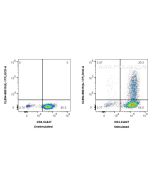
TEX14 Polyclonal antibody 18351-1-AP proteintech
$149.00
In stock
SKU
18351-1-AP
| Catalog Number | 18351-1-AP |
| Synonyms | SGK307, SGK307, Sugen kinase 307, testis expressed 14, Testis expressed protein 14, Testis expressed sequence 14, TEX14 |
| Host | Rabbit |
| Reactivity | human, mouse |
| Form | Liquid |
| Formulation | PBS, Azide, Glycerol |
| Applications | WB, IHC, IF, ELISA |
| Applications | IHC, ELISA |
| Host / Isotype | Rabbit / IgG |
| Tested Applications — Positive IHC detected in | mouse testis tissue Note: suggested antigen retrieval with TE buffer pH 9.0; (*) Alternatively, antigen retrieval may be performed with citrate buffer pH 6.0 |
| Recommended Dilutions — Immunohistochemistry (IHC) | IHC : 1:400-1:1600 |
| Positive IHC detected in | mouse testis tissue Note: suggested antigen retrieval with TE buffer pH 9.0; (*) Alternatively, antigen retrieval may be performed with citrate buffer pH 6.0 |
| Immunohistochemistry (IHC) | IHC : 1:400-1:1600 |
| Tested Reactivity | human, mouse |
| Cited Reactivity | human, mouse |
| Class | Polyclonal |
| Type | Antibody |
| Immunogen | CatNo: Ag13177 Product name: Recombinant human TEX14 protein Source: e coli. -derived, PGEX-4T Tag: GST Domain: 1149-1497 aa of BC040526 Sequence: QPVRSTEDEQEETSKESPKELKEKDISLTDIQDLSSISYEPDSSFKEASCKTPKINHAPTSVSTPLSPGSVSSAASQYKDCLESITFQVKTEFASCWNSQEFIQTLSDDFISVRERAKKLDSLLTSSETPPSRLTGLKRLSSFIGAGSPSLVKACDSSPPHATQRRSLPKVEAFSQHHIDELPPPSQELLDDIELLKQQQGSSTVLHENTASDGGGTANDQRHLEEQETDSKKEDSSMPLSKETEDLGEDTERAHSTLDEDLERWLQPPEESVELQDLPKGSERETNIKDQKVGEEKRKREDSITPERRKSEGVLGTSEEDELKSCFWKRLGWSESSRIIVLDQSDLSD Predict reactive species |
| Full Name | testis expressed 14 |
| Calculated Molecular Weight | 957aa,107 kDa; 1497aa,168 kDa |
| Observed Molecular Weight | 180-200 kDa, 106 kDa |
| GenBank Accession Number | BC040526 |
| Gene Symbol | TEX14 |
| Gene ID (NCBI) | 56155 |
| RRID | AB_10641992 |
| Conjugate | Unconjugated |
| Purification Method | Antigen affinity purification |
| UNIPROT ID | Q8IWB6 |
| Storage Buffer | PBS with 0.02% sodium azide and 50% glycerol, pH 7.3. |
| Storage Conditions | Store at -20°C. Stable for one year after shipment. Aliquoting is unnecessary for -20 o C storage. 20ul sizes contain 0.1% BSA. |
| IHC protocol for TEX14 antibody 18351-1-AP | Download protocol |
| WB protocol for TEX14 antibody 18351-1-AP | Download protocol |
| human | WB,IF Int J Mol Sci MCF7 Spheroid Development: New Insight about Spatio/Temporal Arrangements of TNTs, Amyloid Fibrils, Cell Connections, and Cellular Bridges. Authors - Laura Pulze View Article |
| mouse | IF Cell Death Dis Specific deletion of protein phosphatase 6 catalytic subunit in Sertoli cells leads to disruption of spermatogenesis. Authors - Wen-Long Lei View Article |
| human,mouse | IF FASEB J Dazl determines primordial follicle formation through the translational regulation of Tex14. Authors - Roseanne Rosario View Article |
| Citations | 10 |
| Dilutions | IHC : 1:400-1:1600 |
| Isotype | IgG |
| Clonality | Polyclonal |
| Clone Number | - |
| Conjugation | Unconjugated |
Tex14 is required both for the formation of intercellular bridges during meiosis and for kinetochore-microtubule attachment during mitosis. Intercellular bridges are evolutionarily conserved structures that connect differentiating germ cells and are required for spermatogenesis and male fertility. Tex14 acts by promoting the conversion of midbodies into intercellular bridges via its interaction with CEP55: interaction with CEP55 inhibits the interaction between CEP55 and PDCD6IP/ALIX and TSG101, blocking cell abscission and leading to transform midbodies into intercellular bridges.Tex14 also plays a role during mitosis: recruited to kinetochores by PLK1 during early mitosis and regulates the maturation of the outer kinetochores and microtubule attachment. Tex14 has several variant isoforms with the MW from about 100 kDa to 168 kDa. Protocols Product Specific Protocols IHC protocol for TEX14 antibody 18351-1-AP Download protocol WB protocol for TEX14 antibody 18351-1-AP Download protocol Standard Protocols Click here to view our Standard Protocols
Publications