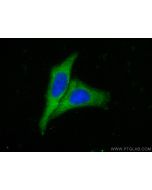
TIM4 Polyclonal antibody 12008-1-AP proteintech
$149.00
In stock
SKU
12008-1-AP
| Catalog Number | 12008-1-AP |
| Synonyms | TIMD4, SMUCKLER, T-cell immunoglobulin and mucin domain-containing protein 4, T-cell immunoglobulin mucin receptor 4, T-cell membrane protein 4 |
| Host | Rabbit |
| Reactivity | human and More (1) |
| Reactivity | human, mouse |
| Form | Liquid |
| Formulation | PBS, Azide, Glycerol |
| Applications | WB, IHC, IF-P, ELISA |
| Applications | IHC, IF-P, ELISA |
| Host / Isotype | Rabbit / IgG |
| Tested Applications — Positive IHC detected in | human tonsillitis tissue, human liver tissue Note: suggested antigen retrieval with TE buffer pH 9.0; (*) Alternatively, antigen retrieval may be performed with citrate buffer pH 6.0 |
| Tested Applications — Positive IF-P detected in | human tonsillitis tissue |
| Recommended Dilutions — Immunohistochemistry (IHC) | IHC : 1:400-1:1600 |
| Recommended Dilutions — Immunofluorescence (IF)-P | IF-P : 1:50-1:500 |
| Positive IHC detected in | human tonsillitis tissue, human liver tissue Note: suggested antigen retrieval with TE buffer pH 9.0; (*) Alternatively, antigen retrieval may be performed with citrate buffer pH 6.0 |
| Positive IF-P detected in | human tonsillitis tissue |
| Immunohistochemistry (IHC) | IHC : 1:400-1:1600 |
| Immunofluorescence (IF)-P | IF-P : 1:50-1:500 |
| Tested Reactivity | human |
| Cited Reactivity | human, mouse |
| Class | Polyclonal |
| Type | Antibody |
| Immunogen | CatNo: Ag2621 Product name: Recombinant human TIMD4 protein Source: e coli. -derived, PGEX-4T Tag: GST Domain: 24-378 aa of BC008988 Sequence: SETVVTEVLGHRVTLPCLYSSWSHNSNSMCWGKDQCPYSGCKEALIRTDGMRVTSRKSAKYRLQGTIPRGDVSLTILNPSESDSGVYCCRIEVPGWFNDVKINVRLNLQRASTTTHRTATTTTRRTTTTSPTTTRQMTTTPAALPTTVVTTPDLTTGTPLQMTTIAVFTTANTCLSLTPSTLPEEATGLLTPEPSKEGPILTAESETVLPSDSWSSAESTSADTVLLTSKESKVWDLPSTSHVSMWKTSDSVSSPQPGASDTAVPEQNKTTKTGQMDGIPMSMKNEMPISQLLMIIAPSLGFVLFALFVAFLLRGKLMETYCSQKHTRLDYIGDSKNVLNDVQHGREDEDGLFTL Predict reactive species |
| Full Name | T-cell immunoglobulin and mucin domain containing 4 |
| Calculated Molecular Weight | 378 aa, 42 kDa |
| GenBank Accession Number | BC008988 |
| Gene Symbol | TIM4 |
| Gene ID (NCBI) | 91937 |
| RRID | AB_2877816 |
| Conjugate | Unconjugated |
| Purification Method | Antigen affinity purification |
| UNIPROT ID | Q96H15 |
| Storage Buffer | PBS with 0.02% sodium azide and 50% glycerol, pH 7.3. |
| Storage Conditions | Store at -20°C. Stable for one year after shipment. Aliquoting is unnecessary for -20 o C storage. 20ul sizes contain 0.1% BSA. |
| IF protocol for TIM4 antibody 12008-1-AP | Download protocol |
| IHC protocol for TIM4 antibody 12008-1-AP | Download protocol |
| goat | Adv Sci (Weinh) Bone Marrow Mesenchymal Stem Cell-Derived Dermcidin-Containing Migrasomes enhance LC3-Associated Phagocytosis of Pulmonary Macrophages and Protect against Post-Stroke Pneumonia Authors - Tiemei Li View Article |
| mouse | IHC Biomedicines Comparative Proteomic Analysis of tPVAT during Ang II Infusion. Authors - Xiuying Liang View Article |
| human | IF Pathol Res Pract Multi-omic and functional analyses identified an endoplasmic reticulum stress-driven TIMD4⁺ IL1β⁺ macrophage subpopulation contributes to osteoarthritis progression. Authors - Ruicong Hao View Article |
| Citations | 12 |
| Dilutions | IHC : 1:400-1:1600 IF-P : 1:50-1:500 |
| Isotype | IgG |
| Clonality | Polyclonal |
| Clone Number | - |
| Conjugation | Unconjugated |
T-cell immunoglobulin and mucin domain-containing protein 4 (TIM4) belongs to the phosphatidylserine receptor family and acts as a key regulator of immunity. It is responsible for phagocytosis of apoptotic cells and T cell modulation (PMID: 18082433; 32640697). Moreover, TIM4 drives efferocytosis, a process wherein phagocytes eliminate apoptotic cells, by boosting the engulfment of apoptotic bodies and exogenous substances (PMID: 18082433; 32703939; 34067457). Protocols Product Specific Protocols IF protocol for TIM4 antibody 12008-1-AP Download protocol IHC protocol for TIM4 antibody 12008-1-AP Download protocol Standard Protocols Click here to view our Standard Protocols
Publications