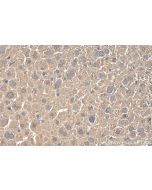
ANKRD53 Polyclonal antibody 24283-1-AP proteintech
$149.00
In stock
SKU
24283-1-AP
| Catalog Number | 24283-1-AP |
| Synonyms | ankyrin repeat domain 53, Ankyrin repeat domain-containing protein 53 |
| Host | Rabbit |
| Reactivity | human, mouse, rat |
| Form | Liquid |
| Formulation | PBS, Azide, Glycerol |
| Applications | WB, IHC, IF/ICC, ELISA |
| Host / Isotype | Rabbit / IgG |
| Tested Applications — Positive WB detected in | HeLa cells, HepG2 cells |
| Tested Applications — Positive IHC detected in | human rectal cancer tissue, mouse testis tissue, mouse stomach tissue, rat stomach tissue Note: suggested antigen retrieval with TE buffer pH 9.0; (*) Alternatively, antigen retrieval may be performed with citrate buffer pH 6.0 |
| Tested Applications — Positive IF/ICC detected in | HepG2 cells |
| Recommended Dilutions — Western Blot (WB) | WB : 1:500-1:2000 |
| Recommended Dilutions — Immunohistochemistry (IHC) | IHC : 1:500-1:2000 |
| Recommended Dilutions — Immunofluorescence (IF)/ICC | IF/ICC : 1:50-1:500 |
| Positive WB detected in | HeLa cells, HepG2 cells |
| Positive IHC detected in | human rectal cancer tissue, mouse testis tissue, mouse stomach tissue, rat stomach tissue Note: suggested antigen retrieval with TE buffer pH 9.0; (*) Alternatively, antigen retrieval may be performed with citrate buffer pH 6.0 |
| Positive IF/ICC detected in | HepG2 cells |
| Western Blot (WB) | WB : 1:500-1:2000 |
| Immunohistochemistry (IHC) | IHC : 1:500-1:2000 |
| Immunofluorescence (IF)/ICC | IF/ICC : 1:50-1:500 |
| Tested Reactivity | human, mouse, rat |
| Cited Reactivity | human |
| Class | Polyclonal |
| Type | Antibody |
| Immunogen | CatNo: Ag15030 Product name: Recombinant human ANKRD53 protein Source: e coli. -derived, PGEX-4T Tag: GST Domain: 1-343 aa of BC035234 Sequence: MASAGSTARRAGSGSWHSERGEGRGARPQPTPSGSMQQANKVSLKATWTDAESKQPSQPLPDLADHLSAQATALARPRRPASLTPPRADPSPSKESDQTAIDQTAIGSYYQLFAAAVGNVEWLRFCLNQSLREIPTDDKGFTAIHFAAQWGKIACLQVLVEEYKFPVDLLTNNSQTPLHLVIHRDNTTVALPCIYYLLEKGADLNAQTCNGSTPLHLAARDGLLDCVKVLVQSGANVHAQDAMGYKPIDFCKIWNHRACARFLKDAMWKKDKKDFAREMTKMKMFKSQLTLMEHNYLIEYQGQGCSVHFPFAFSPITPETLLWQDISLLSDCGFLWRRRELSF Predict reactive species |
| Full Name | ankyrin repeat domain 53 |
| Calculated Molecular Weight | 530 aa, 60 kDa |
| Observed Molecular Weight | 60-70 kDa |
| GenBank Accession Number | BC035234 |
| Gene Symbol | ANKRD53 |
| Gene ID (NCBI) | 79998 |
| RRID | AB_2879470 |
| Conjugate | Unconjugated |
| Purification Method | Antigen affinity purification |
| UNIPROT ID | Q8N9V6 |
| Storage Buffer | PBS with 0.02% sodium azide and 50% glycerol, pH 7.3. |
| Storage Conditions | Store at -20°C. Stable for one year after shipment. Aliquoting is unnecessary for -20 o C storage. 20ul sizes contain 0.1% BSA. |
| IF protocol for ANKRD53 antibody 24283-1-AP | Download protocol |
| IHC protocol for ANKRD53 antibody 24283-1-AP | Download protocol |
| WB protocol for ANKRD53 antibody 24283-1-AP | Download protocol |
| human | WB Mol Metab ANKRD53 is downregulated in human obesity and coordinates lipolysis with mitochondrial oxidative metabolism in adipocytes. Authors - Yingying Su KD Validated View Article |
| Human | Discov Oncol Integrative analysis indicates the potential values of ANKRD53 in stomach adenocarcinoma Authors - Chunjing Jin View Article |
| Citations | 2 |
| Dilutions | WB : 1:500-1:2000 IHC : 1:500-1:2000 IF/ICC : 1:50-1:500 |
| Isotype | IgG |
| Clonality | Polyclonal |
| Clone Number | - |
| Conjugation | Unconjugated |
ANKRD53 also termed as ankyrin repeat domain 53 is a 533 amino-acid protein,which contains three ANK repeats and belongs to ankyrin family. The function of ANKRD53 is still non-known and need to be further studied. Ankyrins are membrane adaptor molecules that play important roles in coupling integral membrane proteins to the spectrin-based cytoskeleton network. Protocols Product Specific Protocols IF protocol for ANKRD53 antibody 24283-1-AP Download protocol IHC protocol for ANKRD53 antibody 24283-1-AP Download protocol WB protocol for ANKRD53 antibody 24283-1-AP Download protocol Standard Protocols Click here to view our Standard Protocols
Publications