TULP3 Polyclonal antibody 13637-1-AP proteintech
$149.00
In stock
SKU
13637-1-AP
| Catalog Number | 13637-1-AP |
| Synonyms | Tubby-like protein 3, Tubby-related protein 3, TUBL3 |
| Host | Rabbit |
| Reactivity | human, mouse, rat |
| Form | Liquid |
| Formulation | PBS, Azide, Glycerol |
| Applications | WB, IHC, IF/ICC, IP, CoIP, ELISA |
| Applications | WB, IHC, IF/ICC, IP, ELISA |
| Host / Isotype | Rabbit / IgG |
| Tested Applications — Positive WB detected in | HEK-293 cells, SH-SY5Y cells, HeLa cells, SK-N-SH cells |
| Tested Applications — Positive IP detected in | SH-SY5Y cells |
| Tested Applications — Positive IHC detected in | human ovary cancer tissue, human gliomas tissue Note: suggested antigen retrieval with TE buffer pH 9.0; (*) Alternatively, antigen retrieval may be performed with citrate buffer pH 6.0 |
| Tested Applications — Positive IF/ICC detected in | hTERT-RPE1 cells |
| Recommended Dilutions — Western Blot (WB) | WB : 1:1000-1:8000 |
| Recommended Dilutions — Immunoprecipitation (IP) | IP : 0.5-4.0 ug for 1.0-3.0 mg of total protein lysate |
| Recommended Dilutions — Immunohistochemistry (IHC) | IHC : 1:50-1:500 |
| Recommended Dilutions — Immunofluorescence (IF)/ICC | IF/ICC : 1:50-1:500 |
| Positive WB detected in | HEK-293 cells, SH-SY5Y cells, HeLa cells, SK-N-SH cells |
| Positive IP detected in | SH-SY5Y cells |
| Positive IHC detected in | human ovary cancer tissue, human gliomas tissue Note: suggested antigen retrieval with TE buffer pH 9.0; (*) Alternatively, antigen retrieval may be performed with citrate buffer pH 6.0 |
| Positive IF/ICC detected in | hTERT-RPE1 cells |
| Western Blot (WB) | WB : 1:1000-1:8000 |
| Immunoprecipitation (IP) | IP : 0.5-4.0 ug for 1.0-3.0 mg of total protein lysate |
| Immunohistochemistry (IHC) | IHC : 1:50-1:500 |
| Immunofluorescence (IF)/ICC | IF/ICC : 1:50-1:500 |
| Tested Reactivity | human, mouse, rat |
| Cited Reactivity | human, mouse |
| Class | Polyclonal |
| Type | Antibody |
| Immunogen | CatNo: Ag4570 Product name: Recombinant human TULP3 protein Source: e coli. -derived, PGEX-4T Tag: GST Domain: 96-442 aa of BC032587 Sequence: DEVHAPSVSSSVVEEDAENTVDTASKPGLQERLQKHDISESVNFDEETDGISQSACLERPNSASSQNSTDTGTSGSATAAQPADNLLGDIDYLEDFVYSPAPQGVTVRCRIIRDKRGMDRGLFPTYYMYLEKEENQKIFLLAARKRKKSKTANYLISIDPVDLSREGESYVGKLRSNLMGTKFTVYDRGICPMKGRGLVGAAHTRQELAAISYETNVLGFKGPRKMSVIIPGMTLNHKQIPYQPQNNHDSLLSRWQNRTMENLVELHNKAPVWNSDTQSYVLNFRGRVTQASVKNFQIVHKNDPDYIVMQFGRVADDVFTLDYNYPLCAVQAFGIGLSSFDSKLACE Predict reactive species |
| Full Name | tubby like protein 3 |
| Calculated Molecular Weight | 442 aa, 50 kDa |
| Observed Molecular Weight | 60 kDa |
| GenBank Accession Number | BC032587 |
| Gene Symbol | TULP3 |
| Gene ID (NCBI) | 7289 |
| RRID | AB_2211547 |
| Conjugate | Unconjugated |
| Purification Method | Antigen affinity purification |
| UNIPROT ID | O75386 |
| Storage Buffer | PBS with 0.02% sodium azide and 50% glycerol, pH 7.3. |
| Storage Conditions | Store at -20°C. Stable for one year after shipment. Aliquoting is unnecessary for -20 o C storage. 20ul sizes contain 0.1% BSA. |
| IF protocol for TULP3 antibody 13637-1-AP | Download protocol |
| IHC protocol for TULP3 antibody 13637-1-AP | Download protocol |
| IP protocol for TULP3 antibody 13637-1-AP | Download protocol |
| WB protocol for TULP3 antibody 13637-1-AP | Download protocol |
| human | WB J Cell Sci RABL2 positively controls localization of GPCRs in mammalian primary cilia. Authors - Izumi Dateyama View Article |
| mouse | IF J Biol Chem Deletion of the phosphatase INPP5E in the murine retina impairs photoreceptor axoneme formation and prevents disc morphogenesis. Authors - Ali S Sharif View Article |
| Evan (Verified Customer) (09-30-2019) | One of the worst antibodies I have ever used. I do not believe this antibody accurately detects Tulp3 by western blotting at all. The amount of non-specific bands at all sizes is so bad this antibody is pretty much only good for a protein stain. I have wasted weeks trying to get this antibody to work to no avail. Avoid this product for western blotting at all costs. Applications: Western Blot, Primary Antibody Dilution: 1/1000 Cell Tissue Type: HEK293T |
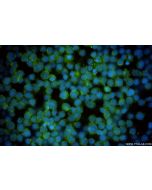
| Francesc (Verified Customer) (09-19-2018) | We previously described that TULP3 (a PIP2-binding protein) accumulates in INPP5E-KO cilia, which also accumulate PIP2 (Garcia-Gonzalo et al. 2015 Dev Cell 34:400-409). We have successfully confirmed those results using Proteintech's anti-TULP3 antibody (13637-1-AP) in both mouse embryonic fibroblasts (MEFs, see my previous review) and in hTERT-RPE1 cells (here). This TULP3 antibody works beautifully, especially in human cells (it also works well in MEFs, but ciliary signal is less intense and lower dilution is needed). As far as I know, this is the best commercial anti-TULP3 available. Applications: Immunofluorescence, Primary Antibody Dilution: 1/200 Cell Tissue Type: hTERT-RPE1 cells (human origin) TULP3 Antibody Immunofluorescence, validation (1/200 dilution) in hTERT-RPE1 cells (human origin) (Cat no:13637-1-AP) |
| Citations | 20 |
| Dilutions | WB : 1:1000-1:8000 IP : 0.5-4.0 ug for IP and 0.5-4.0 ug for 1.0-3.0 mg of total protein lysate for WB IHC : 1:50-1:500 IF/ICC : 1:50-1:500 |
| Isotype | IgG |
| Clonality | Polyclonal |
| Clone Number | - |
| Conjugation | Unconjugated |
The tubby-like protein 3 (TULP3) has been identified as a member of tubby and tubby-like proteins (TULPs) that plays an important role in maintenance and function of neuronal cells during development and post-differentiation. Tulp3 gene is essential for embryonic development in mice. Recently TULP3 has been reported to bind to the IFT (intraflagellar transport)-A complex and promote trafficking of G protein-coupled receptors into primary cilia, which is implicated in regulating neuronal function. Protocols Product Specific Protocols IF protocol for TULP3 antibody 13637-1-AP Download protocol IHC protocol for TULP3 antibody 13637-1-AP Download protocol IP protocol for TULP3 antibody 13637-1-AP Download protocol WB protocol for TULP3 antibody 13637-1-AP Download protocol Standard Protocols Click here to view our Standard Protocols
Publications