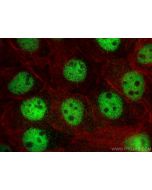
XRCC4 Polyclonal antibody 15817-1-AP proteintech
$149.00
In stock
SKU
15817-1-AP
| Catalog Number | 15817-1-AP |
| Synonyms | DNA repair protein XRCC4, hXRCC4, Protein XRCC4, C-terminus, X-ray repair cross-complementing protein 4 |
| Host | Rabbit |
| Reactivity | human, rat and More (1) |
| Reactivity | human, rat, mouse |
| Form | Liquid |
| Formulation | PBS, Azide, Glycerol |
| Applications | WB, IHC, IF, IP, ELISA |
| Applications | WB, IHC, IP, ELISA |
| Host / Isotype | Rabbit / IgG |
| Tested Applications — Positive WB detected in | HepG2 cells, HEK-293 cells, COLO 320 cells |
| Tested Applications — Positive IP detected in | HepG2 cells |
| Tested Applications — Positive IHC detected in | human breast cancer tissue, rat testis tissue, rat small intestine tissue Note: suggested antigen retrieval with TE buffer pH 9.0; (*) Alternatively, antigen retrieval may be performed with citrate buffer pH 6.0 |
| Recommended Dilutions — Western Blot (WB) | WB : 1:500-1:2000 |
| Recommended Dilutions — Immunoprecipitation (IP) | IP : 0.5-4.0 ug for 1.0-3.0 mg of total protein lysate |
| Recommended Dilutions — Immunohistochemistry (IHC) | IHC : 1:50-1:500 |
| Positive WB detected in | HepG2 cells, HEK-293 cells, COLO 320 cells |
| Positive IP detected in | HepG2 cells |
| Positive IHC detected in | human breast cancer tissue, rat testis tissue, rat small intestine tissue Note: suggested antigen retrieval with TE buffer pH 9.0; (*) Alternatively, antigen retrieval may be performed with citrate buffer pH 6.0 |
| Western Blot (WB) | WB : 1:500-1:2000 |
| Immunoprecipitation (IP) | IP : 0.5-4.0 ug for 1.0-3.0 mg of total protein lysate |
| Immunohistochemistry (IHC) | IHC : 1:50-1:500 |
| Tested Reactivity | human, rat |
| Cited Reactivity | human, mouse |
| Class | Polyclonal |
| Type | Antibody |
| Immunogen | CatNo: Ag8606 Product name: Recombinant human XRCC4 protein Source: e coli. -derived, PGEX-4T Tag: GST Domain: 6-310 aa of BC005259 Sequence: SRIHLVSEPSITHFLQVSWEKTLESGFVITLTDGHSAWTGTVSESEISQEADDMAMEKGKYVGELRKALLSGAGPADVYTFNFSKESCYFFFEKNLKDVSFRLGSFNLEKVENPAEVIRELICYCLDTIAENQAKNEHLQKENERLLRDWNDVQGRFEKCVSAKEALETDLYKRFILVLNEKKTKIRSLHNKLLNAAQEREKDIKQEGETAICSEMTADRDPVYDESTDEESENQTDLSGLASAAVSKDDSIISSLDVTDIAPSRKRRQRMQRNLGTEPKMAPQENQLQEKEKGRKKETSEKEAV Predict reactive species |
| Full Name | X-ray repair complementing defective repair in Chinese hamster cells 4 |
| Calculated Molecular Weight | 310 aa, 35 kDa |
| Observed Molecular Weight | 55 kDa |
| GenBank Accession Number | BC005259 |
| Gene Symbol | XRCC4 |
| Gene ID (NCBI) | 7518 |
| RRID | AB_2257478 |
| Conjugate | Unconjugated |
| Purification Method | Antigen affinity purification |
| UNIPROT ID | Q13426 |
| Storage Buffer | PBS with 0.02% sodium azide and 50% glycerol, pH 7.3. |
| Storage Conditions | Store at -20°C. Stable for one year after shipment. Aliquoting is unnecessary for -20 o C storage. 20ul sizes contain 0.1% BSA. |
| IHC protocol for XRCC4 antibody 15817-1-AP | Download protocol |
| IP protocol for XRCC4 antibody 15817-1-AP | Download protocol |
| WB protocol for XRCC4 antibody 15817-1-AP | Download protocol |
| human | WB Toxicol Appl Pharmacol Polychlorinated biphenyl quinone induces oxidative DNA damage and repair responses: The activations of NHEJ, BER and NER via ATM-p53 signaling axis. Authors - Hui Dong View Article |
| Mohammed (Verified Customer) (05-20-2026) | The product is good and gives reproducible ChIP-Seq results. Applications: ChIP Cell Tissue Type: U2OS |
| Mohammed (Verified Customer) (04-22-2026) | The antibody works perfect for ChIP-seq and it gives reporducible results Applications: ChIP Primary Antibody Dilution: 1:250 Cell Tissue Type: U2OS |
| Alexandra (Verified Customer) (07-02-2024) | For plasmid expression it works fine with 1000x dilution, but for the detection of endogenous XRCC4 I recommend the use of 500x dilution. Applications: Western Blot, Immunofluorescence, Immunoprecipitation, Cell culture Primary Antibody Dilution: 1000x Cell Tissue Type: U2OS XRCC4 Antibody Western Blot,Immunofluorescence,Immunoprecipitation,Cell culture validation (1000x dilution) in U2OS (Cat no:15817-1-AP) |
| Citations | 17 |
| Dilutions | WB : 1:500-1:2000 IP : 0.5-4.0 ug for IP and 0.5-4.0 ug for 1.0-3.0 mg of total protein lysate for WB IHC : 1:50-1:500 |
| Isotype | IgG |
| Clonality | Polyclonal |
| Clone Number | - |
| Conjugation | Unconjugated |
There are at least two pathways for eukaryotes to repair DNA double-strand breaks: homologous recombination and nonhomologous end joining(NHEJ). XRCC4 is one of the core machiney of NHEJ that required for double-strand break repair and V(D)J recombination. The DNA ligase IV(LIG4)-XRCC4 complex is responsible for the NHEJ ligation step, and XRCC4 enhances the joining activity of LIG4. Protocols Product Specific Protocols IHC protocol for XRCC4 antibody 15817-1-AP Download protocol IP protocol for XRCC4 antibody 15817-1-AP Download protocol WB protocol for XRCC4 antibody 15817-1-AP Download protocol Standard Protocols Click here to view our Standard Protocols
Publications