ChromoTek pan-RFP Polyclonal antibody pabr1 proteintech
$149.00
In stock
SKU
pabr1
| Synonyms | Red fluorescent protein, RFP, mRFP, dsRed, mCherry, tdTomato, mScarlet, TagRFP, TagBFP, mKate, mRuby |
| Reactivity | WB, IF, ELISA |
| Reactivity | Recombinant proteins, stably and transiently transfected cell lines; red fluorescent proteins from Discosoma (dsRed, mCherry, tdTomato, mPlum); fluorescent proteins from Entacmaea lineages (TagRFP, TagBFP, mKate2, mRuby2), synthetic red fluorescent protein mScarlet. |
| Form | Liquid |
| Formulation | United States |
| Applications | WB, IF, ELISA |
| Recommended Dilution | Western blot: 1:1,000 IF: 1:400-1:800 ELISA: N/A |
| Host / Isotype | Rabbit / IgG |
| Description | Rabbit polyclonal antibody to Red Fluorescent Protein |
| Specificity/Target | TagBFP, DsRed, mCherry, mRuby2, mScarlet, TagRFP, tdTomato, mKate2, mPlum |
| Host/IsoType | Rabbit / IgG |
| Class | Polyclonal |
| Type | Primary Antibody |
| Immunogen | Red Fluorescent Proteins (RFPs), a mixture of several representatives from different lineages |
| Calculated molecular weight | 26kDa |
| Conjugate | Unconjugated |
| Purification Method | Antigen affinity purification |
| RRID | AB_3101915 |
| Storage Buffer | PBS with 50% glycerol and 0.05% NaN3 |
| Storage Condition | Shipped on ice. Store at -20°C. Stable for 1 year after shipment. |
| Size | 20 µL; 150 µL |
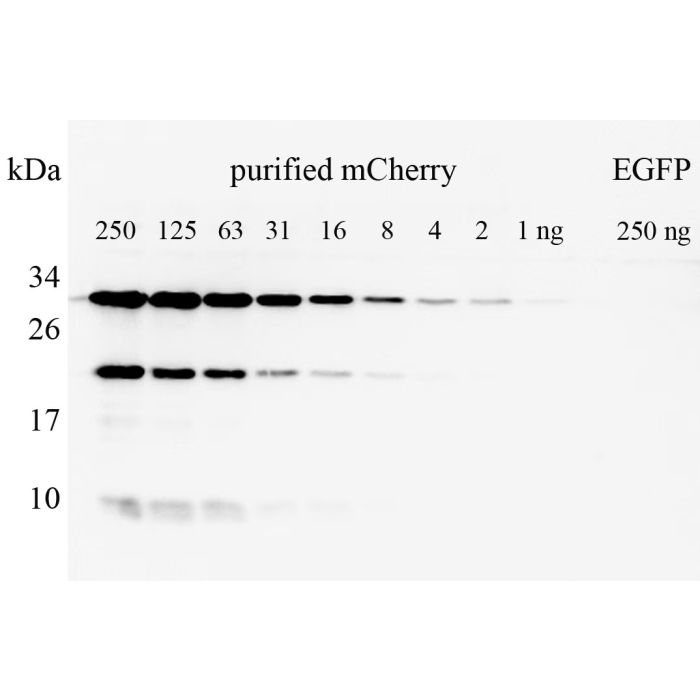
| Background | Red fluorescent proteins (RFPs) is a collective term referring to a heterogenous group of red chromophore-carrying proteins, originating from various species and forming different protein lineages. The original RFP (dsRed) is a 225 amino acid fluorescent protein (25.9 kDa) derived from Discosoma sp.. It emits red light with a peak wavelength of 593 nm upon excitation by green light (excitation peak at 558 nm). When fused with other proteins, RFP serves as a versatile reporter protein e.g. for quantifying expression levels or facilitates visualization of subcellular localization through fluorescence microscopy. PABR1 is a rabbit polyclonal antibody raised against a mixture of RFP and can detect a broad range of RFPs from different species. This antibody detects dsRed-derivatives from Discosoma sp., including mCherry, mRFP, tdTomato, mPlum. PABR1 antibody also detects representatives of different FP lineages from Entacmaea sp., such as eqFP578-derivatives including TagRFP, TagBFP, mKate2, as well as eqFP611-derivatives including mRuby2. PABR1 also detects the red fluorescent protein mScarlet, engineered from a synthetic template. |
| WB | Sci Adv Comparative proteomic profiling of receptor kinase signaling reveals key trafficking components enforcing plant stomatal development. Authors - Pengfei Bai View Article |
| IHC | Mol Psychiatry BDNF restores impaired long-term potentiation of GABAergic synapses induced by chronic ethanol exposure in the VTA and attenuates reward-seeking behavior. Authors - Jun-Wei Xiong View Article |
| IF | Adipocyte A non-invasive method for light-inducible knockout across all cell types in mouse subcutaneous adipose tissue. Authors - Erica de Sousa KO Validated View Article |
| FH Sreejith (Verified Customer) (11-19-2024) | Several strong non-specific bands with cell lysate and couldn't detect our protein of interest. Applications: Western Blot Cell Tissue Type: Physcomitrella patens |
Publications