
Centrin 1 Polyclonal antibody 12794-1-AP proteintech

$149.00
In stock
SKU
12794-1-AP
Catalog No.SizePrice (USD)
12794-1-AP-20UL20 μL$149.00
12794-1-AP-150UL150 μL$449.00
Catalog Number12794-1-AP
SynonymsCETN1, Caltractin isoform 2, CEN1, Centrin-1, CETN
HostRabbit
Reactivityhuman and More (2)
Reactivityhuman, mouse, zebrafish
FormLiquid
FormulationPBS, Azide, Glycerol
ApplicationsWB, IF/ICC, ELISA
Host / IsotypeRabbit / IgG
Tested Applications — Positive WB detected inHL-60 cells, HeLa cells, human heart tissue
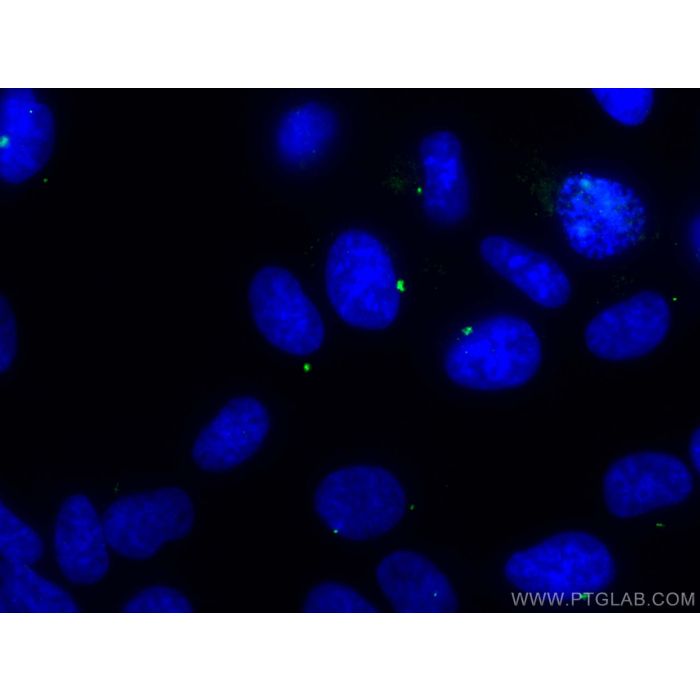
Tested Applications — Positive IF/ICC detected inhTERT-RPE1 cells, HeLa cells
Recommended Dilutions — Western Blot (WB)WB : 1:500-1:2000
Recommended Dilutions — Immunofluorescence (IF)/ICCIF/ICC : 1:200-1:800
Positive WB detected inHL-60 cells, HeLa cells, human heart tissue
Positive IF/ICC detected inhTERT-RPE1 cells, HeLa cells
Western Blot (WB)WB : 1:500-1:2000
Immunofluorescence (IF)/ICCIF/ICC : 1:200-1:800
Tested Reactivityhuman
Cited Reactivityhuman, mouse, zebrafish
ClassPolyclonal
TypeAntibody
ImmunogenCatNo: Ag3529 Product name: Recombinant human CETN1 protein Source: e coli. -derived, PGEX-4T Tag: GST Domain: 1-172 aa of BC029515 Sequence: MASGFKKPSAASTGQKRKVAPKPELTEDQKQEVREAFDLFDVDGSGTIDAKELKVAMRALGFEPRKEEMKKMISEVDREGTGKISFNDFLAVMTQKMSEKDTKEEILKAFRLFDDDETGKISFKNLKRVANELGENLTDEELQEMIDEADRDGDGEVNEEEFLRIMKKTSLY Predict reactive species
Full Namecentrin, EF-hand protein, 1
Calculated Molecular Weight172 aa, 20 kDa
Observed Molecular Weight20 kDa
GenBank Accession NumberBC029515
Gene SymbolCentrin 1
Gene ID (NCBI)1068
RRIDAB_2077371
ConjugateUnconjugated
Purification MethodAntigen affinity purification
UNIPROT IDQ12798
Storage BufferPBS with 0.02% sodium azide and 50% glycerol, pH 7.3.
Storage ConditionsStore at -20°C. Stable for one year after shipment. Aliquoting is unnecessary for -20 o C storage. 20ul sizes contain 0.1% BSA.
WB protocol for Centrin 1 antibody 12794-1-APDownload protocol
IF protocol for Centrin 1 antibody 12794-1-APDownload protocol
mouse,humanWB,IF Nat Cell Biol The Cep63 paralogue Deup1 enables massive de novo centriole biogenesis for vertebrate multiciliogenesis. Authors - Huijie Zhao View Article
humanIF Nat Commun DNA replication licensing factor Cdc6 and Plk4 kinase antagonistically regulate centrosome duplication via Sas-6. Authors - Xiaowei Xu View Article
mouseIF Nat Commun Cytoplasmic E2f4 forms organizing centres for initiation of centriole amplification during multiciliogenesis. Authors - Munemasa Mori View Article
zebrafishIF Nucleic Acids Res Resting cells rely on the DNA helicase component MCM2 to build cilia. Authors - Teresa Casar Tena View Article
Julie (Verified Customer) (02-14-2019)Nice staining of ciliated human fibroblasts. Applications: Immunofluorescence, Primary Antibody Dilution: 1:100 Cell Tissue Type: human fibroblasts Centrin 1 Antibody Immunofluorescence, validation (1:100 dilution) in human fibroblasts (Cat no:12794-1-AP)
Citations55
DilutionsWB : 1:500-1:2000 IF/ICC : 1:200-1:800
IsotypeIgG
ClonalityPolyclonal
Clone Number-
ConjugationUnconjugated

EF-hand type Ca2+-binding proteins consists of several family members, including Centrin-1, Centrin-2 and Centrin-3. The Centrin proteins are ubiquitously expressed cytoskeletal components that show increased expression during cell differentiation. Centrin-1 plays important roles in the determination of centrosome position and segregation, and in the process of microtubule severing. Centrin-1 is localized to the centrosome of interphase cells, and redistributes to the region of the spindle poles during mitosis, reflecting the dynamic behavior of the centrosome during the cell cycle. Protocols Product Specific Protocols WB protocol for Centrin 1 antibody 12794-1-AP Download protocol IF protocol for Centrin 1 antibody 12794-1-AP Download protocol Standard Protocols Click here to view our Standard Protocols

Publications
  1. The Cep63 paralogue Deup1 enables massive de novo centriole biogenesis for vertebrate multiciliogenesis.
    Journal: Nat Cell Biol | Authors: Huijie Zhao | Species: mouse,human | Application: WB,IF
  2. Posterior Neocortex-Specific Regulation of Neuronal Migration by CEP85L Identifies Maternal Centriole-Dependent Activation of CDK5.
    Journal: Neuron | Authors: Andrew Kodani | Species: human
  3. NudC regulates actin dynamics and ciliogenesis by stabilizing cofilin 1.
    Journal: Cell Res | Authors: Cheng Zhang | Species: human | Application: IF
  4. Cytoplasmic E2f4 forms organizing centres for initiation of centriole amplification during multiciliogenesis.
    Journal: Nat Commun | Authors: Munemasa Mori | Species: mouse | Application: IF
  5. Resting cells rely on the DNA helicase component MCM2 to build cilia.
    Journal: Nucleic Acids Res | Authors: Teresa Casar Tena | Species: zebrafish | Application: IF
  6. DNA replication licensing factor Cdc6 and Plk4 kinase antagonistically regulate centrosome duplication via Sas-6.
    Journal: Nat Commun | Authors: Xiaowei Xu | Species: human | Application: IF
  7. Competitive antagonism of KAT7 crotonylation against acetylation affects procentriole formation and colorectal tumorigenesis
    Journal: Nat Commun | Authors: Meng Wang | Species: human | Application: WB,IF
  8. Cytoplasmic E2f4 forms organizing centres for initiation of centriole amplification during multiciliogenesis.
    Journal: Nat Commun | Authors: Munemasa Mori | Species: mouse | Application: IF
  9. DNA replication licensing factor Cdc6 and Plk4 kinase antagonistically regulate centrosome duplication via Sas-6.
    Journal: Nat Commun | Authors: Xiaowei Xu | Species: human | Application: IF
  10. Uncovering structural themes across cilia microtubule inner proteins with implications for human cilia function
    Journal: Nat Commun | Authors: Jens S Andersen | Species: human | Application: IF
  11. Identification of a component of the tubulin poly-glutamylase complex required for phosphoinositide homeostasis and cilium assembly and maintenance.
    Journal: Nat Commun | Authors: Binshad Badarudeen | Species: human | Application: IF
  12. Posterior Neocortex-Specific Regulation of Neuronal Migration by CEP85L Identifies Maternal Centriole-Dependent Activation of CDK5.
    Journal: Neuron | Authors: Andrew Kodani | Species: human
  13. Resting cells rely on the DNA helicase component MCM2 to build cilia.
    Journal: Nucleic Acids Res | Authors: Teresa Casar Tena | Species: zebrafish | Application: IF
  14. NuSAP Safeguards Centriole Integrity to Mediate CEP57-CEP152 Torus Recruitment for Proper Engagement.
    Journal: Adv Sci (Weinh) | Authors: Shiyu Zhang | Species: human | Application: IF
  15. Hornerin mediates phosphorylation of the polo-box domain in Plk1 by Chk1 to induce death in mitosis
    Journal: Cell Death Differ | Authors: Haiyu Song | Species: human | Application: IF
  16. The parkin-γ-tubulin axis regulates epidermal homeostasis and is associated with the susceptibility to psoriasis.
    Journal: Cell Death Differ | Authors: Yuanyuan Liu | Species: human,mouse,zebrafish | Application: IF
  17. Cilia defects upon loss of WDR4 are linked to proteasomal hyperactivity and ubiquitin shortage
    Journal: Cell Death Dis | Authors: Martin D Burkhalter | Species: human | Application: IF
  18. Cdk1-phosphorylated Nur77 accumulates at the centrosome during mitosis to regulate the Cep192-PLK1 signaling axis.
    Journal: Cell Death Dis | Authors: Guobin Xie | Species: human,mouse | Application: IF
  19. Cell-supporting cytoskeletons and phagocytic acquisition of compatible solutes emerge as common strategies for high-salt adaptation in different ciliates
    Journal: Sci China Life Sci | Authors: Fengchao Li
  20. Centrosomal Localization of RXRα Promotes PLK1 Activation and Mitotic Progression and Constitutes a Tumor Vulnerability.
    Journal: Dev Cell | Authors: Guobin Xie | Species: human | Application: IF
  21. ASK1-Mediated Phosphorylation Blocks HDAC6 Ubiquitination and Degradation to Drive the Disassembly of Photoreceptor Connecting Cilia.
    Journal: Dev Cell | Authors: Jie Ran | Species: mouse | Application: IF
  22. Kif3a interacts with Dynactin subunit p150 Glued to organize centriole subdistal appendages.
    Journal: EMBO J | Authors: Kodani Andrew A | Species: mouse | Application: IF
  23. c-Cbl Acts as an E3 Ligase Against DDA3 for Spindle Dynamics and Centriole Duplication during Mitosis.
    Journal: Mol Cells | Authors: Dasom Gwon | Species: human | Application: IF
  24. Wdr47 Controls Neuronal Polarization through the Camsap Family Microtubule Minus-End-Binding Proteins.
    Journal: Cell Rep | Authors: Yawen Chen | Species: mouse
  25. Dynamic shape-shifting of the single-celled eukaryotic predator Lacrymaria via unconventional cytoskeletal components
    Journal: Curr Biol | Authors: Weiwei Qin | Application: IF
  26. Cilia in the brain display region-dependent oscillations of length and orientation
    Journal: PLoS Biol | Authors: Roudabeh Vakil Monfared | Species: mouse | Application: IF
  27. INF2 formin variants linked to human inherited kidney disease reprogram the transcriptome, causing mitotic chaos and cell death
    Journal: Cell Mol Life Sci | Authors: Leticia Labat-de-Hoz
  28. CFAP65 is essential for C2a projection integrity in axonemes: implications for organ-specific ciliary dysfunction and infertility
    Journal: Cell Mol Life Sci | Authors: Jinyi Chen | Species: mouse
  29. CCDC15 localizes to the centriole inner scaffold and controls centriole length and integrity
    Journal: J Cell Biol | Authors: Melis D Arslanhan | Species: human | Application: WB
  30. JNK regulates ciliogenesis through the interflagellar transport complex and actin networks
    Journal: J Cell Biol | Authors: Maria Chatzifrangkeskou | Application: IF
  31. PLK4-phosphorylated NEDD1 facilitates cartwheel assembly and centriole biogenesis initiations.
    Journal: J Cell Biol | Authors: Wangfei Chi | Species: human | Application: IF
  32. Parental centrioles are dispensable for deuterosome formation and function during basal body amplification.
    Journal: EMBO Rep | Authors: Huijie Zhao | Species: mouse | Application: IF
  33. ENKD1 promotes CP110 removal through competing with CEP97 to initiate ciliogenesis.
    Journal: EMBO Rep | Authors: Ting Song | Species: mouse | Application: IF
  34. Dynamic SAS-6 phosphorylation aids centrosome duplication and elimination in C. elegans oogenesis
    Journal: EMBO Rep | Authors: Feifei Qi | Application: IF
  35. CDK2 inhibition disorders centrosome stoichiometry and alters cellular outcomes in aneuploid cancer cells
    Journal: Cancer Biol Ther | Authors: Zibo Chen | Species: mouse,human | Application: IF
  36. CCHCR1-astrin interaction promotes centriole duplication through recruitment of CEP72
    Journal: BMC Biol | Authors: Zhenguang Ying | Species: human | Application: IF
  37. CCHCR1-astrin interaction promotes centriole duplication through recruitment of CEP72
    Journal: BMC Biol | Authors: Zhenguang Ying | Species: human | Application: IF
  38. Norlichexanthone, a shunt product of Griseofulvin, disrupts spindle assembly checkpoint and nucleocytoplasmic transport by targeting TPR in the nuclear pore complex.
    Journal: Bioorg Chem | Authors: Huong T. Pham
  39. Tau tubulin kinase 1 and 2 regulate ciliogenesis and human pluripotent stem cells-derived neural rosettes
    Journal: Sci Rep | Authors: Lucia Binó | Species: human | Application: IF
  40. K-Ras Binds Calmodulin-Related Centrin1 with Potential Implications for K-Ras Driven Cancer Cell Stemness
    Journal: Cancers (Basel) | Authors: Ganesh Babu Manoharan | Species: human | Application: WB
  41. Molecular mechanisms underlying the role of the centriolar CEP164-TTBK2 complex in ciliopathies.
    Journal: Structure | Authors: Ivan Rosa E Silva | Species: human | Application: IF
  42. Cartwheel disassembly regulated by CDK1-Cyclin B kinase allows human centriole disengagement and licensing
    Journal: J Biol Chem | Authors: Fan Huang | Species: human | Application: IF
  43. PEDF regulates plasticity of a novel lipid-MTOC axis in prostate cancer-associated fibroblasts.
    Journal: J Cell Sci | Authors: Francesca Nardi | Species: human | Application: IF
  44. MICAL-L1 coordinates ciliogenesis by recruitment of EHD1 to the primary cilium.
    Journal: J Cell Sci | Authors: Shuwei Xie | Species: human | Application: IF
  45. Homozygous mutations in DZIP1 can induce asthenoteratospermia with severe MMAF.
    Journal: J Med Genet | Authors: Mingrong Lv | Species: mouse,human | Application: IF
  46. Loss of DRC1 function leads to multiple morphological abnormalities of the sperm flagella and male infertility in human and mouse.
    Journal: Hum Mol Genet | Authors: Jintao Zhang | Species: human | Application: WB,IF
  47. ciBAR1 loss in mice causes laterality defects, pancreatic degeneration, and altered glucose tolerance
    Journal: Life Sci Alliance | Authors: Eunice N Kim | Species: mouse | Application: IF
  48. Vesicular trafficking plays a role in centriole disengagement and duplication.
    Journal: Mol Biol Cell | Authors: ShuweiXie | Species: human | Application: IF
  49. Characterization of centriole biogenesis during multiciliation in planarians.
    Journal: Biol Cell | Authors: Yaping Li | Application: IF
  50. Bisphenol A disrupts mitotic progression via disturbing spindle attachment to kinetochore and centriole duplication in cancer cell lines.
    Journal: Toxicol In Vitro | Authors: Seul Kim | Species: human
  51. The tumor suppressor proteins ASPP1 and ASPP2 interact with C-Nap1 and regulate centrosome linker reassembly.
    Journal: Biochem Biophys Res Commun | Authors: Yuanyuan Zhang | Species: human | Application: IF
  52. The Cilia-Associated Protein CCDC89 Is Dispensable for Male Fertility in Mice.
    Journal: Cytoskeleton (Hoboken) | Authors: Dehao Song | Species: mouse | Application: IF
  53. Visualizing Cartwheel Disassembly Process During Mitosis in Fixed and Live Cells by Fluorescence Microscope
    Journal: Methods Mol Biol | Authors: Fan Huang | Species: human | Application: IF
  54. Centriolar satellites assemble centrosomal microcephaly proteins to recruit CDK2 and promote centriole duplication.
    Journal: Elife | Authors: Andrew Kodani | Species: human | Application: IF
  55. Absence of CEP78 causes photoreceptor and sperm flagella impairments in mice and a human individual
    Journal: Elife | Authors: Tianyu Zhu | Species: mouse | Application: IF
  56. CFAP100 forms phase-separated condensates required for ciliary transition zone assembly.
    Journal: Nat Commun | Authors: Shuang Sun | Species: human | Application: IF

Product Documents

Datasheet

Datasheet

Reviews

Write Your Own Review
You're reviewing:Centrin 1 Polyclonal antibody 12794-1-AP proteintech
Your Rating
Copyright © 2025 Biogege, Inc. All rights reserved.