
HSL Polyclonal antibody 17333-1-AP proteintech

$149.00
In stock
SKU
17333-1-AP
Catalog No.SizePrice (USD)
17333-1-AP-20UL20 μL$149.00
17333-1-AP-150UL150 μL$449.00
Catalog Number17333-1-AP
SynonymsLIPE, REH, LHS, Hormone-sensitive lipase, EC:3.1.1.79
HostRabbit
Reactivityhuman, mouse, pig and More (4)
Reactivityhuman, mouse, pig, rat, monkey, zebrafish, bovine
FormLiquid
FormulationPBS, Azide, Glycerol
ApplicationsWB, IHC, IF, IP, ELISA
ApplicationsWB, IHC, ELISA
Host / IsotypeRabbit / IgG
Tested Applications — Positive WB detected inmouse adipose tissue, pig adipose tissue
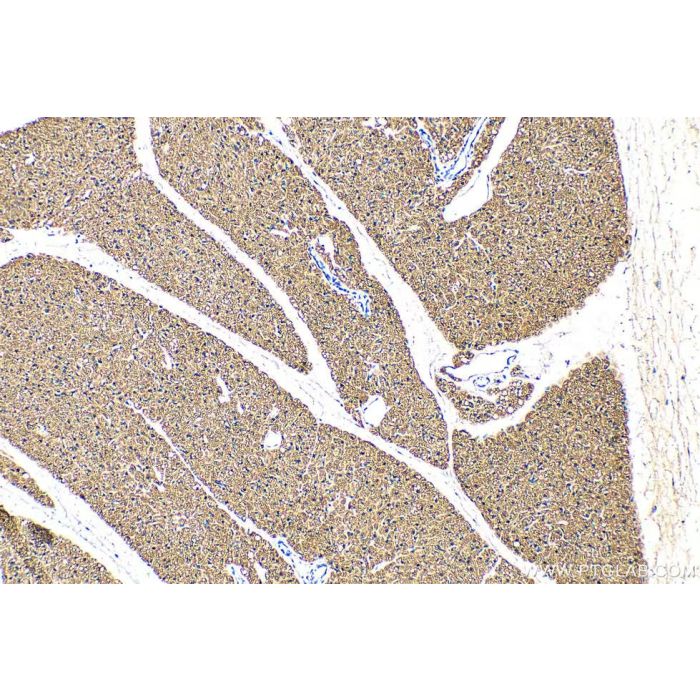
Tested Applications — Positive IHC detected inmouse brown adipose tissue, mouse testis tissue Note: suggested antigen retrieval with TE buffer pH 9.0; (*) Alternatively, antigen retrieval may be performed with citrate buffer pH 6.0
Recommended Dilutions — Western Blot (WB)WB : 1:1000-1:8000
Recommended Dilutions — Immunohistochemistry (IHC)IHC : 1:200-1:800
Positive WB detected inmouse adipose tissue, pig adipose tissue
Positive IHC detected inmouse brown adipose tissue, mouse testis tissue Note: suggested antigen retrieval with TE buffer pH 9.0; (*) Alternatively, antigen retrieval may be performed with citrate buffer pH 6.0
Western Blot (WB)WB : 1:1000-1:8000
Immunohistochemistry (IHC)IHC : 1:200-1:800
Tested Reactivityhuman, mouse, pig
Cited Reactivityhuman, mouse, rat, pig, monkey, zebrafish, bovine
ClassPolyclonal
TypeAntibody
ImmunogenCatNo: Ag11360 Product name: Recombinant human LIPE protein Source: e coli. -derived, PGEX-4T Tag: GST Domain: 728-1076 aa of BC070041 Sequence: GNLCFTVALRAAAYGVRVPDGIMAAYPATMLQPAASPSRLLSLMDPLLPLSVLSKCVSAYAGAKTEDHSNSDQKALGMMGLVRRDTALLLRDFRLGASSWLNSFLELSGRKSQKMSEPIAEPMRRSVSEAALAQPQGPLGTDSLKNLTLRDLSLRGNSETSSDTPEMSLSAETLSPSTPSDVNFLLPPEDAGEEAEAKNELSPMDRGLGVRAAFPEGFHPRRSSQGATQMPLYSSPIVKNPFMSPLLAPDSMLKSLPPVHIVACALDPMLDDSVMLARRLRNLGQPVTLRVVEDLPHGFLTLAALCRETRQAAELCVERIRLVLTPPAGAGPSGETGAAGVDGGCGGRH Predict reactive species
Full Namelipase, hormone-sensitive
Calculated Molecular Weight117 kDa
Observed Molecular Weight84 kDa
GenBank Accession NumberBC070041
Gene SymbolHSL
Gene ID (NCBI)3991
RRIDAB_2878386
ConjugateUnconjugated
Purification MethodAntigen affinity purification
UNIPROT IDQ05469
Storage BufferPBS with 0.02% sodium azide and 50% glycerol, pH 7.3.
Storage ConditionsStore at -20°C. Stable for one year after shipment. Aliquoting is unnecessary for -20 o C storage. 20ul sizes contain 0.1% BSA.
IHC protocol for HSL antibody 17333-1-APDownload protocol
WB protocol for HSL antibody 17333-1-APDownload protocol
mouseWB Food Funct Gentisic acid prevents diet-induced obesity in mice by accelerating the thermogenesis of brown adipose tissue. Authors - Xue Han View Article
humanWB,IF,IP Biochim Biophys Acta Mol Cell Biol Lipids DECR1 directly activates HSL to promote lipolysis in cervical cancer cells. Authors - Huijuan Zhou View Article
pigWB Epigenetics Differential regulatory roles of microRNAs during intramuscular adipogenesis in Chinese Guizhou Congjiang Xiang pigs. Authors - Lulin Tan View Article
Citations51
DilutionsWB : 1:1000-1:8000 IHC : 1:200-1:800
IsotypeIgG
ClonalityPolyclonal
Clone Number-
ConjugationUnconjugated

Hormone sensitive lipase (HSL) belongs to the 'GDXG' lipolytic enzyme family. In adipose tissue and heart, it primarily hydrolyzes stored triglycerides to free fatty acids, while in steroidogenic tissues, it principally converts cholesteryl esters to free cholesterol for steroid hormone production. HSL has two isoforms with the molecular mass of 117 kDa and 84 kDa. Protocols Product Specific Protocols IHC protocol for HSL antibody 17333-1-AP Download protocol WB protocol for HSL antibody 17333-1-AP Download protocol Standard Protocols Click here to view our Standard Protocols

Publications
  1. Paternal cadmium exposure affects testosterone synthesis by reducing the testicular cholesterol pool in offspring mice
    Journal: Ecotoxicol Environ Saf | Authors: Jinzhao Zhou | Species: mouse | Application: WB
  2. LAMC1-mediated preadipocytes differentiation promoted peritoneum pre-metastatic niche formation and gastric cancer metastasis.
    Journal: Int J Biol Sci | Authors: Yan Fang | Application: WB
  3. PLK1 promotes cholesterol efflux and alleviates atherosclerosis by up-regulating ABCA1 and ABCG1 expression via the AMPK/PPARγ/LXRα pathway
    Journal: Biochim Biophys Acta Mol Cell Biol Lipids | Authors: Heng-Jing Hu | Species: mouse
  4. DECR1 directly activates HSL to promote lipolysis in cervical cancer cells.
    Journal: Biochim Biophys Acta Mol Cell Biol Lipids | Authors: Huijuan Zhou | Species: human | Application: WB,IF,IP
  5. Differential regulatory roles of microRNAs during intramuscular adipogenesis in Chinese Guizhou Congjiang Xiang pigs.
    Journal: Epigenetics | Authors: Lulin Tan | Species: pig | Application: WB
  6. Gentisic acid prevents diet-induced obesity in mice by accelerating the thermogenesis of brown adipose tissue.
    Journal: Food Funct | Authors: Xue Han | Species: mouse | Application: WB
  7. NAT10-mediated N4-acetylcytidine modification in KLF9 mRNA promotes adipogenesis
    Journal: Cell Death Differ | Authors: Xinxing Wan | Species: human,mouse | Application: WB
  8. A galacturonan from sea buckthorn (Hippophae rhamnoides L.) berry modulates dyslipidemia by promoting hepatic lipolysis and mitochondrial oxidation
    Journal: Carbohydr Polym | Authors: Yunpeng Sun | Species: zebrafish | Application: WB
  9. LAMC1-mediated preadipocytes differentiation promoted peritoneum pre-metastatic niche formation and gastric cancer metastasis.
    Journal: Int J Biol Sci | Authors: Yan Fang | Application: WB
  10. Lysosomal cholesteryl ester hydrolysis drives white matter repair by reprogramming microglia into a novel reparative state.
    Journal: J Neuroinflammation | Authors: Yu Hu | Species: mouse | Application: IF
  11. Combined exposure to deoxynivalenol facilitates lipid metabolism disorder in high-fat-diet-induced obesity mice
    Journal: Environ Int | Authors: Jing Jin | Species: mouse | Application: WB
  12. Cyanidin-3-glucoside mitigates zearalenone-enhanced hepatic lipotoxicity via inhibition of PXR activation.
    Journal: Food Res Int | Authors: Bingxin Huangfu
  13. Cyanidin-3-glucoside mitigates zearalenone-enhanced hepatic lipotoxicity via inhibition of PXR activation.
    Journal: Food Res Int | Authors: Bingxin Huangfu
  14. TMEM132C and LIPE protein molecules drive synovial hyperplasia via the PPARγ signaling axis: Mechanistic insights into core pathogenic proteins in rheumatoid arthritis
    Journal: Int J Biol Macromol | Authors: Fangyue Cheng | Species: human | Application: WB
  15. PRRSV Nsp4 induces ATGL protein degradation to promote viral replication and lipid droplet accumulation
    Journal: Int J Biol Macromol | Authors: Ermin Xie | Species: monkey | Application: WB
  16. Lactoferrin Prevents Chronic Alcoholic Injury by Regulating Redox Balance and Lipid Metabolism in Female C57BL/6J Mice
    Journal: Antioxidants (Basel) | Authors: De-Ming Li | Species: mouse | Application: WB
  17. Isomeranzin activates Gnas-AMPK signaling to drive white adipose browning and curb obesity in mice.
    Journal: EMBO Mol Med | Authors: Menghao Shi | Species: mouse | Application: WB
  18. HuR promotes triglyceride synthesis and intestinal fat absorption
    Journal: Cell Rep | Authors: Cihang Liu | Species: mouse | Application: WB
  19. In Vitro Comparative Analysis of the Effect and Structure-Based Influencing Factors of Flavonols on Lipid Accumulation
    Journal: J Agric Food Chem | Authors: Beijun Ang | Species: mouse | Application: WB
  20. Paternal cadmium exposure affects estradiol synthesis by impairing intracellular cholesterol homeostasis and mitochondrial function in offspring female mice
    Journal: Ecotoxicol Environ Saf | Authors: Yanwei Zhang | Species: mouse | Application: WB,IF
  21. Paternal cadmium exposure affects testosterone synthesis by reducing the testicular cholesterol pool in offspring mice
    Journal: Ecotoxicol Environ Saf | Authors: Jinzhao Zhou | Species: mouse | Application: WB
  22. ACSL6 alleviates myocardial hypertrophy by ameliorating cardiac lipid synthesis and mitochondrial function.
    Journal: Life Sci | Authors: Qiying Xie | Species: mouse | Application: WB
  23. Rhodiola activates macrophage migration inhibitory factor to alleviate non-alcoholic fatty liver disease
    Journal: Life Sci | Authors: Jie Liu | Species: human,mouse | Application: WB
  24. Gentisic acid prevents diet-induced obesity in mice by accelerating the thermogenesis of brown adipose tissue.
    Journal: Food Funct | Authors: Xue Han | Species: mouse | Application: WB
  25. Pea Albumin Alleviates Oleic Acid-Induced Lipid Accumulation in LO2 Cells Through Modulating Lipid Metabolism and Fatty Acid Oxidation Pathways
    Journal: Foods | Authors: Bing Fang | Species: human | Application: WB
  26. CircRNA-mediated regulation of brown adipose tissue adipogenesis
    Journal: Front Nutr | Authors: Kaiqing Liu | Species: mouse | Application: WB
  27. African swine fever virus hijacks lipolysis induced by chaperone-mediated autophagy to upregulate fatty acid β-oxidation and promote viral replication.
    Journal: mBio | Authors: Xing Yang | Species: pig | Application: WB,IF
  28. Sestrin2 in POMC Neurons Modulates Energy Balance and Obesity Related Metabolic Disorders via mTOR Signaling
    Journal: J Nutr Biochem | Authors: Huiling Hu | Species: mouse | Application: WB
  29. Sleep deprivation induced fat accumulation in the visceral white adipose tissue by suppressing SIRT1/FOXO1/ATGL pathway activation
    Journal: J Physiol Biochem | Authors: Wei Wang | Species: rat | Application: WB
  30. 1-Linoleoylglycerophosphocholine stimulates UCP1-dependent thermogenesis and mitochondrial respiration to combat obesity.
    Journal: J Lipid Res | Authors: Rui Wang | Species: human | Application: WB
  31. Cancer‑associated adipocytes exhibit distinct phenotypes and facilitate tumor progression in pancreatic cancer.
    Journal: Oncol Rep | Authors: Zhiwei Cai | Species: human | Application: WB
  32. TRIM59 deficiency aggravates HFD-induced obesity in mice associated with increased adipose tissue inflammation, lipid accumulation, and apoptosis.
    Journal: Cell Signal | Authors: Yinni Chen | Species: mouse | Application: WB
  33. Human gingival mesenchymal stem cells improve movement disorders and tyrosine hydroxylase neuronal damage in Parkinson disease rats
    Journal: Cytotherapy | Authors: Tong Lei | Species: mouse | Application: WB
  34. WTAP boosts lipid oxidation and induces diabetic cardiac fibrosis by enhancing AR methylation
    Journal: iScience | Authors: Kai Song | Species: mouse | Application: WB
  35. Monascus pilosus SWM-008-Fermented Red Mold Rice and Its Monascinol Ameliorate Non-Alcoholic Fatty Liver Disease via Activation of the AMPK-ATGL Pathway and Enrichment of Butyrate-Producing Bacteria.
    Journal: Mol Nutr Food Res | Authors: Chia-Pei Hsieh | Species: mouse | Application: WB,ELISA
  36. Mechanism of Myh3 gene regulation of intramuscular fat content in Beijing black pigs via the MAPK signaling pathway
    Journal: BMC Genomics | Authors: Yunyan Luo | Species: pig | Application: WB
  37. DECR1 directly activates HSL to promote lipolysis in cervical cancer cells.
    Journal: Biochim Biophys Acta Mol Cell Biol Lipids | Authors: Huijuan Zhou | Species: human | Application: WB,IF,IP
  38. PLK1 promotes cholesterol efflux and alleviates atherosclerosis by up-regulating ABCA1 and ABCG1 expression via the AMPK/PPARγ/LXRα pathway
    Journal: Biochim Biophys Acta Mol Cell Biol Lipids | Authors: Heng-Jing Hu | Species: mouse
  39. Differential regulatory roles of microRNAs during intramuscular adipogenesis in Chinese Guizhou Congjiang Xiang pigs.
    Journal: Epigenetics | Authors: Lulin Tan | Species: pig | Application: WB
  40. Loss of Lipid Droplet-Mitochondria contacts confers protection against Ethanol-induced cardiotoxicity
    Journal: Exp Cell Res | Authors: Wenlong He | Species: human | Application: WB
  41. Molecular mechanism of MAFB transcriptional activation of PPARD in regulating adipose browning and protecting against vascular endothelial cell injury.
    Journal: Exp Cell Res | Authors: Xiaoyong Hu
  42. Ox-LDL-stimulated macrophage-derived exosomes regulate adipose tissue remodeling and promote the progression of atherosclerosis.
    Journal: Mol Cell Endocrinol | Authors: Xiaoyu Liu | Species: mouse | Application: WB
  43. Identification of Adipogenesis Subgroups and Immune Infiltration Characteristics in Diabetic Peripheral Neuropathy
    Journal: J Immunol Res | Authors: Yumin Lin | Species: mouse | Application: IHC
  44. Cold-Induced DHRS4 Promotes Thermogenesis via Enhanced Fatty Acid β-Oxidation in Porcine Subcutaneous Adipocytes
    Journal: Animals (Basel) | Authors: Xiangfei Ma | Application: WB
  45. Calmodulin Contributes to Lipolysis and Inflammatory Responses in Clinical Ketosis Cows through the TLR4/IKK/NF-κB Pathway
    Journal: Animals (Basel) | Authors: Jinshui Chang | Species: bovine | Application: WB
  46. Dahuang Huanglian Xiexin Decoction ameliorates obesity via modulating adipocyte differentiation and lipid degradation through inhibiting endoplasmic reticulum stress
    Journal: Prostaglandins Other Lipid Mediat | Authors: Long Hao | Species: mouse | Application: WB
  47. Effect of Cordyceps militaris Extract on Visceral Adipose Tissue Changes After Ovariectomy in Rodents.
    Journal: Int J Endocrinol | Authors: Kazuya Kusama | Species: mouse | Application: WB
  48. The involvement of hormone-sensitive lipase in all-trans retinoic acid induced cleft palate
    Journal: Int J Dev Biol | Authors: K Zheng | Species: Mouse | Application: WB,IHC
  49. The involvement of hormone-sensitive lipase in all-trans retinoic acid induced cleft palate
    Journal: Int J Dev Biol | Authors: K Zheng | Species: Mouse | Application: WB,IHC
  50. Phenotypic and genotypic changes in obesity and type 2 diabetes of male KK mice with aging.
    Journal: Exp Anim | Authors: Yuzuru Iizuka | Species: mouse | Application: WB
  51. Annexin A1 exacerbates islet stellate cell activation by regulating triglyceride catabolism via the PPARα/ACOX1/CYP4a pathway.
    Journal: Islets | Authors: Qing Li | Species: mouse | Application: WB
  52. Bovine viral diarrhea virus (BVDV) relies on cellular lipid droplet biogenesis and lipolysis to provide energy for viral replication.
    Journal: Vet Res | Authors: Xiaoran Xiong | Species: bovine | Application: WB,IF

Product Documents

Datasheet

Datasheet

Reviews

Write Your Own Review
You're reviewing:HSL Polyclonal antibody 17333-1-AP proteintech
Your Rating
Copyright © 2025 Biogege, Inc. All rights reserved.