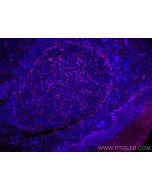
CoraLite® Plus 750-conjugated Beta Tubulin Monoclonal antibody CL750-66240 proteintech
$189.00
In stock
SKU
CL750-66240
| Catalog Number | CL750-66240 |
| Synonyms | beta 4, beta tubulin, MC1R, TUBB, TUBB3, TUBB4, Tubulin beta 3 chain, Tubulin beta 4 chain, Tubulin beta III, tubulin, beta 3 |
| Host | Mouse |
| Reactivity | human, mouse, rat, nematode, pig, zebrafish |
| Form | Liquid |
| Formulation | PBS, Proclin300, BSA, Glycerol |
| Applications | WB |
| Host / Isotype | Mouse / IgG2a |
| Tested Applications — Positive WB detected in | HeLa cells, Jurkat cells. HEK-293 cells |
| Recommended Dilutions — Western Blot (WB) | WB : 1:1000-1:8000 |
| Positive WB detected in | HeLa cells, Jurkat cells. HEK-293 cells |
| Western Blot (WB) | WB : 1:1000-1:8000 |
| Tested Reactivity | human, mouse, rat, nematode, pig, zebrafish |
| Cited Reactivity | human |
| Class | Monoclonal |
| Type | Antibody |
| Immunogen | CatNo: Ag0117 Product name: Recombinant human Tubulin-beta protein Source: e coli. -derived, PGEX-4T Tag: GST Domain: 44-259 aa of BC000748 Sequence: LERISVYYNEASSHKYVPRAILVDLEPGTMDSVRSGAFGHLFRPDNFIFGQSGAGNNWAKGHYTEGAELVDSVLDVVRKECENCDCLQGFQLTHSLGGGTGSGMGTLLISKVREEYPDRIMNTFSVVPSPKVSDTVVEPYNATLSIHQLVENTDETYCIDNEALYDICFRTLKLATPTYGDLNHLVSATMSGVTTSLRFPGQLNADLRKLAVNMVP Predict reactive species |
| Full Name | tubulin, beta 3 |
| Calculated Molecular Weight | 450 aa, 50 kDa |
| Observed Molecular Weight | 50-55 kDa |
| GenBank Accession Number | BC000748 |
| Gene Symbol | TUBB3 |
| Gene ID (NCBI) | 10381 |
| RRID | AB_3086570 |
| Conjugate | CoraLite® Plus 750 Fluorescent Dye |
| Excitation/Emission Maxima Wavelengths | 755 nm / 780 nm |
| Excitation Laser | Red Laser (633 nm) |
| Purification Method | Protein A purification |
| UNIPROT ID | Q13509 |
| Storage Buffer | PBS with 50% glycerol, 0.05% Proclin300, 0.5% BSA, pH 7.3. |
| Storage Conditions | Store at -20°C. Avoid exposure to light. Stable for one year after shipment. Aliquoting is unnecessary for -20 o C storage. |
| WB protocol for CL Plus 750 Beta Tubulin antibody CL750-66240 | Download protocol |
| human | WB Eur J Med Chem Discovery of α-carboline fused benzofuran-containing anticancer agents as rapid apoptosis inducers through intrinsic pathway. Authors - Fang Lin View Article |
| Citations | 1 |
| Dilutions | WB : 1:1000-1:8000 |
| Isotype | IgG2a |
| Clonality | Monoclonal |
| Clone Number | 1D4A4 |
| Conjugation | CoraLite® Plus 750 |
There are five tubulins in human cells: alpha, beta, gamma, delta, and epsilon. Tubulins are conserved across species. They form heterodimers, which multimerize to form a microtubule filament. An alpha and beta tubulin heterodimer is the basic structural unit of microtubules. The alpha and beta tubulins (+/- 55 kDa MW) are homologous but are not identical. Beta tubulins have been widely used as loading control. What is the molecular weight of beta-tubulin? Are there any isoforms of beta-tubulin? The molecular weight of tubulin is 50-52 kDa. Humans have eight beta-tubulin isotypes, encoded by different genes, that differ in their C-terminal sequences. They have different tissue expression profiles and can rise to microtubules of different properties (PMID: 20191564). How to use beta-tubulin as a loading control Beta-tubulin is one of the most commonly used references as a loading control for cell lysates in western blotting. It is abundantly expressed across various tissues and developmental stages and highly conserved across species. However, since some variability has been observed in the expression levels of commonly used housekeeping genes (PMID: 15627964), it is recommended that more than one loading control antibody is used while developing new assays. More information can be found here: https://www.ptglab.com/news/blog/loading-control-antibodies-for-western-blotting/ . What drugs can influence beta-tubulin and organization of microtubules? Many drugs that affect microtubule dynamics target beta-tubulin, mainly by interfering with the GTP hydrolysis (PMID: 21381049). Paclitaxel (Taxol) is used to stabilize microtubules by slowing down their depolymerization, while colchicine and vinca alkaloids (vinblastine) destabilize microtubules. They are used in research and also in the clinic as anti-cancer agents. Is beta-tubulin post-translationally modified? Yes, tubulins are subject to extensive post-translational modifications (PTMs) that affect the organization of microtubules and their dynamics. The most common modifications include polyglutamylation, polyglycylation, polyamination, glycososylation, glycation, phosphorylation, and acetylation (PMID: 24801181 and 25468068). Protocols Product Specific Protocols WB protocol for CL Plus 750 Beta Tubulin antibody CL750-66240 Download protocol Standard Protocols Click here to view our Standard Protocols
Publications
Product Documents