Mouse TNFSF11/RANKL ELISA Kit KE10035 proteintech
$299.00
In stock
SKU
KE10035
| Product name | Mouse TNFSF11/RANKL ELISA Kit |
| Synonyms | Ly109l, ODF, OPG, OPGL, RANKL, Tnfsf11, Trance |
| Reactivity | Mouse |
| Host / Isotype | United States |
| Tests | 1 X 96 well plate |
| Sample type | Serum, Plasma |
| Assay type | Sandwich |
| Sensitivity | 1.8 pg/mL |
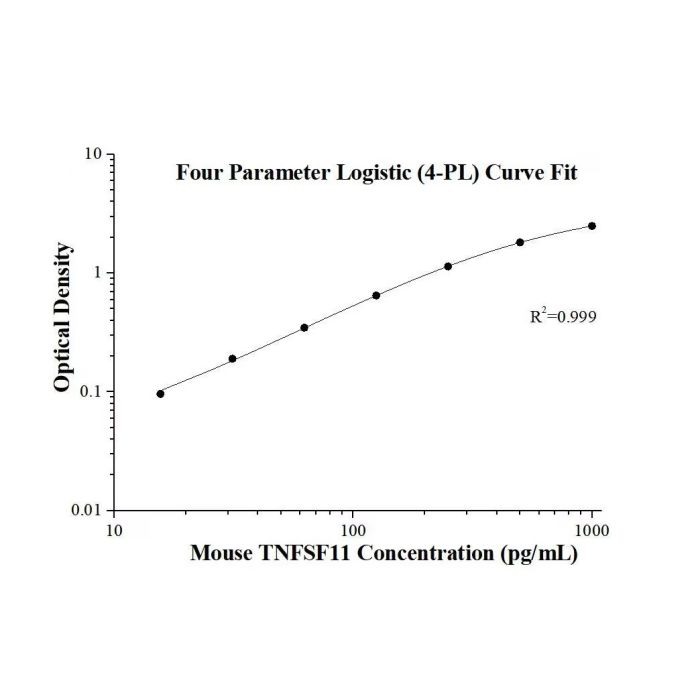
| Range | 15.6-1000 pg/mL |
| Tested applications | Sandwich ELISA |
| Gene ID (NCBI) | 21943 |
| Sample Type | Average Range |
| Mouse serum | 87% 75%-104% |
| Sample | n mean ( pg/mL ) SD CV% |
| 1 | 24 449.2 34.0 7.6 |
| 2 | 24 111.1 5.9 5.3 |
| 3 | 24 26.2 1.8 6.8 |
| Storage Instructions | All the reagents are stored at 2-8℃ for 6 months or -20℃ for 12 months. Refer to the protocol for further storage instructions. |
| mouse | cell culture supernatants Cell Signal ED-71 ameliorates OVX-induced osteoporosis by regulating calcium homeostasis and SIRT1-mediated mitochondrial function, alleviating osteoblast senescence and suppressing osteoclastogenesis Authors - Yaoguang Zhang View Article |
TNFSF11 also known as RANKL, is a member of the tumor necrosis factor (TNF) cytokine family which is a ligand for osteoprotegerin and functions as a key factor for osteoclast differentiation and activation. RANKL is produced by a diverse set of lineage-specific cells and is involved in a wide variety of physiological processes that include skeletal remodeling, lymph node organogenesis, mammary gland development, and thermal regulation. RANKL was shown to be a dentritic cell survival factor and is involved in the regulation of T cell-dependent immune response. The deficient mice exhibited defects in early differentiation of T and B lymphocytes, and failed to form lobulo-alveolar mammary structures during pregnancy. Properties Storage Instructions All the reagents are stored at 2-8℃ for 6 months or -20℃ for 12 months. Refer to the protocol for further storage instructions. Synonyms Ly109l, ODF, OPG, OPGL, RANKL, Tnfsf11, Trance FAQ 1、I have limited sample diluent. How should I handle samples requiring high dilution factors? Answer: We recommend performing a serial dilution. For example, if human serum requires a 1,000,000-fold dilution, you can use a three-step 100× dilution method as follows: Step 1: Take 2 uL of human serum and add it to 198 uL of sample diluent, mix thoroughly to obtain a 100-fold diluted sample. Step 2: Take 2 uL of the 100-fold diluted sample and add it to 198 uL of sample diluent, mix thoroughly to obtain a 10,000-fold diluted sample. Step 3: Take 2 uL of the 10,000-fold diluted sample and add it to 198 uL of sample diluent, mix thoroughly to obtain a 1,000,000-fold diluted sample. If further dilution is required, additional serial steps can be used. We do not recommend using any other solutions or water for dilution, except for the sample diluent we suggest. If your sample diluent is still insufficient, please contact our customer service for more sample diluent.
Publications