Mouse VEGFR2/KDR ELISA Kit KE10081 proteintech
$299.00
In stock
SKU
KE10081
| Product name | Mouse VEGFR2/KDR ELISA Kit |
| Synonyms | 6130401C07, Flk 1, Flk1, Kdr, Krd 1, Ly73, VEGFR 2, VEGFR2 |
| Reactivity | Mouse |
| Host / Isotype | United States |
| Tests | 1 X 96 well plate |
| Sample type | Serum, Plasma, Cell culture supernatants, Tissue homogenates |
| Assay type | Sandwich |
| Sensitivity | 10.2 pg/mL |
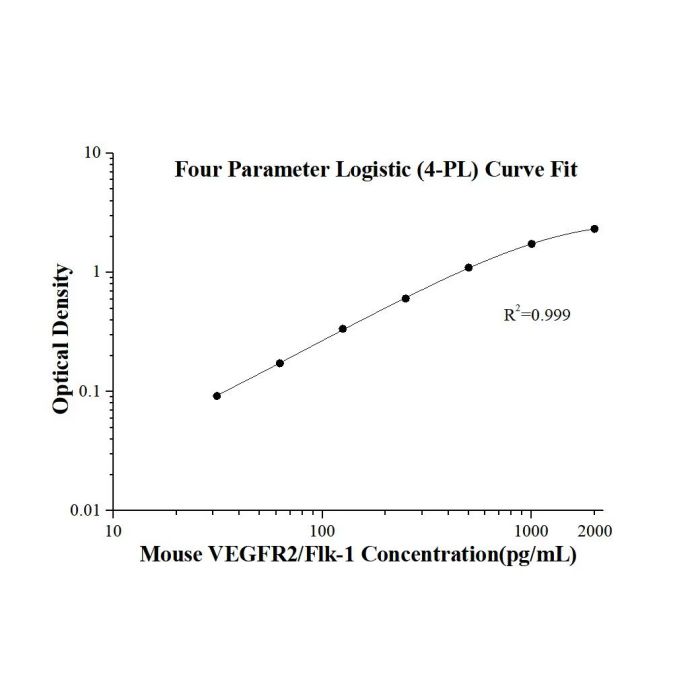
| Range | 31.25-2000 pg/mL |
| Tested applications | Sandwich ELISA |
| Gene ID (NCBI) | 16542 |
| Sample Type | Average Range |
| Mouse serum | 93% 83%-103% |
| Cell culture supernatants | 102% 89%-114% |
| Tissue homogenates | 86% 71%-107% |
| Sample | n mean ( pg/mL ) SD CV% |
| 1 | 24 986.5 61.2 6.2 |
| 2 | 24 246.6 14.6 5.9 |
| 3 | 24 60.7 5.8 9.6 |
| Storage Instructions | All the reagents are stored at 2-8℃ for 6 months or -20℃ for 12 months. Refer to the protocol for further storage instructions. |
VEGFR2, also named as KDR, FLK1 and CD309, is one of the two tyrosine kinase receptors involved in angiogenesis. VEGFR2 is mainly distributed in vascular endothelial cells, lymphatic endothelial cells, and embryonic precursor cells, and can bind to VEGF-A, VEGF-C, and VEGF-D. When activated by its ligand VEGF, VEGFR2 promotes neighbouring vessel formation to facilitate the delivery of growth factors, nutrients and oxygen for cancer proliferation, migration, metastasis and survival. VEGF and VEGFR2 mediated angiogenesis contributes to the aggressive natures and leads to high mortality rate in gastric cancer. Properties Storage Instructions All the reagents are stored at 2-8℃ for 6 months or -20℃ for 12 months. Refer to the protocol for further storage instructions. Synonyms 6130401C07, Flk 1, Flk1, Kdr, Krd 1, Ly73, VEGFR 2, VEGFR2 FAQ 1、I have limited sample diluent. How should I handle samples requiring high dilution factors? Answer: We recommend performing a serial dilution. For example, if human serum requires a 1,000,000-fold dilution, you can use a three-step 100× dilution method as follows: Step 1: Take 2 uL of human serum and add it to 198 uL of sample diluent, mix thoroughly to obtain a 100-fold diluted sample. Step 2: Take 2 uL of the 100-fold diluted sample and add it to 198 uL of sample diluent, mix thoroughly to obtain a 10,000-fold diluted sample. Step 3: Take 2 uL of the 10,000-fold diluted sample and add it to 198 uL of sample diluent, mix thoroughly to obtain a 1,000,000-fold diluted sample. If further dilution is required, additional serial steps can be used. We do not recommend using any other solutions or water for dilution, except for the sample diluent we suggest. If your sample diluent is still insufficient, please contact our customer service for more sample diluent.