Mouse/Rat ALCAM ELISA Kit KE10159 proteintech
$299.00
In stock
SKU
KE10159
| Product name | Mouse/Rat ALCAM ELISA Kit |
| Synonyms | Activated leukocyte cell adhesion molecule, BEN, CD166, CD166 antigen, Protein DM-GRASP |
| Reactivity | Mouse/Rat |
| Host / Isotype | United States |
| Tests | 1 X 96 well plate |
| Sample type | Mouse serum, Mouse plasma, Tissue lysate |
| Assay type | Sandwich |
| Sensitivity | 4.4 pg/mL |
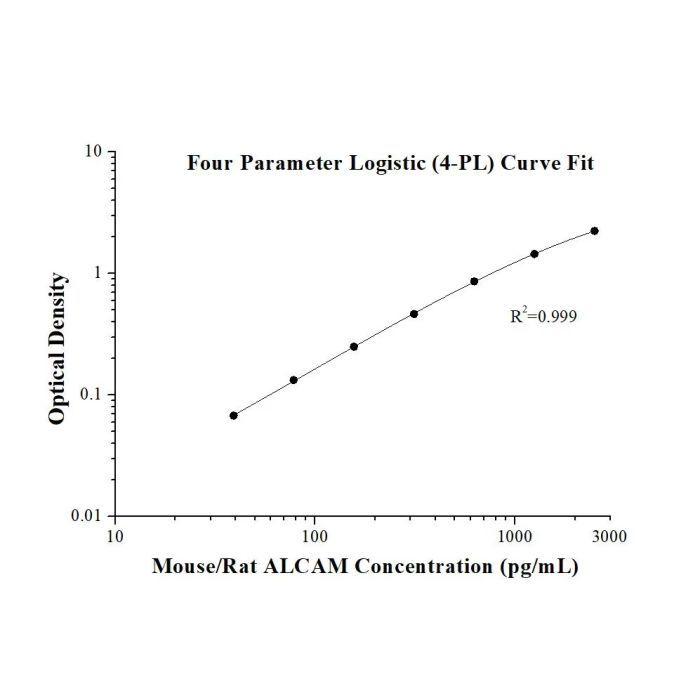
| Range | 39-2500 pg/mL |
| Tested applications | Sandwich ELISA |
| Gene ID (NCBI) | 11658 |
| Sample Type | Average Range |
| Mouse serum | 83% 81%-87% |
| Tissue lysate | 102% 97%-110% |
| Sample | n mean ( pg/mL ) SD CV% |
| 1 | 16 1,471.4 85.0 5.8 |
| 2 | 16 376.3 21.3 5.7 |
| 3 | 16 113.1 5.9 5.2 |
| Storage Instructions | All the reagents are stored at 2-8℃ for 6 months or -20℃ for 12 months. Refer to the protocol for further storage instructions. |
Mouse ALCAM (Activated Leukocyte Cell Adhesion Molecule, also known as CD166) is an immunoglobulin superfamily of cell adhesion molecules that is widely expressed in a variety of cell types including leukocytes, endothelial cells, and neuronal cells. It is involved in biological processes such as T-cell activation, immune synapse formation, cell migration and adhesion by interacting with molecules such as CD6. ALCAM plays an important role in the differentiation and self-renewal of hematopoietic stem cells in mice, and it is highly expressed in long term hematopoietic stem cells (LT-HSC), and the level increases with age. In addition, ALCAM also plays an important role in tumor progression and neurological development and disease, and is an important target for the study of immune regulation, tumor biology and neuroscience. Properties Storage Instructions All the reagents are stored at 2-8℃ for 6 months or -20℃ for 12 months. Refer to the protocol for further storage instructions. Synonyms Activated leukocyte cell adhesion molecule, BEN, CD166, CD166 antigen, Protein DM-GRASP FAQ 1、I have limited sample diluent. How should I handle samples requiring high dilution factors? Answer: We recommend performing a serial dilution. For example, if human serum requires a 1,000,000-fold dilution, you can use a three-step 100× dilution method as follows: Step 1: Take 2 uL of human serum and add it to 198 uL of sample diluent, mix thoroughly to obtain a 100-fold diluted sample. Step 2: Take 2 uL of the 100-fold diluted sample and add it to 198 uL of sample diluent, mix thoroughly to obtain a 10,000-fold diluted sample. Step 3: Take 2 uL of the 10,000-fold diluted sample and add it to 198 uL of sample diluent, mix thoroughly to obtain a 1,000,000-fold diluted sample. If further dilution is required, additional serial steps can be used. We do not recommend using any other solutions or water for dilution, except for the sample diluent we suggest. If your sample diluent is still insufficient, please contact our customer service for more sample diluent.