Mouse G-CSF ELISA Kit KE10025 proteintech
$299.00
In stock
SKU
KE10025
| Product name | Mouse G-CSF ELISA Kit |
| Synonyms | Csf3, Csfg, G CSF, G-CSF, MGI IG |
| Reactivity | Mouse |
| Host / Isotype | United States |
| Tests | 1 X 96 well plate |
| Sample type | Serum, Plasma, Cell culture supernatants |
| Assay type | Sandwich |
| Sensitivity | 0.8 pg/mL |
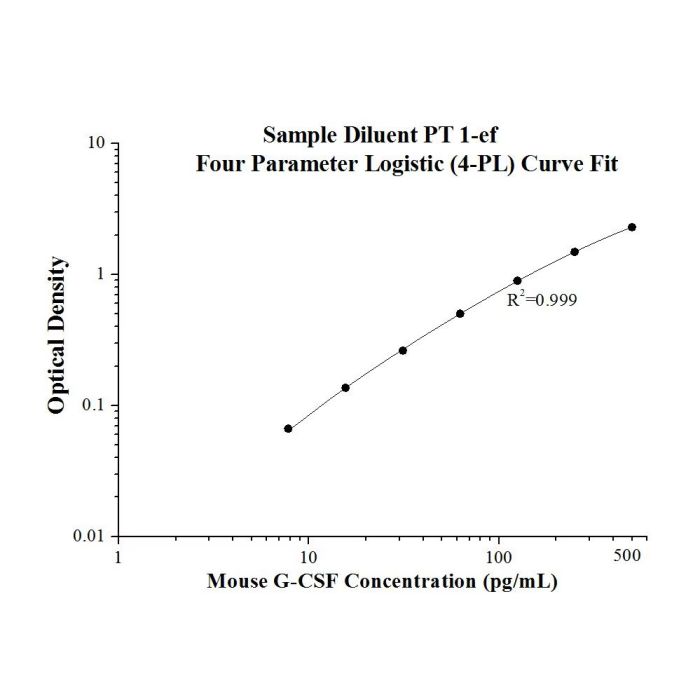
| Range | 7.8-500 pg/mL |
| Tested applications | Sandwich ELISA |
| Gene ID (NCBI) | 12985 |
| Sample Type | Average Range |
| Mouse serum | 95% 74%-127% |
| Cell culture supernatants | 105% 85%-124% |
| Sample | n mean ( pg/mL ) SD CV% |
| 1 | 24 209.1 10.2 4.9 |
| 2 | 24 86.2 4.6 5.3 |
| 3 | 24 51.2 3.8 7.4 |
| Storage Instructions | All the reagents are stored at 2-8℃ for 6 months or -20℃ for 12 months. Refer to the protocol for further storage instructions. |
| mouse | serum Sci Adv Bioactive NIR-II gold clusters for three-dimensional imaging and acute inflammation inhibition Authors - Huizhen Ma View Article |
Granulocyte colony-stimulating factor (G-CSF), also referred to as CSF3, is a protective cytokine with anti-inflammatory effects. G-CSF is important in promoting survival of the granulocytic lineage cells and proliferation and migration of neutrophils as well as trophoblast cells. G-CSF acts by binding to its receptor G-CSFR (also called CSF3R), which after binding with G-CSF activates the canonical Janus kinase (Jak)/signal transducer, activator of transcription (STAT) and Ras/Raf/MAP kinase pathways. G-CSF potently stimulates the proliferation and release of peripheral blood progenitor cells into the bloodstream and is therefore used to treat neutropenia after chemotherapy. Furthermore, G-CSF levels are elevated upon intensive exercise leading to increased neutrophil counts, which are predominantly due to delayed neutrophil apoptosis. Properties Storage Instructions All the reagents are stored at 2-8℃ for 6 months or -20℃ for 12 months. Refer to the protocol for further storage instructions. Synonyms Csf3, Csfg, G CSF, G-CSF, MGI IG FAQ 1、I have limited sample diluent. How should I handle samples requiring high dilution factors? Answer: We recommend performing a serial dilution. For example, if human serum requires a 1,000,000-fold dilution, you can use a three-step 100× dilution method as follows: Step 1: Take 2 uL of human serum and add it to 198 uL of sample diluent, mix thoroughly to obtain a 100-fold diluted sample. Step 2: Take 2 uL of the 100-fold diluted sample and add it to 198 uL of sample diluent, mix thoroughly to obtain a 10,000-fold diluted sample. Step 3: Take 2 uL of the 10,000-fold diluted sample and add it to 198 uL of sample diluent, mix thoroughly to obtain a 1,000,000-fold diluted sample. If further dilution is required, additional serial steps can be used. We do not recommend using any other solutions or water for dilution, except for the sample diluent we suggest. If your sample diluent is still insufficient, please contact our customer service for more sample diluent.
Publications