Mouse/Rat Osteopontin/OPN ELISA Kit KE10118 proteintech
$299.00
In stock
SKU
KE10118
| Product name | Mouse/Rat Osteopontin/OPN ELISA Kit |
| Synonyms | Spp1,Opn,Osteopontin |
| Reactivity | Mouse/Rat |
| Host / Isotype | United States |
| Tests | 1 X 96 well plate |
| Sample type | Serum, Plasma, Cell culture supernatant |
| Assay type | Sandwich |
| Sensitivity | 15.5 pg/mL |
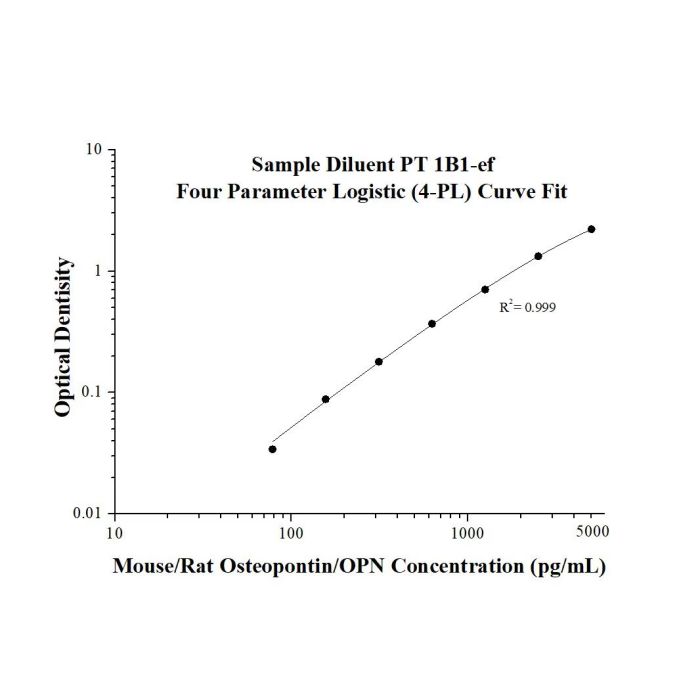
| Range | 78.1-5000 pg/mL |
| Tested applications | Sandwich ELISA |
| Gene ID (NCBI) | 20750 |
| Sample Type | Average Range |
| Mouse serum | 101% 87%-113% |
| Rat serum | 89% 74%-111% |
| Cell culture supernatant | 99% 87%-123% |
| Sample | n mean ( pg/mL ) SD CV% |
| 1 | 24 2,162.2 126.0 5.8 |
| 2 | 24 610.9 32.0 5.2 |
| 3 | 24 205.4 22.4 10.9 |
| Storage Instructions | All the reagents are stored at 2-8℃ for 6 months or -20℃ for 12 months. Refer to the protocol for further storage instructions. |
Osteopontin (OPN) is also named as 2AR, minopontin, bone sialoprotein 1, Spp1, Eta-1 and Op, and belongs to the osteopontin family. Osteopontin is major non-collagenous bone protein that binds tightly to hydroxyapatite. It is a highly phosphorylated glycophosphoprotein having acidic characteristics and rich in aspartic acid. And it acts as a cytokine involved in enhancing production of interferon-gamma and interleukin-12 and reducing production of interleukin-10 and is essential in the pathway that leads to type I immunity. OPN, a multifunctional protein, has important functions on cardiovascular diseases, cancer, diabetes and kidney stone diseases and in the process of inflammation, biomineralization, cell viability and wound healing. OPN is a pleiotropic glycoprotein expressed in various cell types in animals and in humans, including bone, immune, smooth muscle, epithelial and endothelial cells. Moreover, OPN is found in kidneys and urine. Properties Storage Instructions All the reagents are stored at 2-8℃ for 6 months or -20℃ for 12 months. Refer to the protocol for further storage instructions. Synonyms Spp1,Opn,Osteopontin FAQ 1、I have limited sample diluent. How should I handle samples requiring high dilution factors? Answer: We recommend performing a serial dilution. For example, if human serum requires a 1,000,000-fold dilution, you can use a three-step 100× dilution method as follows: Step 1: Take 2 uL of human serum and add it to 198 uL of sample diluent, mix thoroughly to obtain a 100-fold diluted sample. Step 2: Take 2 uL of the 100-fold diluted sample and add it to 198 uL of sample diluent, mix thoroughly to obtain a 10,000-fold diluted sample. Step 3: Take 2 uL of the 10,000-fold diluted sample and add it to 198 uL of sample diluent, mix thoroughly to obtain a 1,000,000-fold diluted sample. If further dilution is required, additional serial steps can be used. We do not recommend using any other solutions or water for dilution, except for the sample diluent we suggest. If your sample diluent is still insufficient, please contact our customer service for more sample diluent.